
慢性肾脏病老年患者骨折的特点和并发症:一项横断面研究。
Characteristics and complications of fracture in older adults with chronic kidney disease: a cross-sectional study.
机构信息
Department of Geriatric Orthopedics, The Third Hospital of Hebei Medical University, Shijiazhuang, 050051, Hebei, People's Republic of China.
Department of Orthopaedic Surgery, The Third Hospital of Hebei Medical University, Shijiazhuang, 050051, Hebei, People's Republic of China.
出版信息
J Orthop Surg Res. 2022 Aug 6;17(1):377. doi: 10.1186/s13018-022-03253-8.
BACKGROUND
The aim of this study was to analyze the clinical characteristics of older fracture patients with chronic kidney disease (CKD) and to determine the risk factors of perioperative cardiovascular complications.
METHODS
We retrospectively reviewed clinical data of older fracture patients with CKD admitted to the Third Hospital of Hebei Medical University from January 2016 to October 2021. The data we collected included baseline characteristics and complications. We finally determined the risk factors of perioperative cardiovascular complications by using logistic regression.
RESULTS
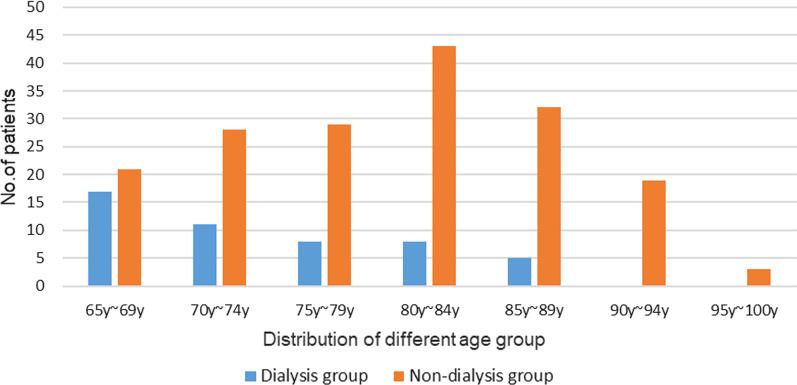
We ended up enrolling 224 patients, and there were 91 (40.6%) males and 133 (59.4%) females, with a median age of 79 years. 80-84 years old was the age group with high incidence of fracture. The majority of fracture occurred indoors (130 cases, 58.0%) and morning (98 cases, 43.8%). Hip fracture was most common (183 cases, 81.7%), of which femoral neck fracture (101 cases, 45.0%) was the most prevalent. The most common comorbid condition was hypertension (171 cases, 76.3%), and anemia was the most common complication (148 cases, 66.1%). Age ≥ 80 years (OR = 2.023, 95% CI 1.110-3.688), previously combined with cardiovascular calcification (OR = 1.901, 95% CI 1.047-3.451) and admission hemoglobin level < 100 g/L (OR = 3.191, 95% CI 1.744-5.838) were independent risk factors of perioperative cardiovascular disease (CVD).
CONCLUSION
It was especially necessary to enhance fracture prevention for CKD. Patients whose age older than 80, hemoglobin less than 100 g/L on admission and have previous cardiovascular calcification are more likely to develop perioperative CVD. Such patients require reasonable decisions during the perioperative period to avoid the occurrence of CVD.
背景
本研究旨在分析合并慢性肾脏病(CKD)的老年骨折患者的临床特征,并确定围手术期心血管并发症的危险因素。
方法
我们回顾性分析了 2016 年 1 月至 2021 年 10 月河北医科大学第三医院收治的合并 CKD 的老年骨折患者的临床资料。收集的资料包括基线特征和并发症。最终采用 logistic 回归确定围手术期心血管并发症的危险因素。
结果
共纳入 224 例患者,男 91 例(40.6%),女 133 例(59.4%),中位年龄 79 岁。80-84 岁年龄段骨折发生率较高。骨折多发生于室内(130 例,58.0%)和上午(98 例,43.8%)。髋部骨折最为常见(183 例,81.7%),其中股骨颈骨折最为常见(101 例,45.0%)。最常见的合并症是高血压(171 例,76.3%),最常见的并发症是贫血(148 例,66.1%)。年龄≥80 岁(OR=2.023,95%CI 1.110-3.688)、既往合并心血管钙化(OR=1.901,95%CI 1.047-3.451)和入院时血红蛋白水平<100 g/L(OR=3.191,95%CI 1.744-5.838)是围术期心血管疾病(CVD)的独立危险因素。
结论
对于 CKD 患者,尤其有必要加强骨折预防。年龄>80 岁、入院时血红蛋白<100 g/L 和既往心血管钙化的患者更易发生围手术期 CVD。此类患者围术期需要合理决策,避免 CVD 发生。
 Zotero 插件