
八种不同 SARS-CoV-2 抗原检测快速检测试剂对奥密克戎 BA.1 变异株的分析灵敏度。
Analytical Sensitivity of Eight Different SARS-CoV-2 Antigen-Detecting Rapid Tests for Omicron-BA.1 Variant.
机构信息
Department of Microbiology and Molecular Medicine, Faculty of Medicine, University of Geneva, Geneva, Switzerland.
Laboratory of Virology, Division of Infectious Diseases and Division of Laboratory Medicine, Geneva University Hospitals, Geneva, Switzerland.
出版信息
Microbiol Spectr. 2022 Aug 31;10(4):e0085322. doi: 10.1128/spectrum.00853-22. Epub 2022 Aug 8.
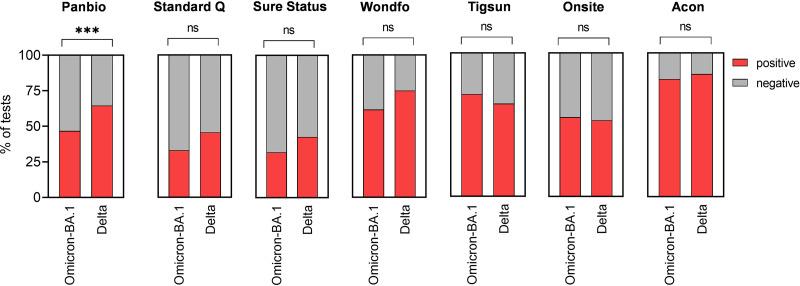
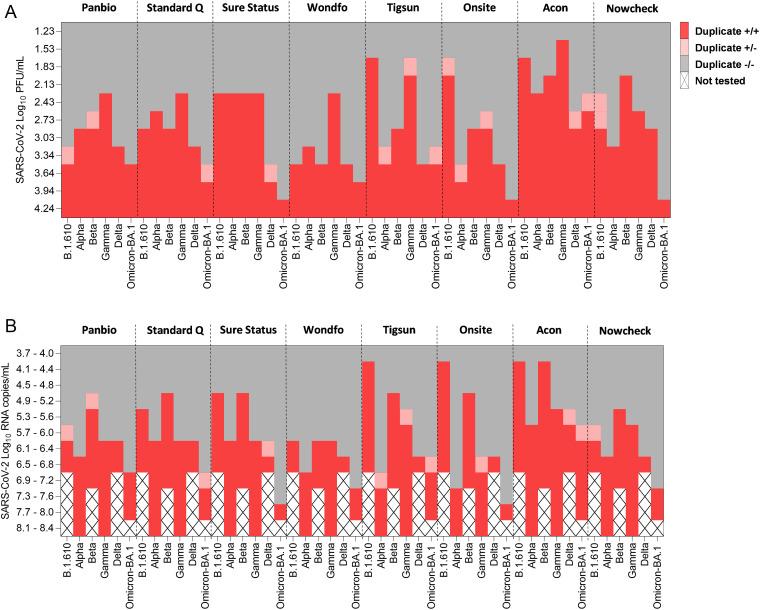
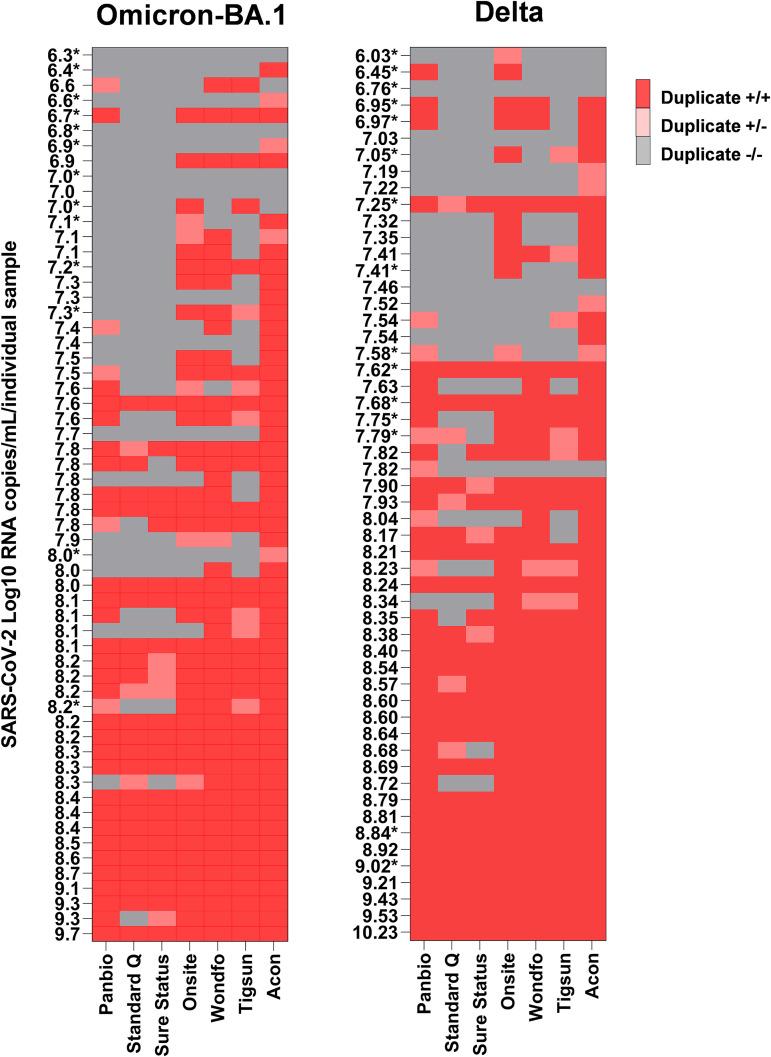
The emergence of each novel SARS-CoV-2 variant of concern (VOC) requires investigation of its potential impact on the performance of diagnostic tests in use, including antigen-detecting rapid diagnostic tests (Ag-RDTs). Although anecdotal reports have been circulating that the newly emerged Omicron-BA.1 variant is in principle detectable by Ag-RDTs, few data on sensitivity are available. We have performed (i) analytical sensitivity testing with cultured virus in eight Ag-RDTs and (ii) retrospective testing in duplicates with clinical samples from vaccinated individuals with Omicron-BA.1 ( = 59) or Delta ( = 54) breakthrough infection on seven Ag-RDTs. Overall, in our analytical study we have found heterogenicity between Ag-RDTs for detecting Omicron-BA.1. When using cultured virus, we observed a trend toward lower endpoint sensitivity for Omicron-BA.1 detection than for earlier circulating SARS-CoV-2 and the other VOCs. In our retrospective study, the detection of Delta and Omicron-BA.1 was assessed in a comparable set of stored clinical samples using seven Ag-RDTs. Four hundred ninety-seven of all 826 tests (60.17%) performed on Omicron-BA.1 samples were positive, compared to 489/756 (64.68%) for Delta samples. In the analytical study, the sensitivity for both Omicron-BA.1 and Delta between the Ag-RDTs was variable. All seven Ag-RDTs showed comparable sensitivities to detect Omicron-BA.1 and Delta in the retrospective study. Sensitivity for detecting Omicron-BA.1 shows high heterogenicity between Ag-RDTs, necessitating a careful consideration when using these tests to guide infection prevention measures. Analytical and retrospective testing is a proxy and timely solution to generate rapid performance data, but it is not a replacement for clinical evaluations, which are urgently needed. Biological and technical reasons for detection failure by some Ag-RDTs need to be further investigated.
新型关注变异株(VOC)的出现都需要研究其对正在使用的诊断检测的潜在影响,包括抗原检测快速诊断检测(Ag-RDT)。虽然有传闻称新出现的奥密克戎 BA.1 变异株原则上可以被 Ag-RDT 检测到,但关于其敏感性的数据很少。我们进行了(i)在 8 种 Ag-RDT 中用培养病毒进行的分析敏感性测试,以及(ii)在 7 种 Ag-RDT 上用奥密克戎 BA.1( = 59)或德尔塔( = 54)突破感染的临床样本进行的回顾性测试。总的来说,在我们的分析研究中,我们发现不同的 Ag-RDT 检测奥密克戎 BA.1 的结果存在异质性。使用培养病毒时,我们观察到奥密克戎 BA.1 检测的终点敏感性较早期循环的 SARS-CoV-2 和其他 VOC 呈下降趋势。在我们的回顾性研究中,使用七种 Ag-RDT 评估了在一组可存储的临床样本中对德尔塔和奥密克戎 BA.1 的检测。与德尔塔样本相比,826 个奥密克戎 BA.1 样本中,有 497 个(60.17%)检测结果为阳性,而 756 个德尔塔样本中有 489 个(64.68%)检测结果为阳性。在分析性研究中,Ag-RDT 之间奥密克戎 BA.1 和德尔塔的敏感性各不相同。在回顾性研究中,所有七种 Ag-RDT 对奥密克戎 BA.1 和德尔塔的敏感性都相似。检测奥密克戎 BA.1 的敏感性在 Ag-RDT 之间存在高度异质性,因此在使用这些检测来指导感染预防措施时需要仔细考虑。分析和回顾性测试是生成快速性能数据的一种代理和及时的解决方案,但它不能替代急需的临床评估。需要进一步研究一些 Ag-RDT 检测失败的生物学和技术原因。
 Zotero 插件