
精油的化学成分、抗氧化、抗菌和抗生物膜活性。
Chemical Composition, Antioxidant, Antibacterial, and Antibiofilm Activities of Essential Oil.
机构信息
School of Graduate Studies, Management and Science University, University Drive, Off Persiaran Olahraga, Section 13, Shah Alam 40100, Malaysia.
International Medical School, Management and Science University, University Drive, Off Persiaran Olahraga, Section 13, Shah Alam 40100, Malaysia.
出版信息
Molecules. 2022 Jul 31;27(15):4895. doi: 10.3390/molecules27154895.
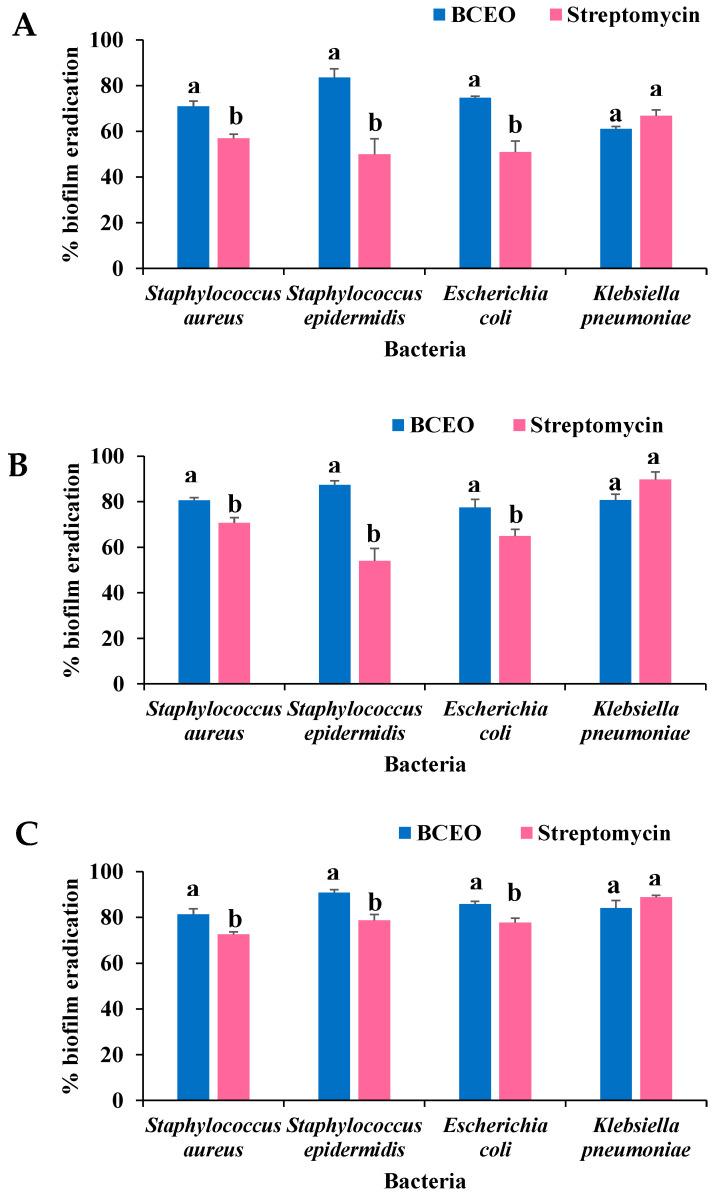
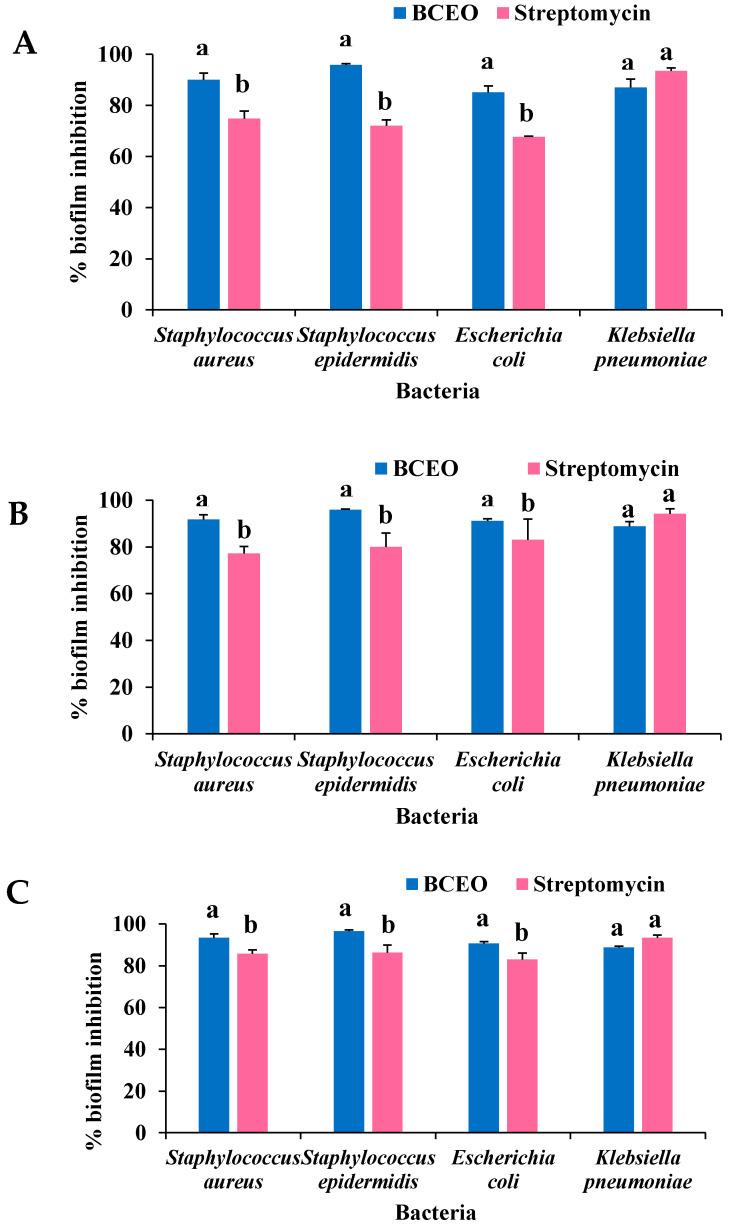
The essential oil of , commonly known as lemon myrtle oil, possesses various beneficial properties due to its richness in bioactive compounds. This study aimed to characterize the chemical profile of the essential oil isolated from leaves of (BCEO) and its biological properties, including antioxidant, antibacterial, and antibiofilm activities. Using gas chromatography-mass spectrometry, 21 compounds were identified in BCEO, representing 98.50% of the total oil content. The isomers of citral, geranial (52.13%), and neral (37.65%) were detected as the main constituents. The evaluation of DPPH radical scavenging activity and ferric reducing antioxidant power showed that BCEO exhibited strong antioxidant activity at IC of 42.57 μg/mL and EC of 20.03 μg/mL, respectively. The antibacterial activity results showed that BCEO exhibited stronger antibacterial activity against Gram-positive bacteria ( and ) than against Gram-negative bacteria ( and ). For the agar disk diffusion method, was the most sensitive to BCEO with an inhibition zone diameter of 50.17 mm, followed by (31.13 mm), (20.33 mm), and (12.67 mm). The results from the microdilution method showed that BCEO exhibited the highest activity against and , with the minimal inhibitory concentration (MIC) value of 6.25 μL/mL. BCEO acts as a potent antibiofilm agent with dual actions, inhibiting (85.10% to 96.44%) and eradicating (70.92% to 90.73%) of the biofilms formed by the four tested bacteria strains, compared with streptomycin (biofilm inhibition, 67.65% to 94.29% and biofilm eradication, 49.97% to 89.73%). This study highlights that BCEO can potentially be a natural antioxidant agent, antibacterial agent, and antibiofilm agent that could be applied in the pharmaceutical and food industries. To the best of the authors' knowledge, this is the first report, on the antibiofilm activity of BCEO against four common nosocomial pathogens.
柠檬桉油,俗称柠檬尤加利油,由于富含生物活性化合物,具有多种有益特性。本研究旨在对柠檬桉叶中分离出的精油的化学特征及其生物特性进行表征,包括抗氧化、抗菌和抗生物膜活性。采用气相色谱-质谱联用技术,鉴定出 BCEO 中的 21 种化合物,占总油含量的 98.50%。检测到香叶醛(52.13%)和橙花醛(37.65%)的异构体为主要成分。DPPH 自由基清除活性和铁还原抗氧化能力评估表明,BCEO 在 IC 为 42.57μg/mL 和 EC 为 20.03μg/mL 时表现出很强的抗氧化活性。抗菌活性结果表明,BCEO 对革兰氏阳性菌( 和 )的抗菌活性强于革兰氏阴性菌( 和 )。对于琼脂圆盘扩散法, 对 BCEO 最敏感,抑菌圈直径为 50.17mm,其次是 (31.13mm)、 (20.33mm)和 (12.67mm)。微量稀释法结果表明,BCEO 对 和 的活性最高,最小抑菌浓度(MIC)值为 6.25μL/mL。BCEO 是一种有效的抗生物膜剂,具有双重作用,能抑制(85.10%至 96.44%)和消除(70.92%至 90.73%)四种受试菌形成的生物膜,而链霉素(生物膜抑制,67.65%至 94.29%和生物膜消除,49.97%至 89.73%)。本研究表明,BCEO 可能是一种天然抗氧化剂、抗菌剂和抗生物膜剂,可应用于制药和食品工业。据作者所知,这是首次报道 BCEO 对四种常见医院病原体的抗生物膜活性。

 Zotero 插件