
与2型糖尿病相关的脂肪量指数和内脏脂肪指数的最佳切点
Optimal cut-off points of fat mass index and visceral adiposity index associated with type 2 diabetes mellitus.
作者信息
Bagheri Amir, Khosravy Tina, Moradinazar Mehdi, Nachvak Seyed Mostafa, Pasdar Yahya, Soleimani Davood, Samadi Mehnoosh
机构信息
Department of Community Nutrition School of Nutritional Sciences and Dietetics Tehran University of Medical Sciences Tehran Iran.
Department of Health Nutrition Lorestan University of Medical Sciences Lorestan Iran.
出版信息
Food Sci Nutr. 2022 Apr 18;10(8):2710-2717. doi: 10.1002/fsn3.2874. eCollection 2022 Aug.
BACKGROUND
Indices, based on anthropometrics with or without non-anthropometric components, are predictive of cardio-metabolic outcomes. Fat mass index (FMI) is similar to BMI except measured fat mass replaces body weight. The visceral adiposity index (VAI) combines anthropometric measures with lipid measurements TG/HDL. The relationship of these indices to incident type 2 diabetes (T2DM) has not been established. Therefore, we have evaluated the predictive power and optimal cut-off points of FMI, and VAI with T2DM in a cross-sectional population study.
METHODS
These population-based cross-sectional study comprised 8411 adults aged 35-65 years using data from the Ravansar Non-Communicable Diseases (RaNCD) cohort. VAI and FMI were defined as previously published. Optimal cut-off points for association with incident T2DM were determined from receiver-operating curves (ROC).
RESULTS
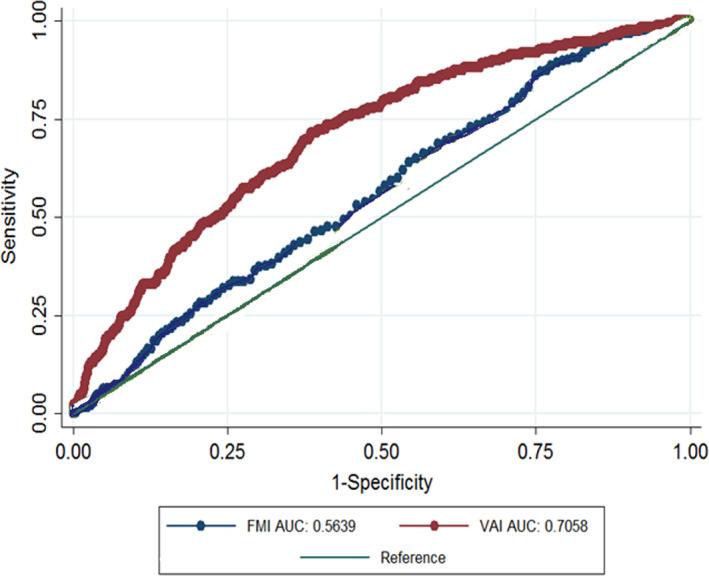
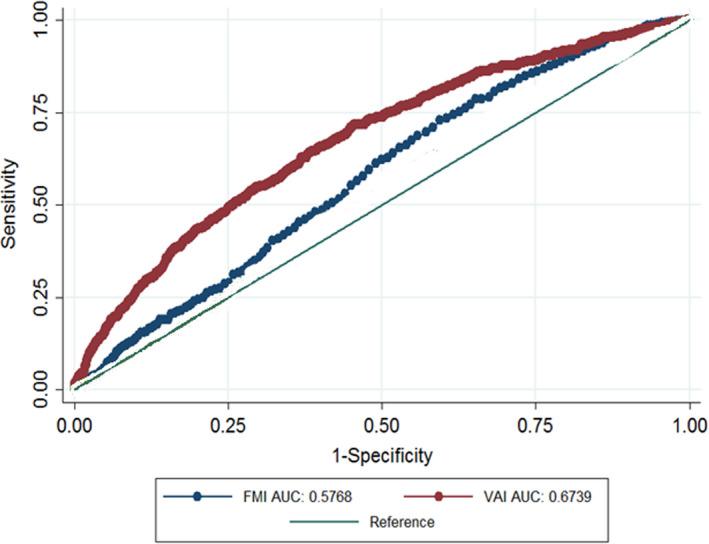
The optimal cut-off point for VAI was 4.86 (AUC: 0.673; 95% CI: 0.65-0.69) and FMI 9.3 (AUC: 0.57; 95% CI: 0.55-0.59), and for T2DM in our study population. The odds ratios (OR) for T2DM were nearly identical, for VAI 1.098 (95% CI: 1.08-1.11) and for FMI 1.08 (95% CI: 1.05-1.10).
CONCLUSIONS
In the current population study, VAI and FMI were weakly associated with T2DM. Therefore, it seems that anthropometric measures are unlikely to be strong mediators of T2DM compared to historical and other factors in the population studied.
背景
基于人体测量学(有或没有非人体测量学成分)的指数可预测心血管代谢结局。脂肪量指数(FMI)与体重指数(BMI)类似,只不过用测量的脂肪量取代了体重。内脏脂肪指数(VAI)将人体测量指标与血脂测量指标甘油三酯/高密度脂蛋白(TG/HDL)相结合。这些指数与2型糖尿病(T2DM)发病之间的关系尚未明确。因此,我们在一项横断面人群研究中评估了FMI和VAI对T2DM的预测能力及最佳切点。
方法
这项基于人群的横断面研究纳入了8411名年龄在35至65岁的成年人,使用了来自拉万萨尔非传染性疾病(RaNCD)队列的数据。VAI和FMI的定义如先前发表的那样。通过受试者工作特征曲线(ROC)确定与T2DM发病相关的最佳切点。
结果
在我们的研究人群中,VAI的最佳切点为4.86(曲线下面积:0.673;95%置信区间:0.65 - 0.69),FMI的最佳切点为9.3(曲线下面积:0.57;95%置信区间:0.55 - 0.59)。T2DM的优势比(OR)在VAI为1.098(95%置信区间:1.08 - 1.11),FMI为1.08(95%置信区间:1.05 - 1.10)时几乎相同。
结论
在当前的人群研究中,VAI和FMI与T2DM的关联较弱。因此,与所研究人群中的历史因素和其他因素相比,人体测量指标似乎不太可能是T2DM的强介导因素。

 Zotero 插件