
在埃塞俄比亚进行大规模高组氨酸蛋白 2 缺失调查期间,恶性疟原虫乳酸脱氢酶快速诊断检测的现场性能。
Field performance of Plasmodium falciparum lactate dehydrogenase rapid diagnostic tests during a large histidine-rich protein 2 deletion survey in Ethiopia.
机构信息
Ethiopian Public Health Institute, Addis Ababa, Ethiopia.
Ministry of Health, Addis Ababa, Ethiopia.
出版信息
Malar J. 2022 Aug 15;21(1):236. doi: 10.1186/s12936-022-04257-9.
BACKGROUND
Malaria rapid diagnostic tests (RDTs) have expanded diagnostic service to remote endemic communities in Ethiopia, where 70% of malaria services per annum are reliant on them. However, diagnostic strategies are threatened by Plasmodium falciparum parasites with deletions of the histidine-rich protein 2 and/or 3 (pfhrp2/3) genes. Studies have reported pfhrp2/3 gene deletion prevalence in Ethiopia that exceeds the WHO recommended threshold to switch to non-HRP2 targeted RDTs for detection of P. falciparum. Therefore, RDTs that target alternative antigens, such as P. falciparum lactate dehydrogenase (PfLDH) are increasingly in programmatic use.
METHODS
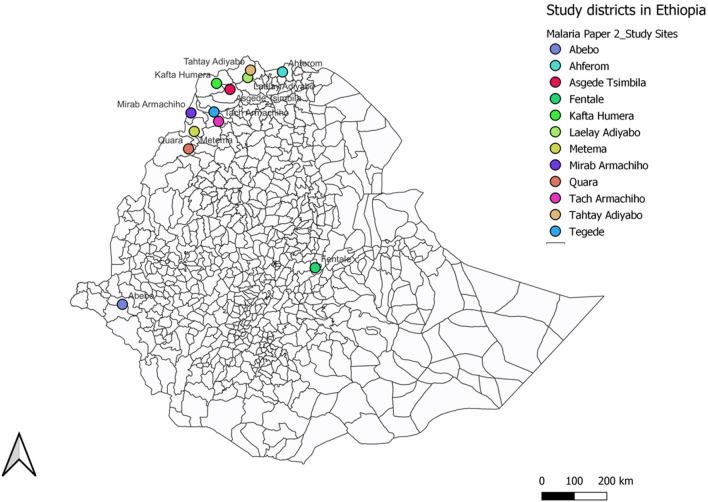
Malaria suspected patients visiting health facilities of Amhara, Tigray, Gambella, and Oromia regions of Ethiopia were screened by community health workers using Carestart Pf/Pv (HRP2/Pv-LDH) and SD-Bioline Pf (HRP2 for Pf/LDH for Pf) RDTs. Dried blood spot (DBS) samples were collected from selected patients for molecular and serological analysis. The clinical data and RDT results were recorded on standard forms, entered into EpiInfo, and analysed using STATA. The Pf-LDH detecting RDT results were compared with real-time PCR and bead-based immunoassay to determine their diagnostic performance.
RESULTS
The 13,172 (56% male and 44% female, median age of 19 years ranging from 1 to 99 year) study participants were enrolled and tested with PfHRP2 and PfLDH detection RDTs; 20.6% (95% CI: 19.6 to 21.6) were P. falciparum RDT positive. A subset of samples (n = 820) were previously tested using P. falciparum lactate dehydrogenase (pfldh) quantitative real-time PCR, and 456 of these further characterized using bead-based immunoassay. The proportion of samples positive for P. falciparum by the PfHRP2 Carestart and SD-Bioline RDTs were 66% (539/820) and 59% (481/820), respectively; 68% (561/820) were positive for the PfLDH band on the SD-Bioline RDT. The sensitivity and specificity of the PfLDH RDT band were 69% and 38%, respectively, versus pfldh qPCR; and 72% and 36%, respectively, versus PfLDH detection by immunoassay. Among samples with results for RDT, qPCR, and immunoassay, higher proportions of P. falciparum were recorded by pfldh qPCR (90%, 411/456) and PfLDH immunoassay (88%, 363/413) compared to the PfLDH band on the SD-Bioline RDT (74.6%, 340/456).
CONCLUSION AND RECOMMENDATION
Both PfHRP2 RDTs detected fewer P. falciparum cases than PfLDH, and fewer cases than qPCR or immunoassay. The poor sensitivity and specificity of the PfLDH RDT compared to qPCR and to immunoassay in this study raises concern. Continuous operator training and RDTs quality assurance programme to ensure quality diagnostic services are recommended.
背景
疟疾快速诊断检测(RDT)已将诊断服务扩展到埃塞俄比亚的偏远流行地区,每年有 70%的疟疾服务依赖于 RDT。然而,寄生虫Pf 富组氨酸蛋白 2 和/或 3(pfhrp2/3)基因缺失对诊断策略构成了威胁。研究报告称,埃塞俄比亚的 pfhrp2/3 基因缺失率超过了世界卫生组织建议的阈值,需要转向非 HRP2 靶向 RDT 来检测疟原虫。因此,越来越多的项目开始使用针对其他抗原的 RDT,例如疟原虫乳酸脱氢酶(PfLDH)。
方法
在埃塞俄比亚的阿姆哈拉、提格雷、甘贝拉和奥罗米亚地区,社区卫生工作者使用 Carestart Pf/Pv(HRP2/Pv-LDH)和 SD-Bioline Pf(HRP2 用于 Pf/LDH 用于 Pf)RDT 对疑似疟疾的患者进行筛查。从选定的患者中采集干血斑(DBS)样本,用于分子和血清学分析。临床数据和 RDT 结果记录在标准表格上,输入 EpiInfo,并使用 STATA 进行分析。Pf-LDH 检测 RDT 结果与实时 PCR 和基于珠的免疫测定进行比较,以确定其诊断性能。
结果
共纳入并检测了 13172 名(56%为男性,44%为女性,年龄中位数为 19 岁,范围为 1 至 99 岁)研究参与者;20.6%(95%CI:19.6 至 21.6)为疟原虫 RDT 阳性。样本的一个子集(n=820)先前使用 Pf 乳酸脱氢酶(pfldh)定量实时 PCR 进行了检测,其中 456 个样本进一步使用基于珠的免疫测定进行了特征分析。Carestart 和 SD-Bioline RDT 检测 PfHRP2 和 PfLDH 的样本阳性比例分别为 66%(539/820)和 59%(481/820);SD-Bioline RDT 的 PfLDH 带 68%(561/820)为阳性。PfLDH RDT 带的灵敏度和特异性分别为 69%和 38%,与 pfldh qPCR 相比;与 PfLDH 免疫测定相比,灵敏度和特异性分别为 72%和 36%。在具有 RDT、qPCR 和免疫测定结果的样本中,Pfldh qPCR(90%,411/456)和 PfLDH 免疫测定(88%,363/413)记录的疟原虫阳性比例高于 SD-Bioline RDT 的 PfLDH 带(74.6%,340/456)。
结论和建议
PfHRP2 RDT 检测到的疟原虫病例均少于 PfLDH,且少于 qPCR 或免疫测定。与 qPCR 和免疫测定相比,本研究中 PfLDH RDT 的敏感性和特异性较差令人担忧。建议持续进行操作员培训和 RDT 质量保证计划,以确保提供高质量的诊断服务。
 Zotero 插件