
印度北部温带地区克什米尔,因严重急性呼吸道感染住院的儿童中存在呼吸道合胞病毒。
Respiratory syncytial virus among children hospitalized with severe acute respiratory infection in Kashmir, a temperate region in northern India.
机构信息
Sher-i-Kashmir Institute of Medical Sciences, Srinagar, India.
Influenza Program, US Centers for Disease Control and Prevention - Delhi office, India.
出版信息
J Glob Health. 2022 Jul 16;12:04050. doi: 10.7189/jogh.12.04050.
BACKGROUND
Severe acute respiratory infections (SARI) are a leading cause of hospitalizations in children, especially due to viral pathogens. We studied the prevalence of respiratory viruses among children aged <5 years hospitalized with severe acute respiratory infections (SARI) in Kashmir, India.
METHODS
We conducted a prospective observational study in two tertiary care hospitals from October 2013 to September 2014, systematically enrolling two children aged <5 years with SARI per day. We defined SARI as history of fever or measured fever (≥38°C) and cough with onset in the last 7 days requiring hospitalization for children aged 3-59 months and as physician-diagnosed acute lower respiratory infection for children aged <3 months. Trained study staff screened children within 24 hours of hospitalization for SARI and collected clinical data and nasopharyngeal swabs from enrolled participants. We tested for respiratory syncytial virus (RSV) A and B, influenza viruses, rhinoviruses (HRV)/enteroviruses, adenovirus (AdV), bocavirus (BoV), human metapneumovirus (hMPV) A and B, coronaviruses (OC43, NL65, C229E), and parainfluenza viruses (PIV) 1, 2, 3 and 4 using standardized duplex real-time polymerase chain reaction.
RESULTS
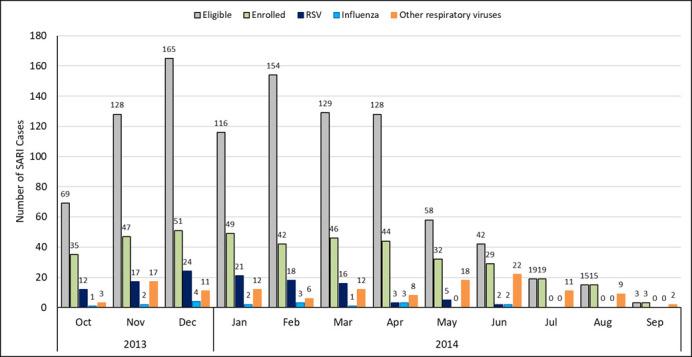
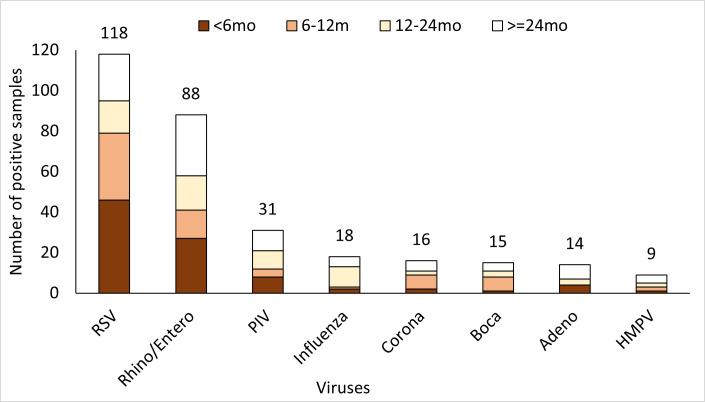
Among 4548 respiratory illness admissions screened from October 2013 to September 2014, 1026 met the SARI case definition, and 412 were enrolled (ages = 5 days to 58 months; median = 12 months). Among enrolees, 256 (62%) were positive for any virus; RSV was the most commonly detected (n = 118, 29%) followed by HRV/enteroviruses (n = 88, 21%), PIVs (n = 31, 8%), influenza viruses (n = 18, 4%), BoV (n = 15, 4%), coronaviruses (n = 16, 4%), AdV (n = 14, 3%), and hMPV (n = 9, 2%). Fifty-four children had evidence of virus co-detection. Influenza-associated SARI was more common among children aged 1-5 years (14/18, 78%) while most RSV detections occurred in children <12 months (83/118, 70%). Of the RSV viruses typed (n = 116), the majority were type B (94, 80%). Phylogenetic analysis of G gene of RSV showed circulation of the BA9 genotype with 60bp nucleotide duplication.
CONCLUSIONS
Respiratory viruses, especially RSV, contributed to a substantial proportion of SARI hospitalizations among children <5 years in north India. These data can help guide clinicians on appropriate treatment and prevention strategies.
背景
严重急性呼吸道感染(SARI)是导致儿童住院的主要原因,尤其是由病毒病原体引起的。我们研究了印度克什米尔地区 5 岁以下因严重急性呼吸道感染(SARI)住院的儿童中呼吸道病毒的流行情况。
方法
我们于 2013 年 10 月至 2014 年 9 月在两家三级保健医院进行了一项前瞻性观察研究,每天系统纳入两名 5 岁以下患有 SARI 的儿童。我们将 SARI 定义为发热或体温测量(≥38°C)和咳嗽的病史,发病时间在过去 7 天内,需要住院治疗,年龄为 3-59 个月,对于年龄小于 3 个月的儿童,定义为医生诊断的急性下呼吸道感染。训练有素的研究人员在住院后 24 小时内对患有 SARI 的儿童进行筛查,并从纳入的参与者中收集临床数据和鼻咽拭子。我们使用标准化的双工实时聚合酶链反应检测呼吸道合胞病毒(RSV)A 和 B、流感病毒、鼻病毒(HRV)/肠道病毒、腺病毒(AdV)、博卡病毒(BoV)、人偏肺病毒(hMPV)A 和 B、冠状病毒(OC43、NL65、C229E)和副流感病毒(PIV)1、2、3 和 4。
结果
2013 年 10 月至 2014 年 9 月,对 4548 例呼吸道疾病住院患者进行了筛查,其中 1026 例符合 SARI 病例定义,412 例入组(年龄=5 天至 58 个月;中位数=12 个月)。在入组患者中,256 例(62%)任何病毒检测均为阳性;RSV 是最常见的检测病毒(n=118,29%),其次是 HRV/肠道病毒(n=88,21%)、PIVs(n=31,8%)、流感病毒(n=18,4%)、BoV(n=15,4%)、冠状病毒(n=16,4%)、AdV(n=14,3%)和 hMPV(n=9,2%)。54 名儿童有病毒合并检测的证据。1-5 岁儿童的流感相关 SARI 更为常见(14/18,78%),而大多数 RSV 检测发生在 12 个月以下的儿童(83/118,70%)。在(n=116)RSV 病毒类型中,大多数为 B 型(94,80%)。RSV G 基因的系统进化分析显示 BA9 基因型的循环,具有 60bp 核苷酸重复。
结论
呼吸道病毒,尤其是 RSV,在印度北部 5 岁以下儿童的 SARI 住院中占很大比例。这些数据可以帮助指导临床医生采取适当的治疗和预防策略。

 Zotero 插件