
补体4d降低会增加非小细胞肺癌合并胃肠道淋巴结转移患者的不良预后。
Decreased complement 4d increases poor prognosis in patients with non-small cell lung cancer combined with gastrointestinal lymph node metastasis.
作者信息
Wang Yan, Xiang Mengqi, Zhang Huachuan, Lu Yongda
机构信息
Department of Gastroenterology, The First Affiliated Hospital of Soochow University, Suzhou, Jiangsu 215000, P.R. China.
Department of Medical Oncology, Sichuan Cancer Hospital, Medical School of University of Electronic Science and Technology of China, Chengdu, Sichuan 610000, P.R. China.
出版信息
Exp Ther Med. 2022 Jul 5;24(3):560. doi: 10.3892/etm.2022.11497. eCollection 2022 Sep.
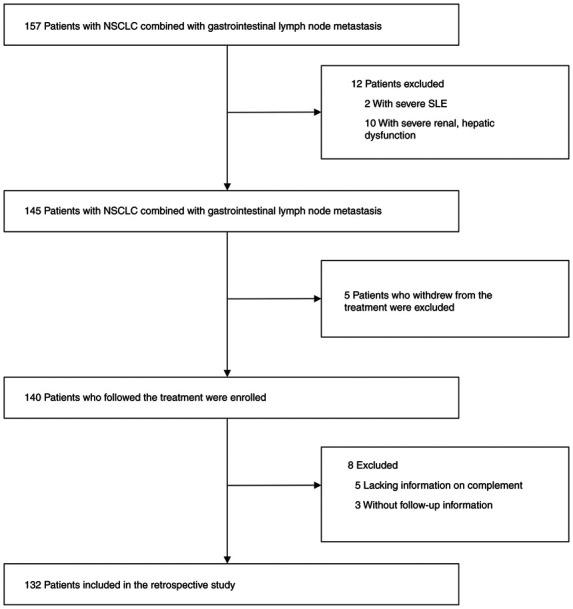
Lung cancer is a common malignancy that is difficult to treat and has a high risk of mortality. Although gastrointestinal lymph node metastasis has long been known to exert major impact on the prognosis of lung cancer, the mechanism of its occurrence and potential biological markers remain elusive. Therefore, the present study retrospectively analyzed data from 132 patients with non-small cell lung cancer (NSCLC) combined with lymph node metastasis between February 2010 and April 2019 from the First Affiliated Hospital of Soochow University (Suzhou, China) and Sichuan Cancer Hospital (Chengdu, China). Overall survival was assessed using Kaplan-Meier analysis and Cox logistic regression model. In addition, a prediction model was constructed based on immune indicators such as complement C3b and C4d (measured by ELISA), before the accuracy of this model was validated using calibration curves for 5-year OS. Among the 132 included patients, a total of 92 (70.0%) succumbed to the disease within 5 years. Multifactorial analysis revealed that complement C3b deficiency increased the risk of mortality by nearly two-fold [hazard ratio (HR)=2.23; 95% CI=1.20-4.14; P=0.017], whilst complement C4d deficiency similarly increased the risk of mortality by two-fold (HR=2.14; 95% CI=1.14-4.00; P=0.012). The variables were subsequently screened using Cox model to construct a prediction model based on complement C3b and C4d levels before a Nomogram plotted. By internal validation for the 132 patients, the Nomogram accurately estimated the risk of mortality, with a corrected C-index of 0.810. External validation of the model in another 50 patients from Sichuan Cancer Hospital revealed an accuracy of 77.0%. Overall, this mortality risk prediction model constructed based on complement levels showed accuracy in assessing the prognosis of patients with metastatic NSCLC. Therefore, complement C3b and C4d have potential for use as biomarkers to predict the risk of mortality in such patients.
肺癌是一种常见的恶性肿瘤,难以治疗且死亡率高。尽管长期以来已知胃肠道淋巴结转移对肺癌预后有重大影响,但其发生机制和潜在生物标志物仍不清楚。因此,本研究回顾性分析了2010年2月至2019年4月期间苏州大学第一附属医院(中国苏州)和四川省肿瘤医院(中国成都)132例非小细胞肺癌(NSCLC)合并淋巴结转移患者的数据。采用Kaplan-Meier分析和Cox逻辑回归模型评估总生存期。此外,基于补体C3b和C4d等免疫指标(通过ELISA测量)构建了预测模型,在使用5年总生存期校准曲线验证该模型的准确性之前。在纳入的132例患者中,共有92例(70.0%)在5年内死于该疾病。多因素分析显示,补体C3b缺乏使死亡风险增加近两倍[风险比(HR)=2.23;95%可信区间(CI)=1.20-4.14;P=0.017],而补体C4d缺乏同样使死亡风险增加两倍(HR=2.14;95%CI=1.14-4.00;P=0.012)。随后使用Cox模型筛选变量,以基于补体C3b和C4d水平构建预测模型,然后绘制列线图。通过对132例患者的内部验证,列线图准确估计了死亡风险,校正后的C指数为0.810。在四川省肿瘤医院另外50例患者中对该模型进行外部验证,准确率为77.0%。总体而言,基于补体水平构建的这种死亡风险预测模型在评估转移性NSCLC患者的预后方面显示出准确性。因此,补体C3b和C4d有潜力用作预测此类患者死亡风险的生物标志物。


 Zotero 插件