
依托泊苷和顺铂与伊立替康和顺铂治疗消化系统晚期神经内分泌癌患者的疗效:TOPIC-NEC 阶段 3 随机临床试验。
Effectiveness of Etoposide and Cisplatin vs Irinotecan and Cisplatin Therapy for Patients With Advanced Neuroendocrine Carcinoma of the Digestive System: The TOPIC-NEC Phase 3 Randomized Clinical Trial.
机构信息
National Cancer Center Hospital, Tokyo, Japan.
Kanagawa Cancer Center, Yokohama, Japan.
出版信息
JAMA Oncol. 2022 Oct 1;8(10):1447-1455. doi: 10.1001/jamaoncol.2022.3395.
IMPORTANCE
Etoposide plus cisplatin (EP) and irinotecan plus cisplatin (IP) are commonly used as community standard regimens for advanced neuroendocrine carcinoma (NEC).
OBJECTIVE
To identify whether EP or IP is a more effective regimen in terms of overall survival (OS) in patients with advanced NEC of the digestive system.
DESIGN, SETTING, AND PARTICIPANTS: This open-label phase 3 randomized clinical trial enrolled chemotherapy-naive patients aged 20 to 75 years who had recurrent or unresectable NEC (according to the 2010 World Health Organization classification system) arising from the gastrointestinal tract, hepatobiliary system, or pancreas. Participants were enrolled across 50 institutions in Japan between August 8, 2014, and March 6, 2020.
INTERVENTIONS
In the EP arm, etoposide (100 mg/m2/d on days 1, 2, and 3) and cisplatin (80 mg/m2/d on day 1) were administered every 3 weeks. In the IP arm, irinotecan (60 mg/m2/d on days 1, 8, and 15) and cisplatin (60 mg/m2/d on day 1) were administered every 4 weeks.
MAIN OUTCOMES AND MEASURES
The primary end point was OS. In total, data from 170 patients were analyzed to detect a hazard ratio (HR) of 0.67 (median OS of 8 and 12 months in inferior and superior arms, respectively) with a 2-sided α of 10% and power of 80%. The pathologic findings were centrally reviewed following treatment initiation.
RESULTS
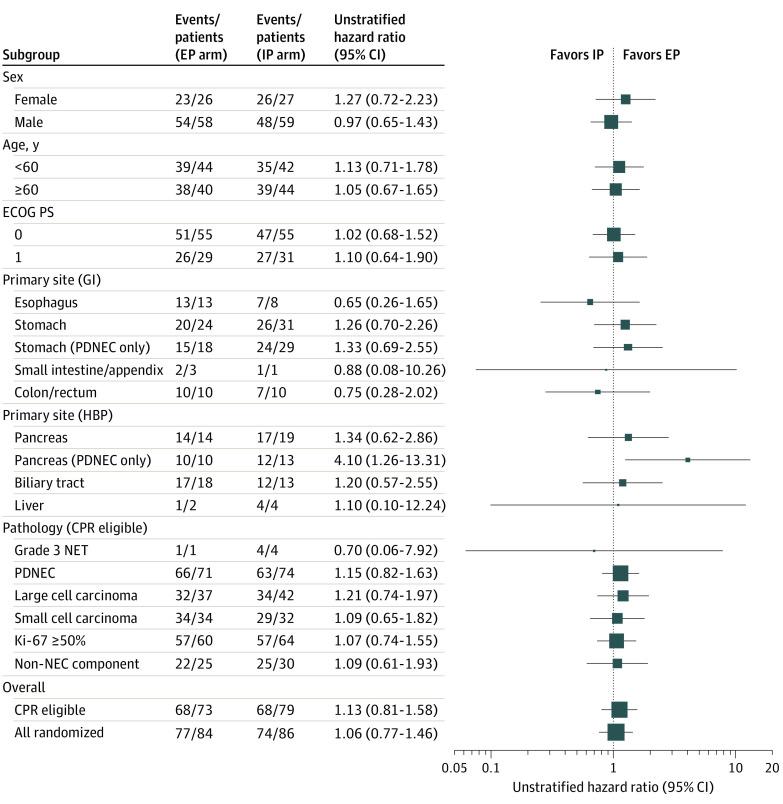
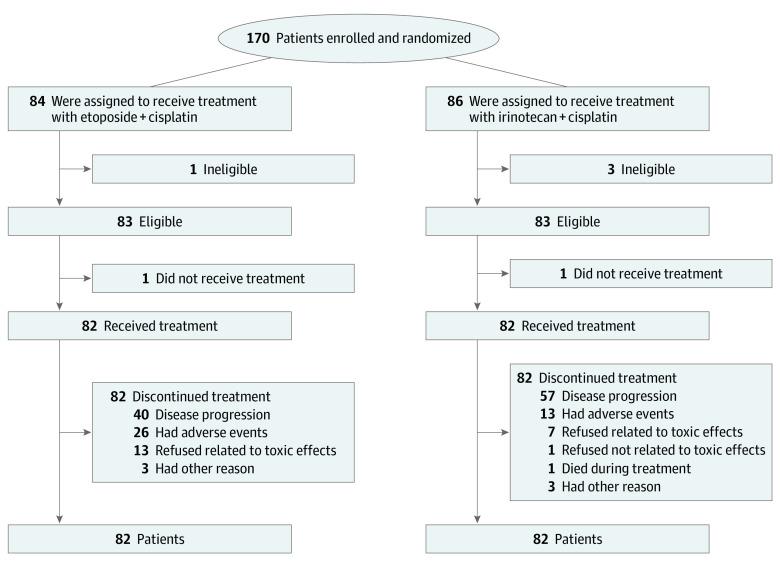
Among the 170 patients included (median [range] age, 64 [29-75] years; 117 [68.8%] male), median OS was 12.5 months in the EP arm and 10.9 months in the IP arm (HR, 1.04; 90% CI, 0.79-1.37; P = .80). The median progression-free survival was 5.6 (95% CI, 4.1-6.9) months in the EP arm and 5.1 (95% CI, 3.3-5.7) months in the IP arm (HR, 1.06; 95% CI, 0.78-1.45). A subgroup analysis of OS demonstrated that EP produced more favorable OS in patients with poorly differentiated NEC of pancreatic origin (HR, 4.10; 95% CI, 1.26-13.31). The common grade 3 and 4 adverse events in the EP vs IP arms were neutropenia (75 of 82 [91.5%] patients vs 44 of 82 [53.7%] patients), leukocytopenia (50 of 82 [61.0%] patients vs 25 of 82 [30.5%] patients), and febrile neutropenia (FN) (22 of 82 [26.8%] patients vs 10 of 82 [12.2%] patients). While incidence of FN was initially high in the EP arm, primary prophylactic use of granulocyte colony-stimulating factor effectively reduced the incidence of FN.
CONCLUSIONS AND RELEVANCE
Results of this randomized clinical trial demonstrate that both EP and IP remain the standard first-line chemotherapy options. Although AEs were generally manageable, grade 3 and 4 AEs were more common in the EP arm.
TRIAL REGISTRATION
Japan Registry of Clinical Trials: jRCTs031180005; UMIN Clinical Trials Registry: UMIN000014795.
重要性
依托泊苷联合顺铂(EP)和伊立替康联合顺铂(IP)是常用于晚期神经内分泌癌(NEC)的社区标准治疗方案。
目的
确定 EP 或 IP 在晚期消化系统 NEC 患者的总生存期(OS)方面哪个方案更有效。
设计、地点和参与者:这是一项开放标签的 3 期随机临床试验,纳入了年龄在 20 至 75 岁之间的化疗初治患者,这些患者患有源于胃肠道、肝胆系统或胰腺的复发性或不可切除的 NEC(根据 2010 年世界卫生组织分类系统)。参与者在日本的 50 家机构中招募,招募时间为 2014 年 8 月 8 日至 2020 年 3 月 6 日。
干预措施
在 EP 组中,给予依托泊苷(100mg/m2/d,第 1、2 和 3 天)和顺铂(80mg/m2/d,第 1 天),每 3 周给药一次。在 IP 组中,给予伊立替康(60mg/m2/d,第 1、8 和 15 天)和顺铂(60mg/m2/d,第 1 天),每 4 周给药一次。
主要终点和措施
主要终点是 OS。共分析了 170 名患者的数据,以检测危险比(HR)为 0.67(下臂和上臂的中位 OS 分别为 8 个月和 12 个月),双侧 α 值为 10%,功效为 80%。治疗开始后对病理发现进行了中心审查。
结果
在纳入的 170 名患者中(中位[范围]年龄,64[29-75]岁;117[68.8%]男性),EP 组的中位 OS 为 12.5 个月,IP 组为 10.9 个月(HR,1.04;90%CI,0.79-1.37;P=0.80)。EP 组中位无进展生存期为 5.6(95%CI,4.1-6.9)个月,IP 组为 5.1(95%CI,3.3-5.7)个月(HR,1.06;95%CI,0.78-1.45)。OS 的亚组分析表明,EP 在胰腺起源的低分化 NEC 患者中产生了更有利的 OS(HR,4.10;95%CI,1.26-13.31)。EP 与 IP 组中常见的 3 级和 4 级不良事件为中性粒细胞减少症(75/82[91.5%]患者与 44/82[53.7%]患者)、白细胞减少症(50/82[61.0%]患者与 25/82[30.5%]患者)和发热性中性粒细胞减少症(FN)(22/82[26.8%]患者与 10/82[12.2%]患者)。尽管 EP 组的 FN 发生率最初较高,但粒细胞集落刺激因子的预防性使用可有效降低 FN 的发生率。
结论和相关性
这项随机临床试验的结果表明,EP 和 IP 仍然是标准的一线化疗选择。尽管 AE 通常是可以控制的,但 EP 组的 3 级和 4 级 AE 更为常见。
试验注册
日本临床试验注册中心:jRCTs031180005;UMIN 临床试验注册中心:UMIN000014795。

 Zotero 插件