
中国 COVID-19 大流行期间潜在病毒市政固体废物的收集和运输系统建设。
Collection and transportation system construction of potentially viral municipal solid waste during the COVID-19 pandemic in China.
机构信息
School of Environment and Energy Engineering, Beijing University of Civil Engineering and Architecture, Beijing 102616, China; Beijing Energy Conservation & Sustainable Urban and Rural Development Provincial and Ministry Co-construction Collaboration Innovation Center, Beijing University of Civil Engineering and Architecture, Beijing 102616, China; Climate Change Research and Talent Training Base in Beijing, Beijing University of Civil Engineering and Architecture, Beijing 100044, China.
School of Environment and Energy Engineering, Beijing University of Civil Engineering and Architecture, Beijing 102616, China.
出版信息
Sci Total Environ. 2022 Dec 10;851(Pt 2):157964. doi: 10.1016/j.scitotenv.2022.157964. Epub 2022 Aug 17.
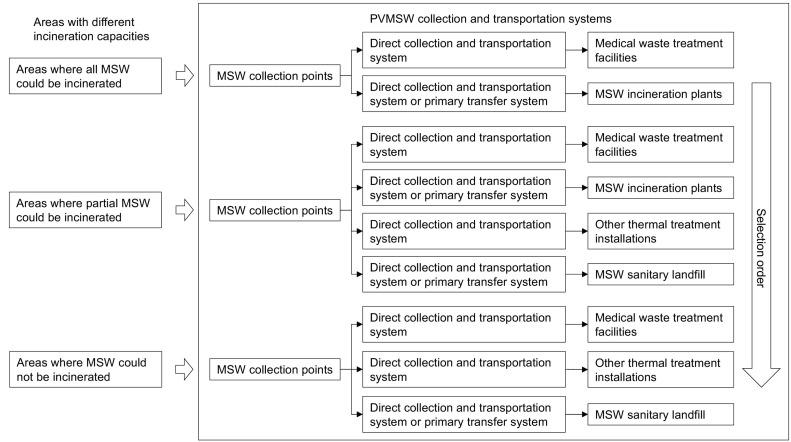
The transmission route of COVID-19 through municipal solid waste (MSW) has been confirmed and receives increasing attention. Potentially viral municipal solid waste (PVMSW) refers to the domestic waste generated by risky areas and epidemic-related populations under a major epidemic in their daily lives or in activities that provide services for their daily lives. For its potential infectivity, PVMSW should be properly collected and transported. This study aimed to standardize the collection and transportation of PVMSW and proposed specific construction schemes of PVMSW collection and transportation systems for three situations which were city-wide lockdown status, medium and high-risk area, and home quarantine separately. In the cases of city-wide lockdown status and home quarantine, PVMSW collection and transportation systems were constructed qualitatively with the examples of Wuhan and Shanghai respectively, and in the case of medium and high-risk area, the systems were constructed quantitatively through the development of a waste collection and transportation costs model. To reduce the risks of virus transmission during the collection and transportation process, the collection and transportation links should be minimized. For the disposal of PVMSW, medical waste treatment facilities and MSW incineration plants should be prioritized. Furthermore, the results showed that the total number of people and the transfer capacity of MSW transfer facility were the two main influencing factors for the selection of PVMSW collection and transportation systems in medium and high-risk area. This article could help manage MSW for preventing virus transmission during the COVID-19 pandemic or similar future epidemics.
新冠病毒通过城市固体废物(MSW)传播的途径已得到确认,并引起了越来越多的关注。潜在病毒城市固体废物(PVMSW)是指在重大疫情期间,高危地区和与疫情相关人群在日常生活或为日常生活提供服务的活动中产生的生活垃圾。由于其潜在的传染性,PVMSW 应妥善收集和运输。本研究旨在规范 PVMSW 的收集和运输,并针对全市封锁、中高风险区和居家隔离三种情况,分别提出了 PVMSW 收集和运输系统的具体建设方案。在全市封锁和居家隔离的情况下,分别以武汉和上海为例,定性构建了 PVMSW 收集和运输系统;在中高风险区的情况下,通过开发废物收集和运输成本模型进行了定量构建。为了降低收集和运输过程中病毒传播的风险,应尽量减少收集和运输环节。对于 PVMSW 的处置,应优先考虑医疗废物处理设施和 MSW 焚烧厂。此外,结果表明,中高风险区选择 PVMSW 收集和运输系统的两个主要影响因素是中转设施的总人数和中转能力。本文有助于管理城市固体废物,以防止新冠疫情或类似未来疫情期间病毒传播。



 Zotero 插件