
在下颌磨牙有症状的不可逆性牙髓炎患者中,添加2毫克地塞米松以提高2%利多卡因与1:80,000肾上腺素用于下牙槽神经阻滞的麻醉效果:一项随机双盲临床试验。
Addition of 2 mg dexamethasone to improve the anesthetic efficacy of 2% lidocaine with 1:80,000 epinephrine administered for inferior alveolar nerve block to patients with symptomatic irreversible pulpitis in the mandibular molars: a randomized double-blind clinical trial.
作者信息
Aggarwal Vivek, Ahmad Tanveer, Singla Mamta, Gupta Alpa, Saatchi Masoud, Hasija Mukesh, Meena Babita, Kumar Umesh
机构信息
Department of Conservative Dentistry & Endodontics, Faculty of Dentistry, Jamia Millia Islamia, New Delhi, India.
Faculty of Dentistry, Jamia Millia Islamia, New Delhi, India.
出版信息
J Dent Anesth Pain Med. 2022 Aug;22(4):305-314. doi: 10.17245/jdapm.2022.22.4.305. Epub 2022 Jul 26.
INTRODUCTION
This clinical trial aimed to evaluate the anesthetic effect of the addition of 2 mg (4 mg/ml) of dexamethasone to 2% lidocaine (plain or with 1:80,000 epinephrine). The solutions were injected for a primary inferior alveolar nerve block (IANB) to provide mandibular anesthesia for the endodontic treatment of mandibular molars with symptomatic irreversible pulpitis.
METHODS
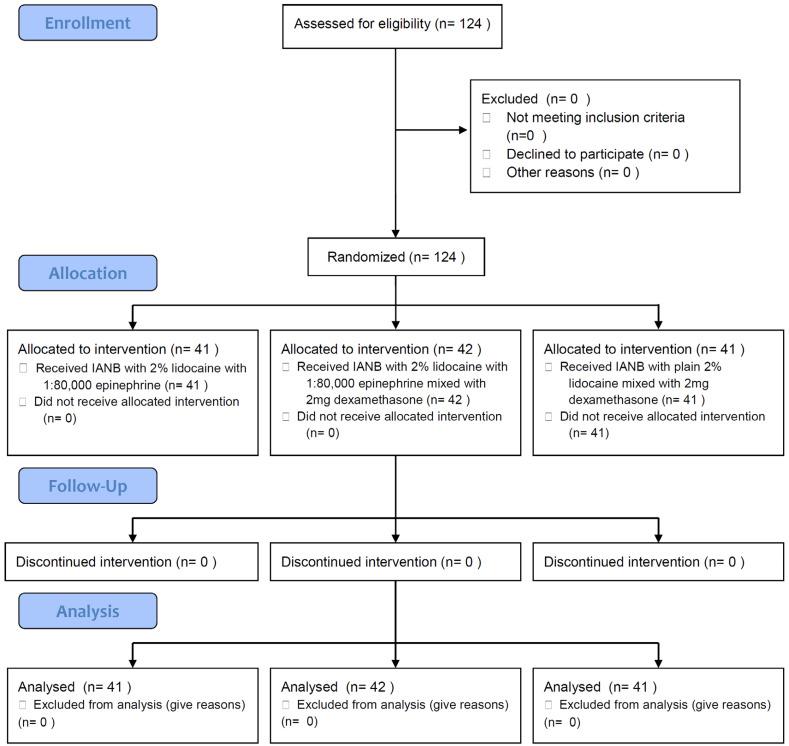
In a double-blinded setup, 124 patients randomly received either of the following injections: 2% lidocaine with 1:80,000 epinephrine, 2% lidocaine with 1:80,000 epinephrine mixed with 2 mg dexamethasone, or plain 2% lidocaine mixed with 2 mg dexamethasone, which were injected as a primary IANB. Ten minutes after injection, patients with profound lip numbness underwent electric and thermal pulp sensibility tests. Patients who responded positively to the tests were categorized as "failed" anesthesia and received supplemental anesthesia. The remaining patients underwent endodontic treatment using a rubber dam. Anesthetic success was defined as "no pain or faint/weak/mild pain" during endodontic access preparation and instrumentation (HP visual analog scale score < 55 mm). The effect of the anesthetic solutions on the maximum change in heart rate was also evaluated. The Pearson chi-square test at 5% and 1% significance was used to analyze anesthetic success rates.
RESULTS
The 2% lidocaine with 1:80,000 epinephrine, 2% lidocaine with 1:80,000 epinephrine mixed with 2 mg dexamethasone, and plain 2% lidocaine mixed with 2 mg dexamethasone groups had anesthetic success rates of 34%, 59%, and 29%, respectively. The addition of dexamethasone resulted in significantly better results (P < 0.001, χ = 9.07, df = 2).
CONCLUSIONS
The addition of dexamethasone to 2% lidocaine with epinephrine, administered as an IANB, can improve the anesthetic success rates during the endodontic management of symptomatic mandibular molars with irreversible pulpitis.
引言
本临床试验旨在评估在2%利多卡因(普通或含1:80,000肾上腺素)中添加2毫克(4毫克/毫升)地塞米松的麻醉效果。将这些溶液注射用于初次下牙槽神经阻滞(IANB),为有症状的不可逆性牙髓炎的下颌磨牙进行牙髓治疗提供下颌麻醉。
方法
在双盲设置下,124例患者随机接受以下注射之一:含1:80,000肾上腺素的2%利多卡因、含1:80,000肾上腺素并混合2毫克地塞米松的2%利多卡因、或普通2%利多卡因混合2毫克地塞米松,均作为初次IANB注射。注射10分钟后,唇部麻木明显的患者接受电和热牙髓敏感度测试。对测试有阳性反应的患者被归类为麻醉“失败”并接受补充麻醉。其余患者使用橡皮障进行牙髓治疗。麻醉成功定义为在牙髓开髓预备和器械操作期间“无疼痛或轻微/微弱/轻度疼痛”(HP视觉模拟量表评分<55毫米)。还评估了麻醉溶液对心率最大变化的影响。采用5%和1%显著性水平的Pearson卡方检验分析麻醉成功率。
结果
含1:80,000肾上腺素的2%利多卡因组、含1:80,000肾上腺素并混合2毫克地塞米松的2%利多卡因组和普通2%利多卡因混合2毫克地塞米松组的麻醉成功率分别为34%、59%和29%。添加地塞米松产生了显著更好的结果(P<0.001,χ=9.07,df=2)。
结论
在下牙槽神经阻滞中,在含肾上腺素的2%利多卡因中添加地塞米松,可提高有症状的不可逆性牙髓炎下颌磨牙牙髓治疗期间的麻醉成功率。
 Zotero 插件