
饮食与 10 岁自由生活儿童尿中三甲胺 N-氧化物(TMAO)及其前体的相关性:来自 SMBCS 的数据。
Associations of Diet with Urinary Trimethylamine-N-Oxide (TMAO) and Its Precursors among Free-Living 10-Year-Old Children: Data from SMBCS.
机构信息
Key Laboratory of Public Health Safety of Ministry of Education, Key Laboratory of Health Technology Assessment of National Health Commission, School of Public Health, Fudan University, No.130 Dong'an Road, Shanghai 200032, China.
Zhejiang Provincial Center for Disease Control and Prevention, No.3399 Binsheng Road, Hangzhou 310051, China.
出版信息
Nutrients. 2022 Aug 19;14(16):3419. doi: 10.3390/nu14163419.
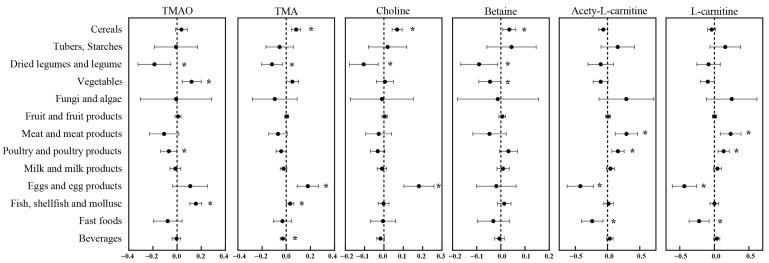
Trimethylamine-N-oxide (TMAO), a diet-derived cometabolite linked to cardiometabolic disease, has been associated with elevated dietary status, particularly in people with kidney failure and adults with dietary modulations. However, the influence of the current diet on TMAO levels in free-living children has not been adequately described. This study was to explore associations of food compositions and dietary diversity with urinary TMAO and its precursor concentrations. Urinary TMAO and its precursor concentrations of 474 healthy children from the Sheyang Mini Birth Cohort were quantified by ultra-performance liquid chromatography−Q Exactive high-resolution mass spectrometer (UPLC-Q Exactive HRMS). Individual food compositions from 24 h dietary recall data were classified into 20 groups and diversity scores were calculated according to the guidelines of the Food and Agriculture Organization of the United Nations (FAO). Associations of urinary TMAO and its precursors with food compositions and dietary diversity scores were assessed by generalized linear regression models. In models adjusted for potential confounders, urinary TMAO was significantly associated with intakes of fish (β, regression coefficient = 0.155, p < 0.05) and vegetables (β = 0.120, p < 0.05). Eggs intake showed positive associations with TMAO’s precursors (trimethylamine: β = 0.179, p < 0.05; choline: β = 0.181, p < 0.05). No association between meat intake and TMAO was observed, whereas meat and poultry intakes were related to the levels of acetyl-L-carnitine and L-carnitine (β: 0.134 to 0.293, p < 0.05). The indicators of dietary diversity were positively correlated to TMAO concentration (β: 0.027 to 0.091, p < 0.05). In this free-living children-based study, dietary factors were related to urinary TMAO and its precursors, especially fish, meat, and eggs. As such, dietary diversity was positively related to the level of TMAO.
三甲基胺 N-氧化物(TMAO)是一种与代谢疾病相关的饮食衍生共代谢物,与饮食状态升高有关,尤其是在肾衰竭患者和饮食调节的成年人中。然而,目前的饮食对自由生活儿童中 TMAO 水平的影响尚未得到充分描述。本研究旨在探讨食物成分和饮食多样性与尿 TMAO 及其前体浓度的关系。通过超高效液相色谱-Q Exactive 高分辨率质谱仪(UPLC-Q Exactive HRMS)定量分析了射阳迷你出生队列的 474 名健康儿童的尿 TMAO 和其前体浓度。根据联合国粮食及农业组织(FAO)的指南,将 24 小时膳食回忆数据中的个体食物成分分为 20 组,并计算多样性评分。采用广义线性回归模型评估尿 TMAO 及其前体与食物成分和饮食多样性评分的关系。在调整了潜在混杂因素的模型中,尿 TMAO 与鱼类(β,回归系数=0.155,p<0.05)和蔬菜(β=0.120,p<0.05)的摄入量呈显著正相关。鸡蛋摄入量与 TMAO 的前体呈正相关(三甲胺:β=0.179,p<0.05;胆碱:β=0.181,p<0.05)。未观察到肉类摄入量与 TMAO 之间的关联,而肉类和禽类摄入量与乙酰左旋肉碱和左旋肉碱的水平有关(β:0.134 至 0.293,p<0.05)。饮食多样性指标与 TMAO 浓度呈正相关(β:0.027 至 0.091,p<0.05)。在这项基于自由生活儿童的研究中,饮食因素与尿 TMAO 及其前体有关,尤其是鱼类、肉类和鸡蛋。因此,饮食多样性与 TMAO 水平呈正相关。

 Zotero 插件