
基于 microRNA 的特征可从子宫内膜液中鉴定植入性子宫内膜。
microRNA-based signatures obtained from endometrial fluid identify implantative endometrium.
机构信息
Human Reproduction Unit, Cruces University Hospital, University of the Basque Country (UPV/EHU), Barakaldo, Spain.
Innovation in Assisted Reproduction Group, Biocruces Bizkaia Health Research Institute, Cruces University Hospital, Barakaldo, Spain.
出版信息
Hum Reprod. 2022 Sep 30;37(10):2375-2391. doi: 10.1093/humrep/deac184.
STUDY QUESTION
Is it possible to use free and extracellular vesicle-associated microRNAs (miRNAs) from human endometrial fluid (EF) samples as non-invasive biomarkers for implantative endometrium?
SUMMARY ANSWER
The free and extracellular vesicle-associated miRNAs can be used to detect implantative endometrium in a non-invasive manner.
WHAT IS KNOWN ALREADY
miRNAs and extracellular vesicles (EVs) from EF have been described as mediators of the embryo-endometrium crosstalk. Therefore, the analysis of miRNA from this fluid could become a non-invasive technique for recognizing implantative endometrium. This analysis could potentially help improve the implantation rates in ART.
STUDY DESIGN, SIZE, DURATION: In this prospective study, we first optimized different protocols for EVs and miRNA analyses using the EF of a setup cohort (n = 72). Then, we examined differentially expressed miRNAs in the EF of women with successful embryo implantation (discovery cohort n = 15/validation cohort n = 30) in comparison with those for whom the implantation had failed (discovery cohort n = 15/validation cohort n = 30). Successful embryo implantation was considered when pregnancy was confirmed by vaginal ultrasound showing a gestational sac 4 weeks after embryo transfer (ET).
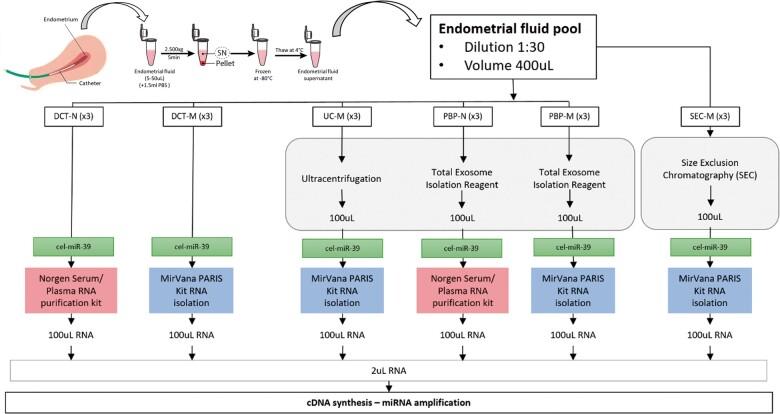
PARTICIPANTS/MATERIALS, SETTING, METHODS: The EF of the setup cohort was obtained before starting fertility treatment during the natural cycle, 16-21 days after the beginning of menstruation. For the discovery and validation cohorts, the EF was collected from women undergoing frozen ET on Day 5, and the samples were collected immediately before ET. In this study, we compared five different methods; two of them based on direct extraction of RNA and the other three with an EV enrichment step before the RNA extraction. Small RNA sequencing was performed to determine the most efficient method and find a predictive model differentiating between implantative and non-implantative endometrium. The models were confirmed using quantitative PCR in two sets of samples (discovery and validation cohorts) with different implantation outcomes.
MAIN RESULTS AND THE ROLE OF CHANCE
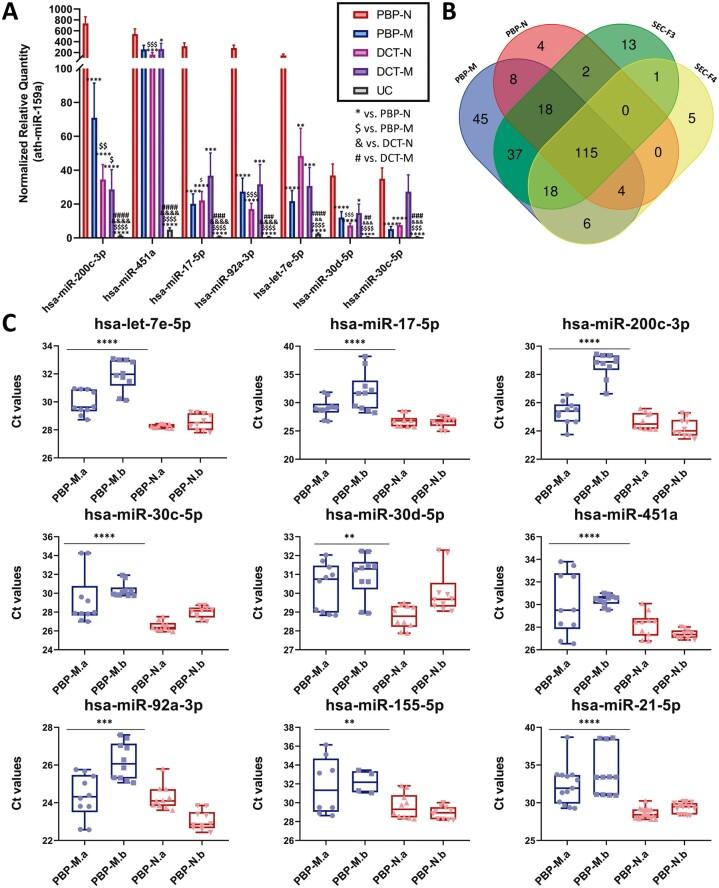
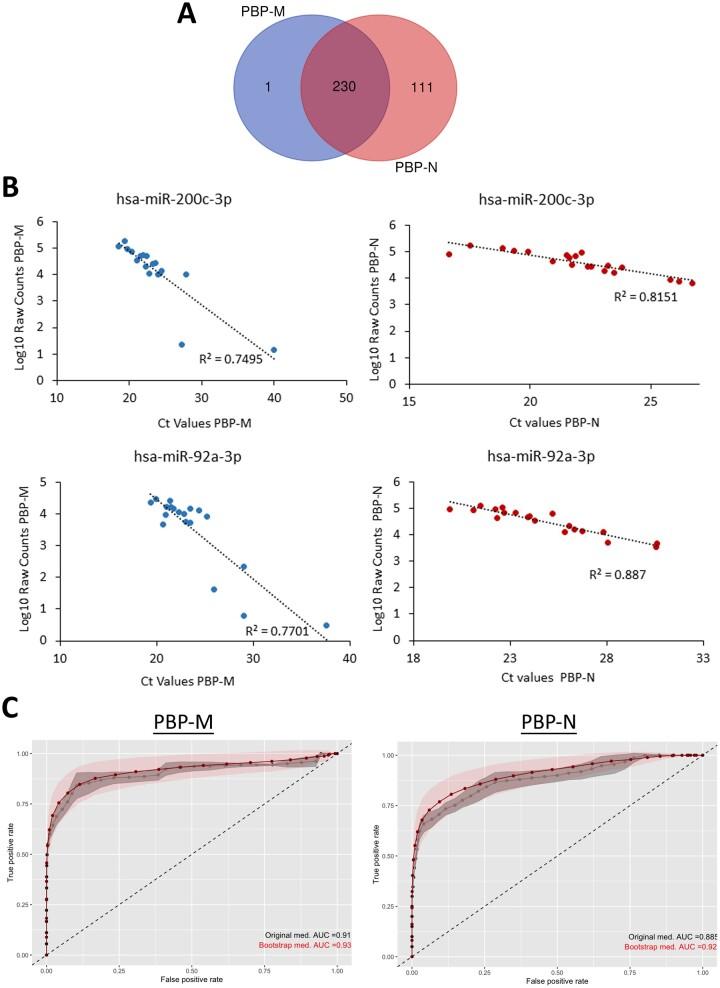
The protocols using EV enrichment detected more miRNAs than the methods based on direct RNA extraction. The two most efficient protocols (using polymer-based precipitation (PBP): PBP-M and PBP-N) were used to obtain two predictive models (based on three miRNAs) allowing us to distinguish between an implantative and non-implantative endometrium. The first Model 1 (PBP-M) (discovery: AUC = 0.93; P-value = 0.003; validation: AUC = 0.69; P-value = 0.019) used hsa-miR-200b-3p, hsa-miR-24-3p and hsa-miR-148b-3p. Model 2 (PBP-N) (discovery: AUC = 0.92; P-value = 0.0002; validation: AUC = 0.78; P-value = 0.0002) used hsa-miR-200b-3p, hsa-miR-24-3p and hsa-miR-99b-5p. Functional analysis of these miRNAs showed strong association with key implantation processes such as in utero embryonic development or transforming growth factor-beta signaling.
LARGE SCALE DATA
The FASTQ data are available in the GEO database (access number GSE178917).
LIMITATIONS, REASONS FOR CAUTION: One important factor to consider is the inherent variability among the women involved in the trial and among the transferred embryos. The embryos were pre-selected based on morphology, but neither genetic nor molecular studies were conducted, which would have improved the accuracy of our tests. In addition, a limitation in miRNA library construction is the low amount of input RNA.
WIDER IMPLICATIONS OF THE FINDINGS
We describe new non-invasive protocols to analyze miRNAs from small volumes of EF. These protocols could be implemented in clinical practice to assess the status of the endometrium before attempting ET. Such evaluation could help to avoid the loss of embryos transferred to a non-implantative endometrium.
STUDY FUNDING/COMPETING INTEREST(S): J.I.-P. was supported by a predoctoral grant from the Basque Government (PRE_2017_0204). This study was partially funded by the Grant for Fertility Innovation (GFI, 2011) from Merck (Darmstadt, Germany). It was also supported by the Spanish Ministry of Economy and Competitiveness MINECO within the National Plan RTI2018-094969-B-I00, the European Union's Horizon 2020 research and innovation program (860303), the Severo Ochoa Centre of Excellence Innovative Research Grant (SEV-2016-0644) and the Instituto de Salud Carlos III (PI20/01131). The funding entities did not play any role in the study design, collection, analysis and interpretation of data, writing of the report or the decision to submit the article for publication. The authors declare no competing interests.
研究问题
是否可以使用来自人子宫内膜液(EF)样本的游离和细胞外囊泡相关 microRNAs(miRNAs)作为植入性子宫内膜的非侵入性生物标志物?
总结答案
游离和细胞外囊泡相关的 miRNAs 可用于非侵入性方式检测植入性子宫内膜。
已知情况
EF 中的 miRNAs 和细胞外囊泡(EVs)已被描述为胚胎-子宫内膜串扰的介质。因此,对来自该液体的 miRNA 进行分析可能成为识别植入性子宫内膜的非侵入性技术。这种分析可能有助于提高 ART 中的植入率。
研究设计、规模、持续时间:在这项前瞻性研究中,我们首先使用设置队列的 EF(n=72)优化了用于 EV 和 miRNA 分析的不同方案。然后,我们比较了成功胚胎植入(发现队列 n=15/验证队列 n=30)和胚胎植入失败(发现队列 n=15/验证队列 n=30)的女性 EF 中差异表达的 miRNAs。当胚胎转移(ET)后 4 周通过阴道超声显示妊娠囊时,认为胚胎着床成功。
参与者/材料、设置、方法:设置队列的 EF 在自然周期开始前获得,在月经开始后 16-21 天。对于发现和验证队列,EF 是在第 5 天进行冷冻 ET 时从女性身上采集的,并且在 ET 前立即采集样本。在这项研究中,我们比较了五种不同的方法;其中两种基于 RNA 的直接提取,另外三种在 RNA 提取之前有 EV 富集步骤。使用小 RNA 测序确定最有效的方法并找到区分植入性和非植入性子宫内膜的预测模型。使用来自不同植入结果的两个样本集(发现和验证队列)的定量 PCR 对模型进行了确认。
主要结果和机会的作用
与基于直接 RNA 提取的方法相比,使用 EV 富集的方案检测到了更多的 miRNAs。两种最有效的方案(使用聚合物沉淀(PBP):PBP-M 和 PBP-N)用于获得两个预测模型(基于三个 miRNAs),使我们能够区分植入性和非植入性子宫内膜。第一个模型 1(PBP-M)(发现:AUC=0.93;P 值=0.003;验证:AUC=0.69;P 值=0.019)使用 hsa-miR-200b-3p、hsa-miR-24-3p 和 hsa-miR-148b-3p。模型 2(PBP-N)(发现:AUC=0.92;P 值=0.0002;验证:AUC=0.78;P 值=0.0002)使用 hsa-miR-200b-3p、hsa-miR-24-3p 和 hsa-miR-99b-5p。这些 miRNA 的功能分析显示它们与关键的植入过程(如宫内胚胎发育或转化生长因子-β信号转导)具有强烈的关联。
大数据
FASTQ 数据可在 GEO 数据库中获得(访问号 GSE178917)。
局限性、谨慎的原因:需要考虑的一个重要因素是试验中涉及的女性和转移的胚胎之间固有的变异性。胚胎是基于形态预先选择的,但没有进行遗传或分子研究,这将提高我们测试的准确性。此外,miRNA 文库构建的一个限制是输入 RNA 的数量低。
研究结果的更广泛意义
我们描述了新的非侵入性方案,用于分析来自少量 EF 的 miRNAs。这些方案可在临床实践中实施,以评估 ET 前子宫内膜的状态。这种评估可以帮助避免将胚胎转移到非植入性子宫内膜。
研究资金/利益冲突:J.I.-P. 得到了巴斯克政府(PRE_2017_0204)的博士前奖学金的支持。本研究部分由 Merck(德国达姆施塔特)的生育创新基金(GFI,2011)资助。它还得到了西班牙经济和竞争力部国家计划 RTI2018-094969-B-I00、欧盟地平线 2020 研究和创新计划(860303)、Severo Ochoa 卓越研究中心创新研究赠款(SEV-2016-0644)和西班牙卡洛斯三世健康研究所(PI20/01131)的支持。这些资金实体在研究设计、数据收集、分析和解释、报告撰写或提交文章发表的决定方面没有任何作用。作者没有利益冲突。


 Zotero 插件