
缺氧的人近端肾小管上皮细胞发生铁死亡,并在树突状细胞 CD1c 中引发 NLRP3 炎性体反应。
Hypoxic human proximal tubular epithelial cells undergo ferroptosis and elicit an NLRP3 inflammasome response in CD1c dendritic cells.
机构信息
Conjoint Internal Medicine Laboratory, Chemical Pathology, Pathology Queensland, Brisbane, QLD, Australia.
Kidney Health Service, Royal Brisbane and Women's Hospital, Brisbane, QLD, Australia.
出版信息
Cell Death Dis. 2022 Aug 27;13(8):739. doi: 10.1038/s41419-022-05191-z.
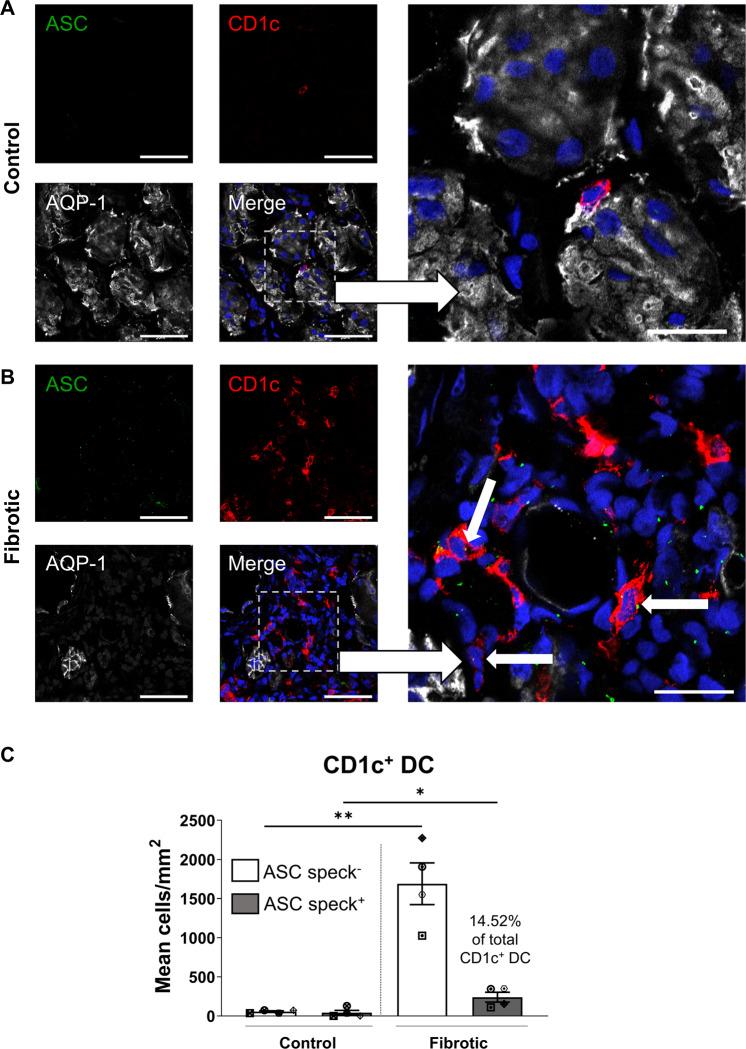
Inflammasomes are multiprotein platforms responsible for the release of pro-inflammatory cytokines interleukin (IL)-1β and IL-18. Mouse studies have identified inflammasome activation within dendritic cells (DC) as pivotal for driving tubulointerstitial fibrosis and inflammation, the hallmarks of chronic kidney disease (CKD). However, translation of this work to human CKD remains limited. Here, we examined the complex tubular cell death pathways mediating inflammasome activation in human kidney DC and, thus, CKD progression. Ex vivo patient-derived proximal tubular epithelial cells (PTEC) cultured under hypoxic (1% O) conditions modelling the CKD microenvironment showed characteristics of ferroptotic cell death, including mitochondrial dysfunction, reductions in the lipid repair enzyme glutathione peroxidase 4 (GPX4) and increases in lipid peroxidation by-product 4-hydroxynonenal (4-HNE) compared with normoxic PTEC. The addition of ferroptosis inhibitor, ferrostatin-1, significantly reduced hypoxic PTEC death. Human CD1c DC activated in the presence of hypoxic PTEC displayed significantly increased production of inflammasome-dependent cytokines IL-1β and IL-18. Treatment of co-cultures with VX-765 (caspase-1/4 inhibitor) and MCC950 (NLRP3 inflammasome inhibitor) significantly attenuated IL-1β/IL-18 levels, supporting an NLRP3 inflammasome-dependent DC response. In line with these in vitro findings, in situ immunolabelling of human fibrotic kidney tissue revealed a significant accumulation of tubulointerstitial CD1c DC containing active inflammasome (ASC) specks adjacent to ferroptotic PTEC. These data establish ferroptosis as the primary pattern of PTEC necrosis under the hypoxic conditions of CKD. Moreover, this study identifies NLRP3 inflammasome signalling driven by complex tubulointerstitial PTEC-DC interactions as a key checkpoint for therapeutic targeting in human CKD.
炎症小体是负责释放促炎细胞因子白细胞介素 (IL)-1β 和 IL-18 的多蛋白平台。小鼠研究已经确定树突状细胞 (DC) 中的炎症小体激活对于驱动肾小管间质纤维化和炎症(慢性肾脏病 (CKD) 的标志)至关重要。然而,将这项工作转化为人类 CKD 仍然有限。在这里,我们研究了介导人类肾脏 DC 中炎症小体激活的复杂管状细胞死亡途径,从而研究 CKD 的进展。在模拟 CKD 微环境的低氧 (1% O) 条件下培养的离体患者来源的近端肾小管上皮细胞 (PTEC) 表现出铁死亡细胞死亡的特征,包括线粒体功能障碍、脂质修复酶谷胱甘肽过氧化物酶 4 (GPX4) 减少和脂质过氧化产物 4-羟基壬烯醛 (4-HNE) 增加与常氧 PTEC 相比。添加铁死亡抑制剂 ferrostatin-1 可显著减少低氧 PTEC 死亡。在缺氧 PTEC 存在的情况下激活的人类 CD1c DC 显示出炎症小体依赖性细胞因子 IL-1β 和 IL-18 的产生显著增加。用 VX-765(半胱天冬酶-1/4 抑制剂)和 MCC950(NLRP3 炎症小体抑制剂)处理共培养物可显著降低 IL-1β/IL-18 水平,支持 NLRP3 炎症小体依赖性 DC 反应。与这些体外发现一致,对人类纤维化肾脏组织的原位免疫标记显示,在 CKD 的低氧条件下,相邻于铁死亡 PTEC 的肾小管间质 CD1c DC 中含有活性炎症小体 (ASC) 斑点的大量积聚。这些数据确立了铁死亡是 CKD 低氧条件下 PTEC 坏死的主要模式。此外,这项研究确定了由复杂的肾小管间质 PTEC-DC 相互作用驱动的 NLRP3 炎症小体信号作为人类 CKD 治疗靶向的关键检查点。


 Zotero 插件