
静脉注射右美托咪定对腹腔镜子宫肌瘤剔除术后胃肠功能恢复的影响:一项随机临床试验。
Impact of intravenous dexmedetomidine on gastrointestinal function recovery after laparoscopic hysteromyomectomy: a randomized clinical trial.
机构信息
Department of Anesthesiology, Bethune International Peace Hospital, Shijiazhuang, 050082, China.
Department of Obstetrics and Gynecology, Bethune International Peace Hospital, Shijiazhuang, 050082, China.
出版信息
Sci Rep. 2022 Aug 27;12(1):14640. doi: 10.1038/s41598-022-18729-0.
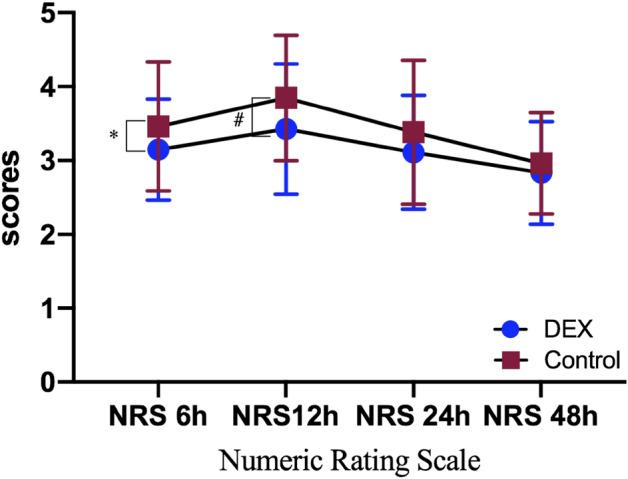
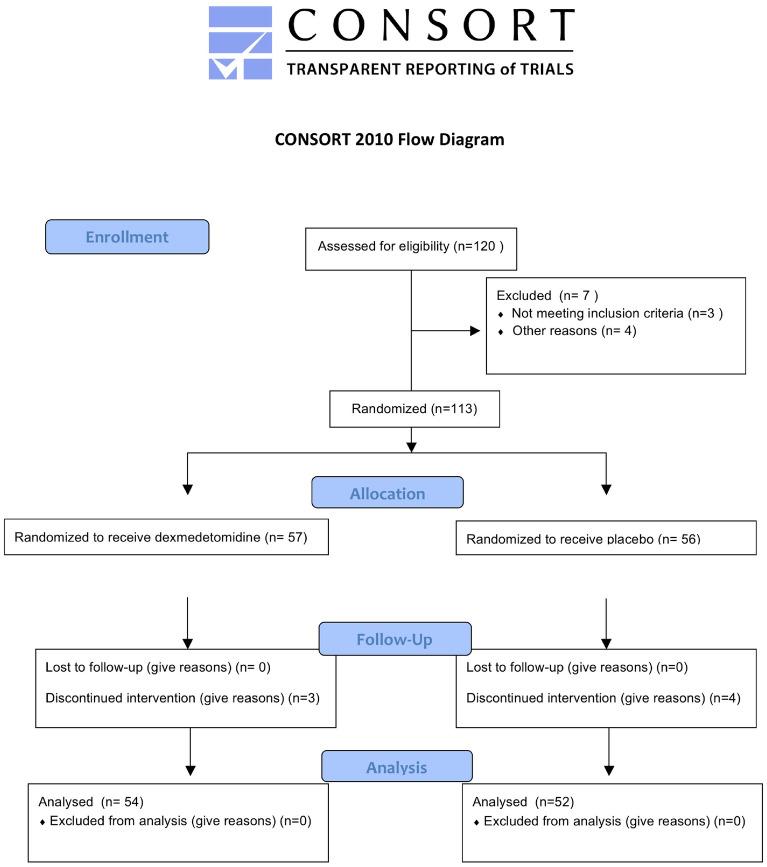
Postoperative intestinal ileus is common after laparoscopic surgery, the incidence of those after hysterectomy was 9.2%. Anesthesia is one of the independent risk factors of postoperative ileus. Dexmedetomidine has been widely used in perioperative anesthesia and previous reports suggested that intraoperative dexmedetomidine may be associated with the improvement of gastrointestinal function recovery after abdominal surgery. We hypothesized that dexmedetomidine could improve gastrointestinal function recovery after laparoscopic hysteromyomectomy. Participants in elective laparoscopic hysteromyomectomy were enrolled with a single dose of 0.5 μg kg dexmedetomidine or the same volume of placebo intravenously administered for 15 min, followed by continuous pumping of 0.2 μg kg h of corresponding drugs until 30 min before the end of surgery. The primary outcome was the time to first flatus. Secondary outcomes were the time to first oral feeding and the first defecation, the occurrence of flatulence, pain score and postoperative nausea and vomiting until 48 h after the surgery. Eventually, 106 participants (54 in dexmedetomidine group and 52 in placebo group) were included for final analysis. The time to first flatus (SD, 25.83 [4.18] vs 27.67 [3.77], P = 0.019), oral feeding time (SD, 27.29 [4.40] vs 28.92 [3.82], P = 0.044), the time to first defecation (SD, 59.82 [10.49] vs 63.89 [7.71], P = 0.025), abdominal distension (n%, 12 (22.2) vs 21 (40.4), P = 0.044), PONV at 24 h (n%, 10 (18.5) vs 19 (36.5), P = 0.037), NRS 6 h (3.15(0.68) vs 3.46 (0.87), P = 0.043) and NRS 12 h (3.43 (0.88) vs 3.85 (0.85), P = 0.014) of dexmedetomidine group were significantly shorter than those of the placebo group. Intraoperative dexmedetomidine reduced the time to first flatus, first oral feeding, and first defecation. These results suggested that this treatment may be a feasible strategy for improving postoperative gastrointestinal function recovery in patients undergoing laparoscopic hysteromyomectomy.
术后肠麻痹是腹腔镜手术后的常见并发症,其在子宫切除术患者中的发生率为 9.2%。麻醉是术后肠麻痹的独立危险因素之一。右美托咪定已广泛应用于围手术期麻醉,先前的报告表明,术中使用右美托咪定可能与腹部手术后胃肠道功能恢复有关。我们假设右美托咪定可以改善腹腔镜子宫肌瘤切除术患者的胃肠道功能恢复。择期行腹腔镜子宫肌瘤切除术的患者静脉注射右美托咪定 0.5μg/kg 或相同容量的安慰剂 15min,然后持续泵注右美托咪定 0.2μg/kg/h 至手术结束前 30min。主要结局是首次排气时间。次要结局是首次进食时间和首次排便时间、腹胀发生率、疼痛评分和术后恶心呕吐至术后 48h。最终,106 例患者(右美托咪定组 54 例,安慰剂组 52 例)纳入最终分析。首次排气时间(SD,25.83[4.18]比 27.67[3.77],P=0.019)、首次进食时间(SD,27.29[4.40]比 28.92[3.82],P=0.044)、首次排便时间(SD,59.82[10.49]比 63.89[7.71],P=0.025)、腹胀发生率(n%,12(22.2)比 21(40.4),P=0.044)、术后 24h 恶心呕吐发生率(n%,10(18.5)比 19(36.5),P=0.037)、6h 时的 NRS 评分(3.15(0.68)比 3.46(0.87),P=0.043)和 12h 时的 NRS 评分(3.43(0.88)比 3.85(0.85),P=0.014)在右美托咪定组明显短于安慰剂组。术中使用右美托咪定可减少首次排气、首次进食和首次排便的时间。这些结果表明,这种治疗方法可能是改善腹腔镜子宫肌瘤切除术患者术后胃肠道功能恢复的一种可行策略。

 Zotero 插件