
对细菌和新冠病毒具有即时和持久抗菌效果的表面。
Surfaces with instant and persistent antimicrobial efficacy against bacteria and SARS-CoV-2.
作者信息
Dhyani Abhishek, Repetto Taylor, Bartikofsky Dylan, Mirabelli Carmen, Gao Zhihe, Snyder Sarah A, Snyder Catherine, Mehta Geeta, Wobus Christiane E, VanEpps J Scott, Tuteja Anish
机构信息
Macromolecular Science and Engineering, University of Michigan, Ann Arbor, MI 48109, USA.
Biointerfaces Institute, University of Michigan, Ann Arbor, MI 48109, USA.
出版信息
Matter. 2022 Nov 2;5(11):4076-4091. doi: 10.1016/j.matt.2022.08.018. Epub 2022 Aug 24.
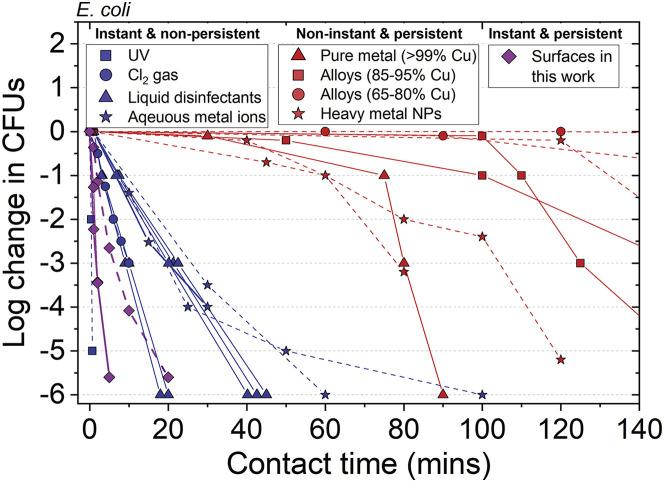
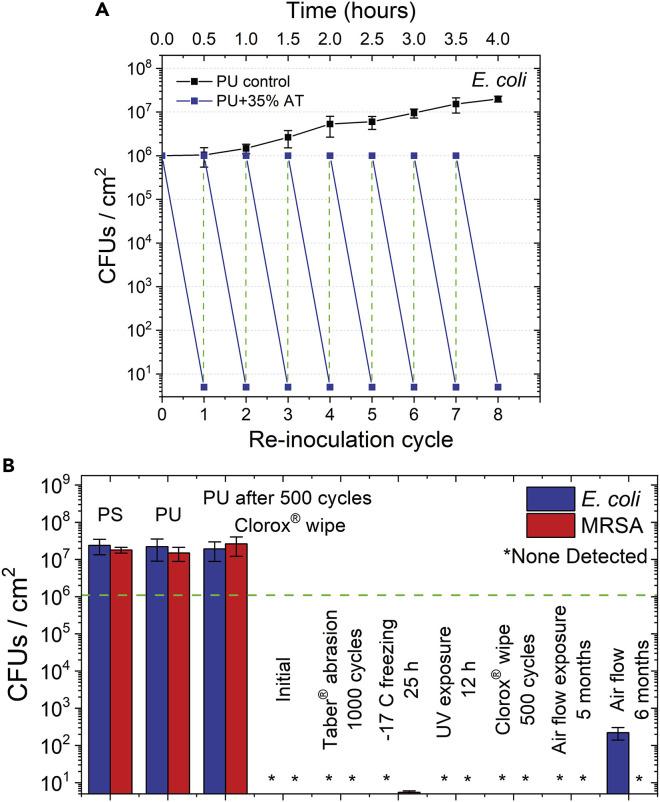
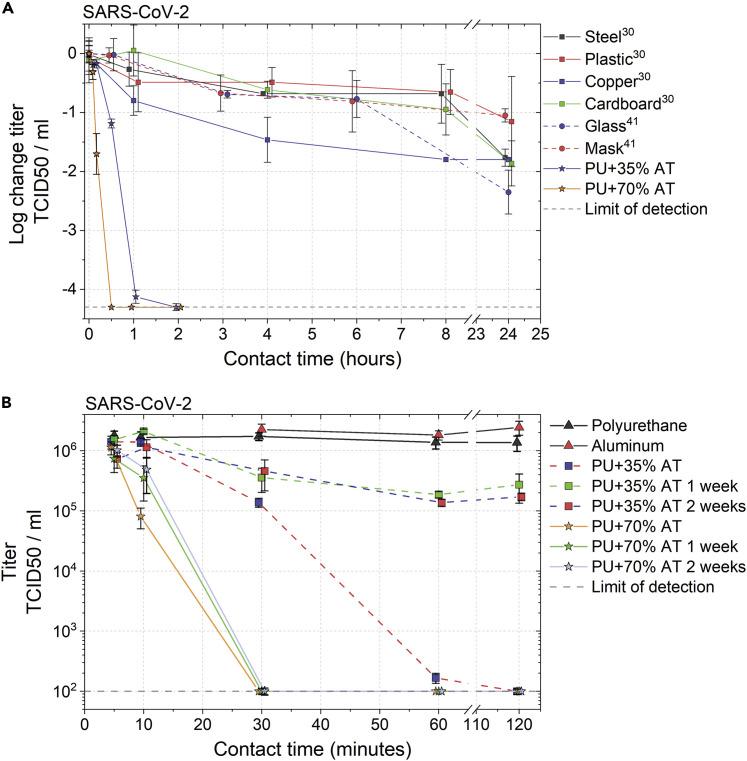
Surfaces contaminated with bacteria and viruses contribute to the transmission of infectious diseases and pose a significant threat to global public health. Modern day disinfection either relies on fast-acting (>3-log reduction within a few minutes), yet impermanent, liquid-, vapor-, or radiation-based disinfection techniques, or long-lasting, but slower-acting, passive antimicrobial surfaces based on heavy metal surfaces, or metallic nanoparticles. There is currently no surface that provides instant and persistent antimicrobial efficacy against a broad spectrum of bacteria and viruses. In this work, we describe a class of extremely durable antimicrobial surfaces incorporating different plant secondary metabolites that are capable of rapid disinfection (>4-log reduction) of current and emerging pathogens within minutes, while maintaining persistent efficacy over several months and under significant environmental duress. We also show that these surfaces can be readily applied onto a variety of desired substrates or devices via simple application techniques such as spray, flow, or brush coating.
被细菌和病毒污染的表面会导致传染病的传播,对全球公共卫生构成重大威胁。现代消毒方法要么依赖于快速起效(几分钟内实现>3个对数级的减少)但效果不持久的基于液体、蒸汽或辐射的消毒技术,要么依赖于基于重金属表面或金属纳米颗粒的长效但起效较慢的被动抗菌表面。目前还没有一种表面能对广谱细菌和病毒提供即时且持久的抗菌效果。在这项工作中,我们描述了一类极具耐久性的抗菌表面,其包含不同的植物次生代谢物,能够在几分钟内对当前和新出现的病原体进行快速消毒(>4个对数级的减少),同时在数月内以及在显著的环境压力下保持持久的效果。我们还表明,这些表面可以通过简单的应用技术,如喷雾、流动或刷涂,轻松地应用于各种所需的基材或设备上。



 Zotero 插件