
水中戊型肝炎病毒:系统评价和荟萃分析。
Hepatitis E Virus in Water Environments: A Systematic Review and Meta-analysis.
机构信息
Centre for Food, Food Security and Nutrition Research, Institute of Medical Research and Medicinal Plants Studies, Yaoundé, Cameroon.
Department of Microbiology and Parasitology, University of Buea, Buea, Cameroon.
出版信息
Food Environ Virol. 2022 Sep;14(3):223-235. doi: 10.1007/s12560-022-09530-3. Epub 2022 Aug 29.
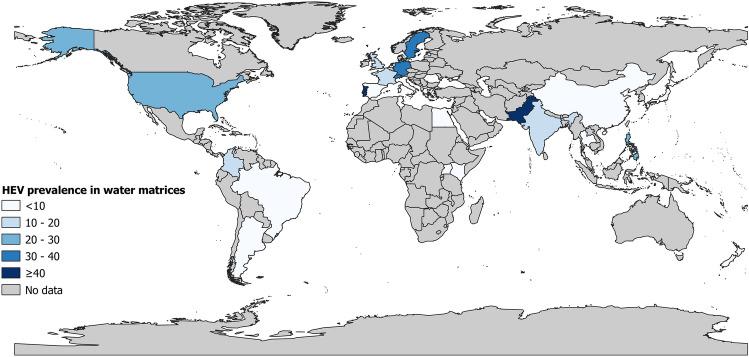
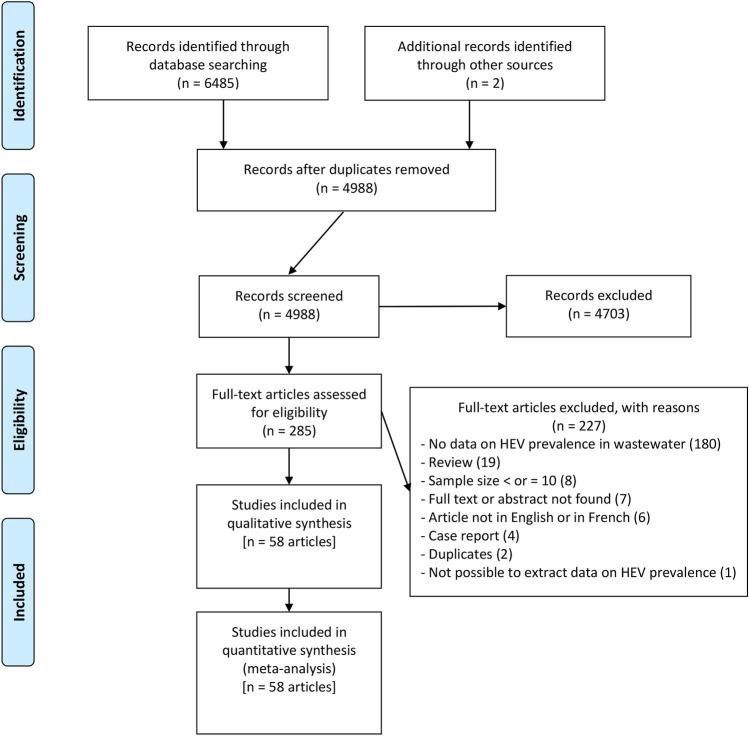
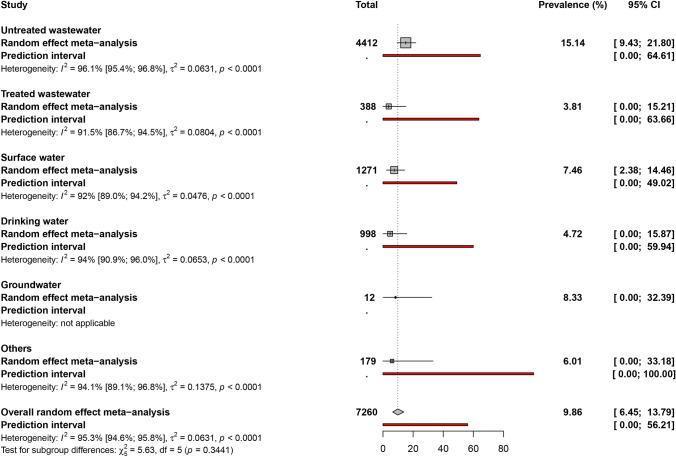
Hepatitis E virus (HEV) is responsible for acute hepatitis in humans, through foodborne, zoonotic, and waterborne transmission routes. This study aimed to assess the prevalence of HEV in water matrices. Six categories were defined: untreated and treated wastewater, surface water (river, lake, and seawater), drinking water, groundwater, and other water environments (irrigation water, grey water, reservoir water, flood water, and effluent of pig slaughterhouse). We searched PubMed, Web of Science, Global Index Medicus, and Excerpta Medica Database. Study selection and data extraction were performed by at least two independent investigators. Heterogeneity (I) was assessed using the χ test on the Cochran Q statistic and H parameter. Sources of heterogeneity were explored by subgroup analysis. This study is registered with PROSPERO, number CRD42021289116. We included 87 prevalence studies from 58 papers, 66.4% of which performed in Europe. The overall prevalence of HEV in water was 9.8% (95% CI 6.4-13.7). The prevalence was higher in untreated wastewater (15.1%) and lower in treated wastewater (3.8%) and in drinking water (4.7%). In surface water, prevalence was 7.4%, and in groundwater, the percentage of positive samples, from only one study available, was 8.3%. Overall, only 36.8% of the studies reported the genotype of HEV, with genotype 3 (HEV-3) prevalent (168 samples), followed by HEV-1 (148 sample), and HEV-4 (2 samples). High-income countries were the most represented with 59/87 studies (67.8%), while only 3/87 (3.5%) of the studies were performed in low-income countries. The overall prevalence obtained of this study was generally higher in industrialized countries. Risk of bias was low in 14.9% of the studies and moderate in 85.1%. The results of this review showed the occurrence of HEV in different waters environments also in industrialized countries with sanitation and safe water supplies. While HEV transmission to humans through water has been widely demonstrated in developing countries, it is an issue still pending in industrialized countries. Better knowledge on the source of pollution, occurrence, survival in water, and removal by water treatment is needed to unravel this transmission path.
戊型肝炎病毒(HEV)通过食物传播、人畜共患和水传播途径导致人类急性肝炎。本研究旨在评估水基质中 HEV 的流行率。将水分为以下六类:未经处理和处理后的废水、地表水(河流、湖泊和海水)、饮用水、地下水和其他水环境(灌溉水、灰水、水库水、洪水和屠宰场污水)。我们检索了 PubMed、Web of Science、Global Index Medicus 和 Excerpta Medica Database。通过 Cochran Q 统计量和 H 参数上的 χ 检验,由至少两名独立研究员进行研究选择和数据提取。使用亚组分析探索异质性(I)的来源。本研究在 PROSPERO 注册,编号 CRD42021289116。我们纳入了来自 58 篇论文的 87 项流行率研究,其中 66.4%的研究在欧洲进行。水中 HEV 的总体流行率为 9.8%(95%CI 6.4-13.7)。未经处理的废水中流行率更高(15.1%),而处理后的废水中流行率较低(3.8%),饮用水中的流行率较低(4.7%)。地表水的流行率为 7.4%,地下水的阳性样本比例(仅一项研究提供)为 8.3%。总体而言,只有 36.8%的研究报告了 HEV 的基因型,其中 HEV-3(HEV-3)最为常见(168 个样本),其次是 HEV-1(148 个样本)和 HEV-4(2 个样本)。高收入国家的研究最多,占 59/87 项研究(67.8%),而低收入国家仅进行了 3/87 项研究(3.5%)。本研究的总体流行率在工业化国家普遍较高。14.9%的研究风险较低,85.1%的研究风险中等。本综述的结果表明,HEV 在不同的水环境中也存在于工业化国家,这些国家的卫生和安全供水系统存在风险。虽然戊型肝炎病毒通过水传播给人类的情况在发展中国家已经得到广泛证实,但在工业化国家仍是一个悬而未决的问题。需要更好地了解污染来源、水中的发生和存活情况以及水处理的去除情况,以揭示这一传播途径。
 Zotero 插件