
COVID-19 限制措施对印度结核病患者收入和卫生服务利用的影响。
Impact of COVID-19 restrictive measures on income and health service utilization of tuberculosis patients in India.
机构信息
George Institute for Global Health, Research Department, 308, Elegance Tower, Plot No 8, Jasola District Centre, 110025, New Delhi, India.
Department of Medicine, University of New South Wales, 18 High Street, 2052, Kensington, NSW, Australia.
出版信息
BMC Infect Dis. 2022 Aug 29;22(1):711. doi: 10.1186/s12879-022-07681-z.
BACKGROUND
The nationwide lockdown (March 25 to June 8, 2020) to curb the spread of coronavirus infection had significant health and economic impacts on the Indian economy. There is limited empirical evidence on how COVID-19 restrictive measures may impact the economic welfare of specific groups of patients, e.g., tuberculosis patients. We provide the first such evidence for India.
METHODS
A total of 291 tuberculosis patients from the general population and from a high-risk group, patients from tea garden areas, were interviewed at different time points to understand household income loss during the complete lockdown, three and eight months after the complete lockdown was lifted. Income loss was estimated by comparing net monthly household income during and after lockdown with prelockdown income. Tuberculosis service utilization patterns before and during the lockdown period also were examined. Household income loss, travel and other expenses related to tuberculosis drug pickup were presented in 2020 US dollars (1 US$ = INR 74.132).
RESULTS
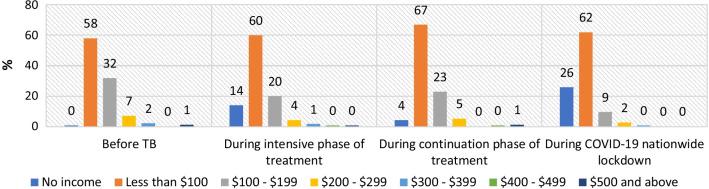
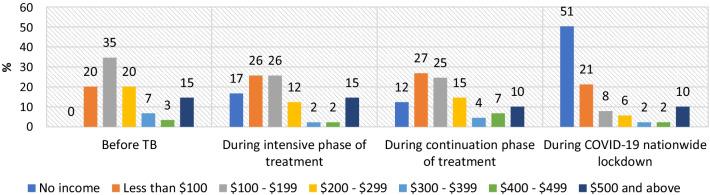
26% of households with tuberculosis patients in tea garden areas and 51% of households in the general population had zero monthly income during the complete lockdown months (April-May 2020). Overall income loss slowly recovered during July-August compared to April-May 2020. Approximately 7% of patients in the general population and 4% in tea garden areas discontinued their tuberculosis medicines because of the complete lockdown.
CONCLUSION
Discontinuation of medicine will have an additional burden on the tuberculosis elimination program in terms of additional cases, including multidrug resistant tuberculosis cases. Income loss for households and poor restoration of income after the lockdown will likely have an impact on the nutrition of tuberculosis patients and families. Tuberculosis patients working in the informal sector were the worst affected group during the nationwide lockdown. This emphasizes that a policy priority must continue to protect those working in informal sectors from the economic consequences of such restrictive measures, including paid sick leave, additional food support, and direct benefit transfers. Alongside ensuring widespread access to COVID-19 vaccines, these policy actions remain pivotal in ensuring the well-being of those who are unfortunate enough to be living with tuberculosis.
背景
为了遏制新冠病毒的传播,印度于 2020 年 3 月 25 日至 6 月 8 日实施了全国性封锁,这对印度经济产生了重大的健康和经济影响。关于 COVID-19 限制措施如何影响特定患者群体(如结核病患者)的经济福利,目前仅有有限的实证证据。我们为印度提供了首个此类证据。
方法
总共对来自普通人群和高危人群(茶园地区的结核病患者)的 291 名结核病患者进行了采访,以了解在全面封锁期间、封锁解除后的三个月和八个月内的家庭收入损失情况。通过比较封锁期间和封锁后的家庭净月收入来估计收入损失。还检查了封锁期间和之前的结核病服务利用模式。以 2020 年美元(1 美元=74.132 印度卢比)呈现结核病患者家庭收入损失、与取药相关的旅行和其他费用。
结果
茶园地区结核病患者家庭中有 26%和普通人群家庭中有 51%在全面封锁期间(2020 年 4 月至 5 月)没有任何月收入。与 2020 年 4 月至 5 月相比,7 月至 8 月期间总体收入恢复缓慢。由于全面封锁,普通人群中有 7%的患者和茶园地区中有 4%的患者停止服用结核病药物。
结论
由于额外的病例,包括耐多药结核病病例,药物中断将给结核病消除计划带来额外负担。家庭收入损失以及封锁后的收入恢复缓慢,可能会影响结核病患者及其家庭的营养状况。在全国性封锁期间,从事非正规部门工作的结核病患者受到的影响最大。这强调必须继续将保护从事非正规部门工作的人免受此类限制措施的经济后果(包括带薪病假、额外的粮食支持和直接福利转移)作为政策重点。除了确保广泛获得 COVID-19 疫苗外,这些政策行动仍然是确保不幸患有结核病的人的福祉的关键。
 Zotero 插件