
运动和军事中的劳力性热射病:流行病学和缓解措施。
Exertional heat stroke in sport and the military: epidemiology and mitigation.
机构信息
Research Institute for Sport and Exercise, University of Canberra, Canberra, Australia.
Army Heat Center, Martin Army Community Hospital, Fort Benning, GA, USA.
出版信息
Exp Physiol. 2022 Oct;107(10):1111-1121. doi: 10.1113/EP090686. Epub 2022 Sep 14.
NEW FINDINGS
What is the topic of this review? Exertional heat stroke epidemiology in sport and military settings, along with common risk factors and strategies and policies designed to mitigate its occurrence. What advances does it highlight? Individual susceptibility to exertional heat stroke risk is dependent on the interaction of intrinsic and extrinsic factors. Heat policies in sport should assess environmental conditions, as well as the characteristics of the athlete, clothing/equipment worn and activity level of the sport. Exertional heat stroke risk reduction in the military should account for factors specific to training and personnel.
ABSTRACT
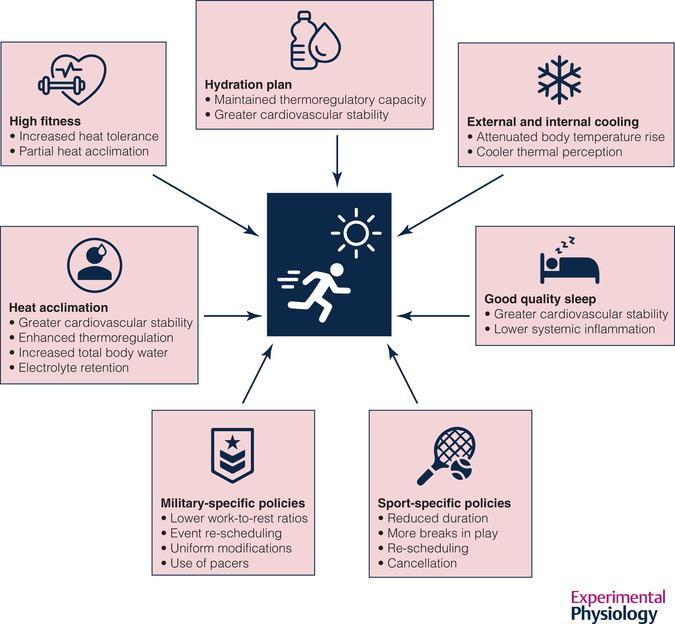
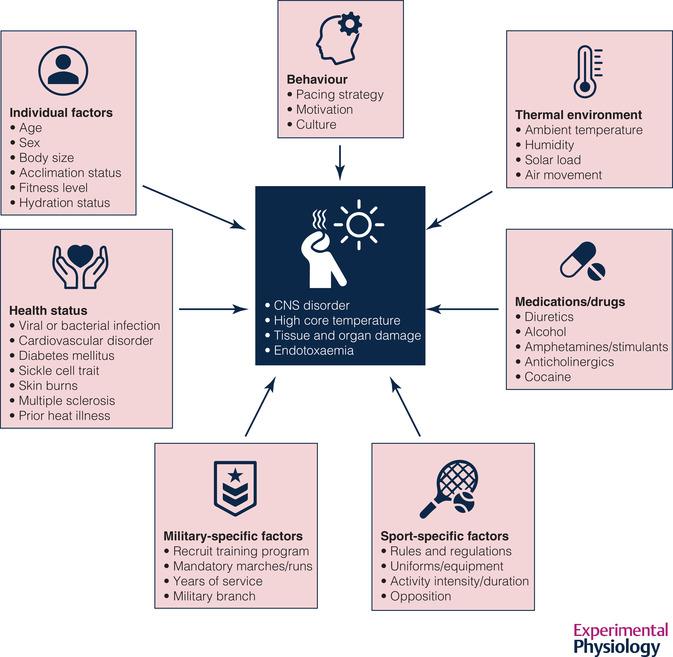
Exertional heat illness occurs along a continuum, developing from the relatively mild condition of muscle cramps, to heat exhaustion, and in some cases to the life-threatening condition of heat stroke. The development of exertional heat stroke (EHS) is associated with an increase in core temperature stemming from inadequate heat dissipation to offset the rate of metabolically generated heat. Susceptibility to EHS is linked to the interaction of several factors including environmental conditions, individual characteristics, health conditions, medication and drug use, behavioural responses, and sport/organisational requirements. Two settings in which EHS is commonly observed are competitive sport and the military. In sport, the exact prevalence of EHS is unclear due to inconsistent exertional heat illness terminology, diagnostic criteria and data reporting. In contrast, exertional heat illness surveillance in the military is facilitated by standardised case definitions, a requirement to report all heat illness cases and a centralised medical record repository. To mitigate EHS risk, several strategies can be implemented by athletes and military personnel, including heat acclimation, ensuring adequate hydration, cold-water immersion and mandated work-to-rest ratios. Organisations may also consider developing sport or military task-specific heat stress policies that account for the evaporative heat loss requirement of participants, relative to the evaporative capacity of the environment. This review examines the epidemiology of EHS along with the strategies and policies designed to reduce its occurrence in sport and military settings. We highlight the nuances of identifying individuals at risk of EHS and summarise the benefits and shortcomings of various mitigation strategies.
新发现
这篇综述的主题是什么?运动和军事环境中与运动性热射病相关的流行病学,以及常见的危险因素和旨在降低其发生的策略和政策。它强调了哪些进展?个体对运动性热射病风险的易感性取决于内在和外在因素的相互作用。运动中的热政策应评估环境条件,以及运动员的特征、穿着的服装/设备和运动的活动水平。军事中运动性热射病风险的降低应考虑到特定于训练和人员的因素。
摘要
运动性热病沿着一个连续体发生,从轻度的肌肉痉挛发展到热衰竭,在某些情况下发展为危及生命的热射病。运动性热射病(EHS)的发展与核心温度的升高有关,这是由于散热不足以抵消代谢产生的热量。EHS 的易感性与几个因素的相互作用有关,包括环境条件、个体特征、健康状况、药物使用、行为反应和运动/组织要求。EHS 常见于竞技体育和军事两个领域。在运动中,由于运动性热病术语、诊断标准和数据报告不一致,EHS 的确切患病率尚不清楚。相比之下,由于标准化的病例定义、报告所有热病病例的要求和集中的医疗记录库,军事中的运动性热病监测更加方便。为了降低 EHS 风险,运动员和军人可以采取几种策略,包括热适应、确保充足的水合作用、冷水浸泡和强制的工作与休息比。组织还可以考虑制定特定于运动或军事任务的热应激政策,这些政策考虑到参与者的蒸发散热需求,相对于环境的蒸发能力。本综述检查了 EHS 的流行病学以及旨在降低运动和军事环境中 EHS 发生的策略和政策。我们强调了识别易患 EHS 个体的细微差别,并总结了各种缓解策略的优缺点。
 Zotero 插件