
2017 至 2019 年韩国 13 价肺炎球菌结合疫苗引入后,导致侵袭性肺炎球菌病的血清型分布和抗菌药物耐药性
Serotype Distribution and Antimicrobial Resistance of Causing Invasive Pneumococcal Disease in Korea Between 2017 and 2019 After Introduction of the 13-Valent Pneumococcal Conjugate Vaccine.
机构信息
Department of Laboratory Medicine, Inje University College of Medicine, Busan, Korea.
Paik Institute for Clinical Research, Inje University College of Medicine, Busan, Korea.
出版信息
Ann Lab Med. 2023 Jan 1;43(1):45-54. doi: 10.3343/alm.2023.43.1.45. Epub 2022 Sep 1.
BACKGROUND
is a serious pathogen causing various infections in humans. We evaluated the serotype distribution and antimicrobial resistance of causing invasive pneumococcal disease (IPD) after introduction of pneumococcal conjugate vaccine (PCV)13 in Korea and investigated the epidemiological characteristics of multidrug-resistant (MDR) isolates.
METHODS
isolates causing IPD were collected from 16 hospitals in Korea between 2017 and 2019. Serotyping was performed using modified sequential multiplex PCR and the Quellung reaction. Antimicrobial susceptibility tests were performed using the broth microdilution method. Multilocus sequence typing was performed on MDR isolates for epidemiological investigations.
RESULTS
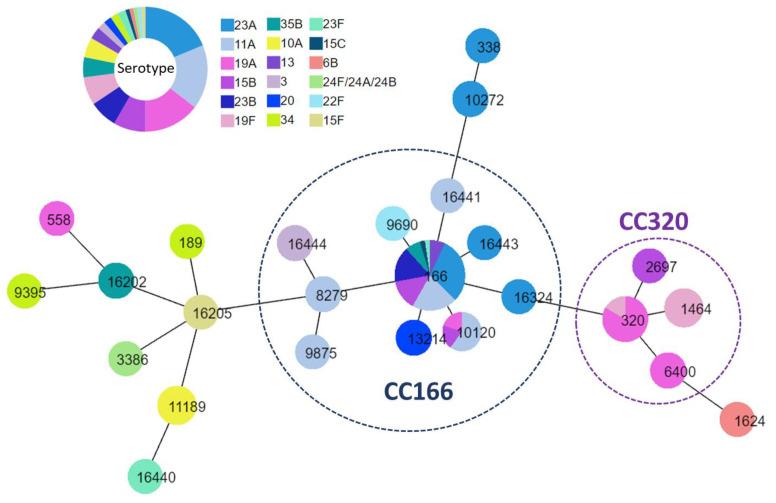
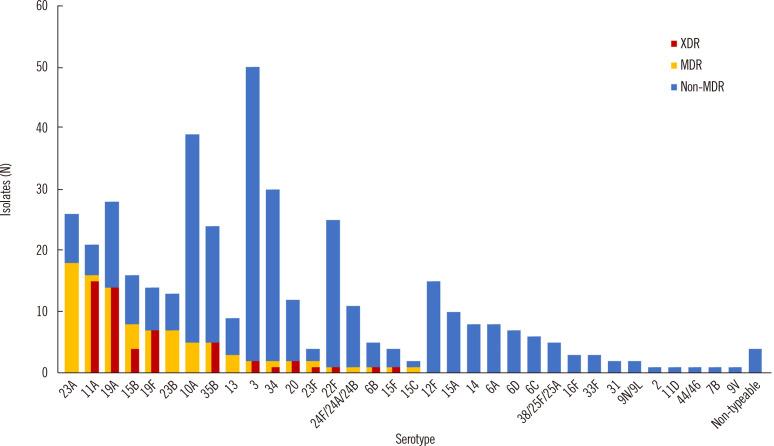
Among the 411 isolates analyzed, the most prevalent serotype was 3 (12.2%), followed by 10A (9.5%), 34 (7.3%), 19A (6.8%), 23A (6.3%), 22F (6.1%), 35B (5.8%), 11A (5.1%), and others (40.9%). The coverage rates of PCV7, PCV10, PCV13, and pneumococcal polysaccharide vaccine (PPSV)23 were 7.8%, 7.8%, 28.7%, and 59.4%, respectively. Resistance rates to penicillin, ceftriaxone, erythromycin, and levofloxacin were 13.1%, 9.2%, 80.3%, and 4.1%, respectively. MDR isolates accounted for 23.4% of all isolates. Serotypes 23A, 11A, 19A, and 15B accounted for the highest proportions of total isolates at 18.8%, 16.7%, 14.6%, and 8.3%, respectively. Sequence type (ST)166 (43.8%) and ST320 (12.5%) were common among MDR isolates.
CONCLUSIONS
Non-PCV13 serotypes are increasing among invasive strains causing IPD. Differences in antimicrobial resistance were found according to the specific serotype. Continuous monitoring of serotypes and antimicrobial resistance is necessary for the appropriate management of infections.
背景
肺炎链球菌是一种严重的病原体,可导致人类发生各种感染。我们评估了肺炎球菌结合疫苗(PCV)13 在韩国引入后引起侵袭性肺炎球菌病(IPD)的血清型分布和抗菌药物耐药性,并调查了耐多药(MDR)分离株的流行病学特征。
方法
2017 年至 2019 年期间,从韩国的 16 家医院收集引起 IPD 的分离株。使用改良的顺序多重 PCR 和 Quellung 反应进行血清分型。使用肉汤微量稀释法进行抗菌药物敏感性试验。对 MDR 分离株进行多位点序列分型以进行流行病学调查。
结果
在分析的 411 株分离株中,最常见的血清型为 3 型(12.2%),其次为 10A 型(9.5%)、34 型(7.3%)、19A 型(6.8%)、23A 型(6.3%)、22F 型(6.1%)、35B 型(5.8%)、11A 型(5.1%)和其他型(40.9%)。PCV7、PCV10、PCV13 和肺炎球菌多糖疫苗(PPSV)23 的覆盖率分别为 7.8%、7.8%、28.7%和 59.4%。青霉素、头孢曲松、红霉素和左氧氟沙星的耐药率分别为 13.1%、9.2%、80.3%和 4.1%。所有分离株中 MDR 分离株占 23.4%。血清型 23A、11A、19A 和 15B 分别占总分离株的 18.8%、16.7%、14.6%和 8.3%,比例最高。MDR 分离株中常见的序列型(ST)为 166 型(43.8%)和 ST320 型(12.5%)。
结论
引起 IPD 的侵袭性肺炎链球菌非 PCV13 血清型正在增加。根据特定血清型,抗菌药物耐药性存在差异。需要对血清型和抗菌药物耐药性进行持续监测,以适当管理肺炎链球菌感染。
 Zotero 插件