
德国新的有组织癌症筛查指南和 HPV 疫苗接种的纵向影响的描述性和差异化呈现提案。
Proposal for a descriptive and differentiated presentation of the longitudinal impact of the new organized cancer screening guideline and HPV vaccination in Germany.
机构信息
Department of Obstetrics and Gynecology, University Hospital Tübingen, Calwerstrasse 7, 72076, Tübingen, Germany.
Saarland Cancer Registry, Saarbrücken, Germany.
出版信息
Arch Gynecol Obstet. 2023 Apr;307(4):1125-1136. doi: 10.1007/s00404-022-06747-2. Epub 2022 Sep 2.
INTRODUCTION
Since 01/01/2020, the cervical cancer screening in Germany has been carried out due to the organized early cancer diagnosis guideline (oKFE-RL). In 2007, HPV vaccination was initiated in Germany. The main goal of both initiatives is to further reduce the incidence of invasive cervical cancer. To assess the effect of the new screening strategy in a timely manner, monitoring of short-term changes need to be considered. Ideally, the effects of both prevention methods would be presented together in one model.
MATERIALS AND METHODS
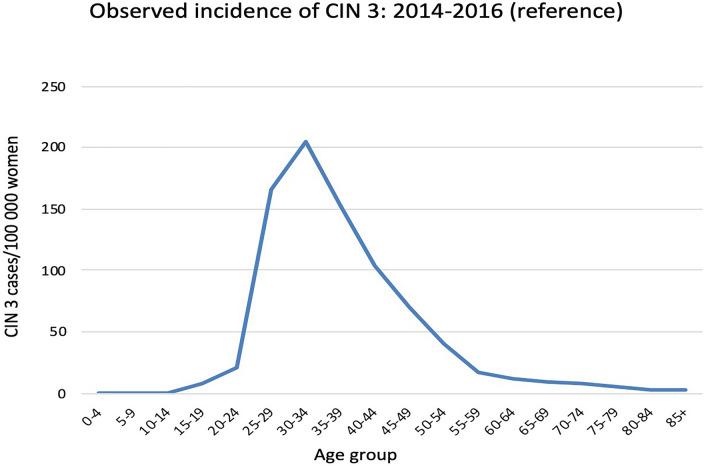
Because no change in the incidence of invasive cervical cancer is initially expected, the incidence of CIN 3 is used as a surrogate parameter to assess the effects of the prevention efforts. Based on expected additional effects of vaccination and co-testing, a model-based estimation of the expected CIN 3 incidence during the evaluation of the screening program is performed using the CIN 3 incidence in the Saarland population.
MODELING RESULTS
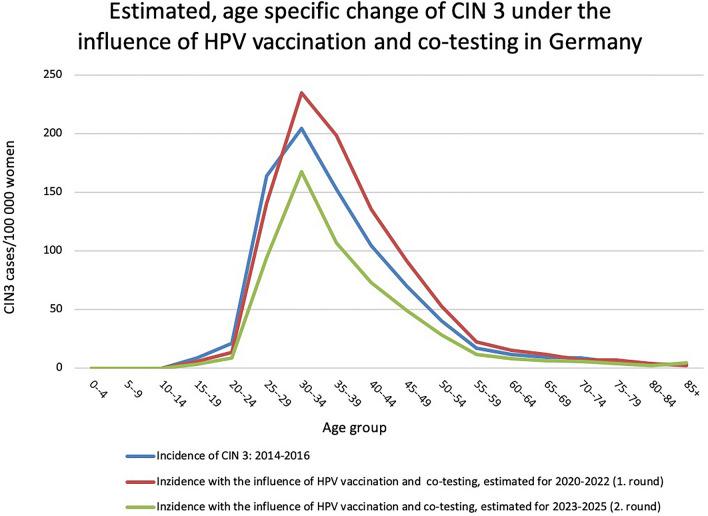
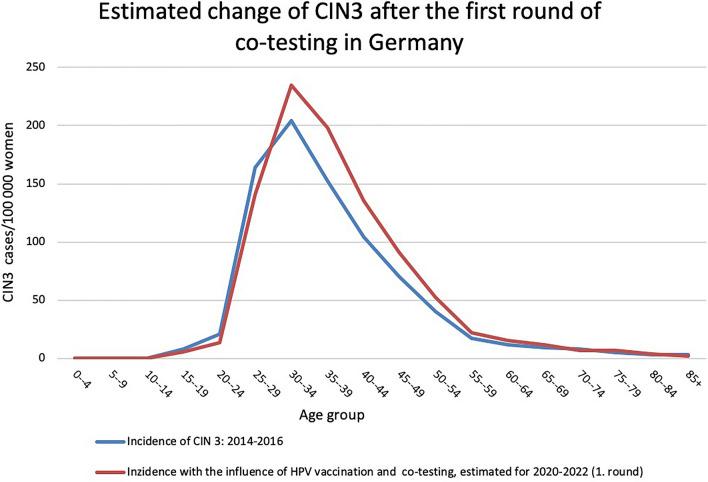
The oKFE-RL provides for two groups: Primary cytodiagnosis continues until 35 years of age. Here, in the next few years, CIN 3 incidence will be reduced not by the oKFE-RL but by the increasing proportion of vaccinated women. In the group over 35 years, co-testing was introduced with a stringent algorithm. Due to the higher sensitivity of the HPV test, significantly more CIN 3 are detected in the first round of 3 years and thus, the CIN 3 incidence initially increases. As these CIN 3 are absent in the second round, significantly fewer CIN 3 cases will be detected then. These effects suggest a global decrease in CIN 3 incidence of 25.8% after 6 years.
CONCLUSION
Observation of the age distribution curve of CIN 3 allows both effects of prevention to be assessed in a timely manner and separately. In the future, data from epidemiologic cancer registries should be incorporated into the model to replace modeling with real data.
引言
自 2020 年 1 月 1 日起,德国根据有组织的早期癌症诊断指南(oKFE-RL)开展宫颈癌筛查。2007 年,德国开始实施 HPV 疫苗接种。这两项举措的主要目标都是进一步降低浸润性宫颈癌的发病率。为了及时评估新筛查策略的效果,需要考虑短期变化的监测。理想情况下,这两种预防方法的效果应在一个模型中共同呈现。
材料与方法
由于最初预计浸润性宫颈癌的发病率不会发生变化,因此使用 CIN3 的发病率作为替代参数来评估预防措施的效果。基于疫苗接种和联合检测的额外效果预期,使用萨尔州人群的 CIN3 发病率,通过模型对筛查项目评估期间预期的 CIN3 发病率进行基于模型的估计。
模型结果
oKFE-RL 将人群分为两组:细胞学初筛一直持续到 35 岁。在接下来的几年中,由于接种疫苗女性比例的增加,CIN3 的发病率不会因 oKFE-RL 而降低。对于 35 岁以上的人群,引入了严格的联合检测算法。由于 HPV 检测的灵敏度更高,在最初的 3 年 3 轮检测中,将能显著更多地发现 CIN3,因此 CIN3 的发病率最初会增加。由于第二轮检测中不存在 CIN3,因此随后将显著减少 CIN3 病例的检出。这些影响表明,6 年后 CIN3 发病率将整体降低 25.8%。
结论
观察 CIN3 的年龄分布曲线,可以及时、分别评估预防的效果。未来,应将来自癌症流行病学登记处的数据纳入模型,用实际数据替代建模。
 Zotero 插件