
挥发性物质的吸收、运输、感知和信号转导构成了植物的“鼻子”。
Volatile uptake, transport, perception, and signaling shape a plant's nose.
机构信息
Institute of Plant Sciences, University of Bern, Altenbergrain 21, 3013 Bern, Switzerland.
出版信息
Essays Biochem. 2022 Sep 30;66(5):695-702. doi: 10.1042/EBC20210092.
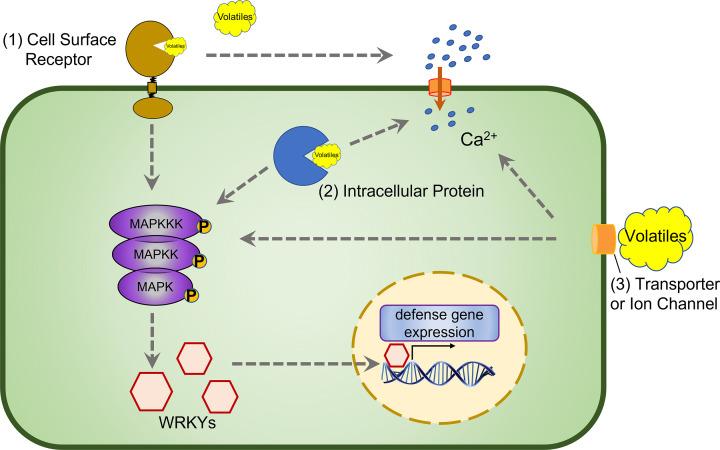
Herbivore-induced plant volatiles regulate defenses in undamaged neighboring plants. Understanding the mechanisms by which plant volatiles are taken up, perceived, and translated into canonical defense signaling pathways is an important frontier of knowledge. Volatiles can enter plants through stomata and the cuticle. They are likely perceived by membrane-associated receptors as well as intracellular receptors. The latter likely involves metabolization and transport across cell membranes by volatile transporters. Translation of volatiles into defense priming and induction typically involves mitogen-activated protein kinases (MAPKs), WRKY transcription factors, and jasmonates. We propose that the broad range of molecular processes involved in volatile signaling will likely result in substantial spatiotemporal and ontogenetic variation in plant responsiveness to volatiles, with important consequences for plant-environment interactions.
食草动物诱导的植物挥发物调节未受损邻近植物的防御。了解植物挥发物被吸收、感知以及转化为典型防御信号通路的机制是知识的一个重要前沿。挥发物可以通过气孔和角质层进入植物。它们可能被膜相关受体以及细胞内受体感知。后者可能涉及通过挥发性转运蛋白进行代谢和跨细胞膜运输。将挥发物转化为防御启动和诱导通常涉及丝裂原活化蛋白激酶 (MAPK)、WRKY 转录因子和茉莉酸。我们提出,参与挥发物信号转导的广泛分子过程可能导致植物对挥发物的响应在时空和个体发育上发生重大变化,这对植物与环境的相互作用有重要影响。

 Zotero 插件