
在 MD 模拟中评估针对 NMR 实验的带电小分子与膜的结合。
Charged Small Molecule Binding to Membranes in MD Simulations Evaluated against NMR Experiments.
机构信息
Institute of Biotechnology, University of Helsinki, 00014 Helsinki, Finland.
出版信息
J Phys Chem B. 2022 Sep 15;126(36):6955-6963. doi: 10.1021/acs.jpcb.2c05024. Epub 2022 Sep 5.
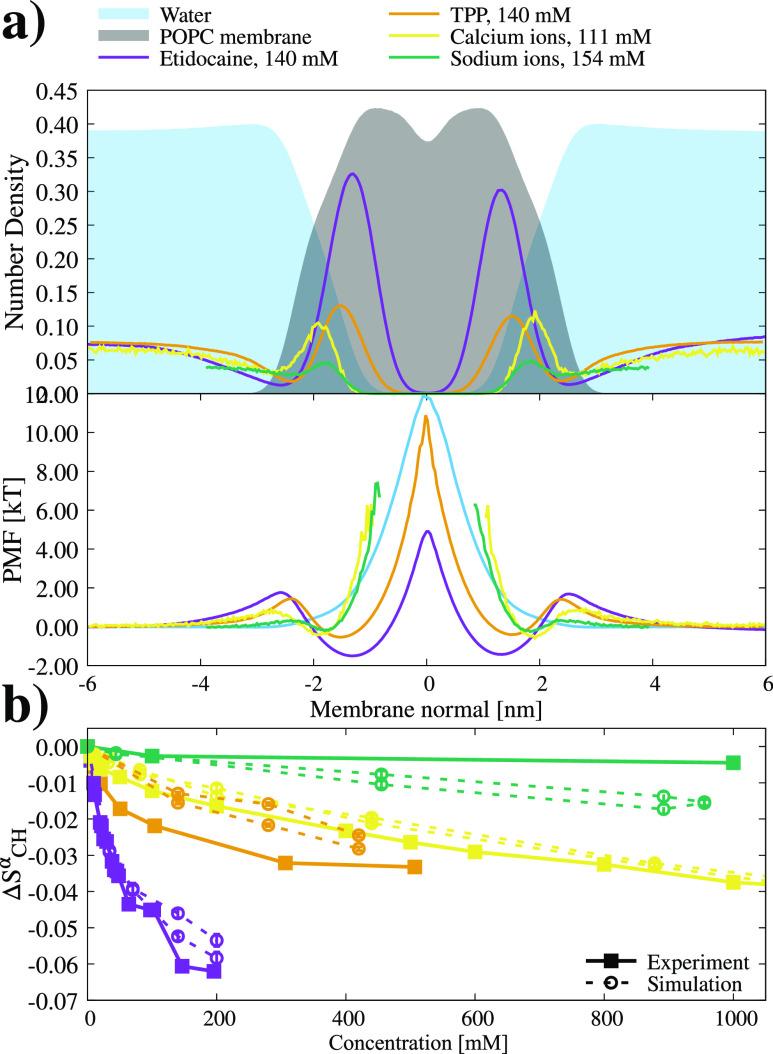
Interactions of charged molecules with biomembranes regulate many of their biological activities, but their binding affinities to lipid bilayers are difficult to measure experimentally and model theoretically. Classical molecular dynamics (MD) simulations have the potential to capture the complex interactions determining how charged biomolecules interact with membranes, but systematic overbinding of sodium and calcium cations in standard MD simulations raises the question of how accurately force fields capture the interactions between lipid membranes and charged biomolecules. Here, we evaluate the binding of positively charged small molecules, etidocaine, and tetraphenylphosphonium to a phosphatidylcholine (POPC) lipid bilayer using the changes in lipid head-group order parameters. We observed that these molecules behave oppositely to calcium and sodium ions when binding to membranes: (i) their binding affinities are not overestimated by standard force field parameters, (ii) implicit inclusion of electronic polarizability increases their binding affinity, and (iii) they penetrate into the hydrophobic membrane core. Our results can be explained by distinct binding mechanisms of charged small molecules with hydrophobic moieties and monoatomic ions. The binding of the former is driven by hydrophobic effects, while the latter has direct electrostatic interactions with lipids. In addition to elucidating how different kinds of charged biomolecules bind to membranes, we deliver tools for further development of MD simulation parameters and methodology.
带电分子与生物膜的相互作用调节着它们的许多生物活性,但它们与脂质双层的结合亲和力很难通过实验和理论模型来测量。经典的分子动力学(MD)模拟有潜力捕捉决定带电生物分子与膜相互作用的复杂相互作用,但在标准 MD 模拟中,钠离子和钙离子的系统过度结合引发了一个问题,即力场在多大程度上准确地捕捉到脂质膜和带电生物分子之间的相互作用。在这里,我们使用脂质头部基团序参数的变化来评估带正电荷的小分子,即依替卡因和四苯膦与磷脂酰胆碱(POPC)脂质双层的结合。我们观察到,这些分子与钙离子和钠离子结合时表现出相反的行为:(i)标准力场参数不会高估它们的结合亲和力,(ii)电子极化率的隐含包含会增加它们的结合亲和力,(iii)它们会渗透到疏水性膜核心。我们的结果可以用带电荷小分子与疏水分子和单价离子的不同结合机制来解释。前者的结合是由疏水作用驱动的,而后者与脂质有直接的静电相互作用。除了阐明不同种类的带电生物分子如何与膜结合外,我们还提供了进一步开发 MD 模拟参数和方法的工具。


 Zotero 插件