
基于 NMR 的循环代谢生物标志物在新诊断 2 型糖尿病发病和风险预测中的作用。
The role of NMR-based circulating metabolic biomarkers in development and risk prediction of new onset type 2 diabetes.
机构信息
Clinical Trial Service Unit and Epidemiological Studies Unit (CTSU), Nuffield Department of Population Health, University of Oxford, BDI Building, Old Road Campus, Oxford, OX3 7LF, UK.
Medical Research Council Population Health Research Unit, Nuffield Department of Population Health, University of Oxford, Oxford, UK.
出版信息
Sci Rep. 2022 Sep 5;12(1):15071. doi: 10.1038/s41598-022-19159-8.
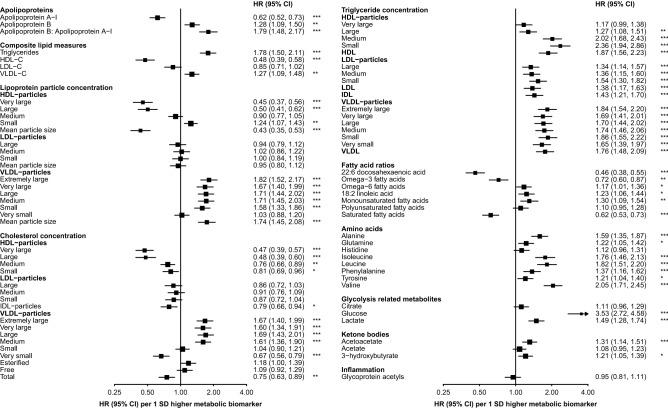
Associations of circulating metabolic biomarkers with type 2 diabetes (T2D) and their added value for risk prediction are uncertain among Chinese adults. A case-cohort study included 882 T2D cases diagnosed during 8-years' follow-up and a subcohort of 789 participants. NMR-metabolomic profiling quantified 225 plasma biomarkers in stored samples taken at recruitment into the study. Cox regression yielded adjusted hazard ratios (HRs) for T2D associated with individual biomarkers, with a set of biomarkers incorporated into an established T2D risk prediction model to assess improvement in discriminatory ability. Mean baseline BMI (SD) was higher in T2D cases than in the subcohort (25.7 [3.6] vs. 23.9 [3.6] kg/m). Overall, 163 biomarkers were significantly and independently associated with T2D at false discovery rate (FDR) controlled p < 0.05, and 138 at FDR-controlled p < 0.01. Branched chain amino acids (BCAA), apolipoprotein B/apolipoprotein A1, triglycerides in VLDL and medium and small HDL particles, and VLDL particle size were strongly positively associated with T2D (HRs 1.74-2.36 per 1 SD, p < 0.001). HDL particle size, cholesterol concentration in larger HDL particles and docosahexaenoic acid levels were strongly inversely associated with T2D (HRs 0.43-0.48, p < 0.001). With additional adjustment for plasma glucose, most associations (n = 147 and n = 129 at p < 0.05 and p < 0.01, respectively) remained significant. HRs appeared more extreme among more centrally adipose participants for apolipoprotein B/apolipoprotein A1, BCAA, HDL particle size and docosahexaenoic acid (p for heterogeneity ≤ 0.05). Addition of 31 selected biomarkers to an established T2D risk prediction model modestly, but significantly, improved risk discrimination (c-statistic 0.86 to 0.91, p < 0.001). In relatively lean Chinese adults, diverse metabolic biomarkers are associated with future risk of T2D and can help improve established risk prediction models.
在中国成年人中,循环代谢生物标志物与 2 型糖尿病(T2D)的关联及其对风险预测的附加值尚不确定。一项病例-队列研究纳入了 882 例在 8 年随访期间诊断为 T2D 的病例和 789 名亚队列参与者。NMR 代谢组学分析定量检测了研究入组时储存样本中的 225 种血浆生物标志物。Cox 回归分析得出了与个体生物标志物相关的 T2D 调整后风险比(HRs),并将一组生物标志物纳入已建立的 T2D 风险预测模型,以评估其在判别能力方面的改善。T2D 病例的平均基线 BMI(标准差)高于亚队列(25.7 [3.6] vs. 23.9 [3.6] kg/m2)。总体而言,在 FDR 控制 p<0.05 时有 163 种生物标志物与 T2D 显著独立相关,在 FDR 控制 p<0.01 时有 138 种生物标志物与 T2D 显著独立相关。支链氨基酸(BCAA)、载脂蛋白 B/载脂蛋白 A1、VLDL 和中、小 HDL 颗粒中的甘油三酯以及 VLDL 颗粒大小与 T2D 呈显著正相关(每 1 SD 的 HR 为 1.74-2.36,p<0.001)。HDL 颗粒大小、较大 HDL 颗粒中的胆固醇浓度和二十二碳六烯酸水平与 T2D 呈显著负相关(HR 为 0.43-0.48,p<0.001)。在进一步调整血浆葡萄糖后,大多数关联(p<0.05 和 p<0.01 时分别有 n=147 和 n=129 种生物标志物)仍然显著。对于载脂蛋白 B/载脂蛋白 A1、BCAA、HDL 颗粒大小和二十二碳六烯酸,更多中心性肥胖参与者的 HR 似乎更为极端(异质性 p 值≤0.05)。在已建立的 T2D 风险预测模型中添加 31 种选定的生物标志物可适度但显著地提高风险判别能力(c 统计量从 0.86 提高到 0.91,p<0.001)。在相对瘦的中国成年人中,不同的代谢生物标志物与未来发生 T2D 的风险相关,并且可以帮助改善已建立的风险预测模型。

 Zotero 插件