
多囊卵巢综合征与白细胞端粒长度:横断面和纵向变化。
Polycystic ovary syndrome and leukocyte telomere length: cross-sectional and longitudinal changes.
机构信息
Department of Obstetrics and Gynecology, University of Oulu and Oulu University Hospital, Medical Research Center, PEDEGO Research Unit, Oulu, Finland.
Center for Life Course Health Research, University of Oulu, Oulu, Finland.
出版信息
Eur J Endocrinol. 2022 Sep 29;187(5):651-661. doi: 10.1530/EJE-22-0462. Print 2022 Nov 1.
OBJECTIVE
Telomeres are DNA-protein complexes that protect chromosome ends from DNA damage and are surrogate biomarkers of cellular aging. Current evidence, almost entirely from cross-sectional observations, supports negative associations between leukocyte telomere length (LTL) and adverse lifestyle factors and cardiometabolic risk factors. Polycystic ovary syndrome (PCOS), the most common gynecological endocrine disorder, is associated with inflammation and oxidative stress, both factors associated with accelerated telomere attrition. We therefore hypothesized that LTL would be shorter and decrease more rapidly in women with PCOS in comparison to a control population.
DESIGN
This is a population-based cohort study comprising women of Northern Finland Birth Cohort 1966, with clinical examinations at ages 31 and 46. The sample included self-reported PCOS (age 31, n = 190; age 46, n = 207) and referent women (age 31, n = 1054; age 46, n = 1324) with data on LTL.
METHODS
The association between LTL and PCOS at ages 31 and 46 was analyzed by linear regression models adjusted for BMI, smoking, alcohol consumption and socioeconomic status at the corresponding age.
RESULTS
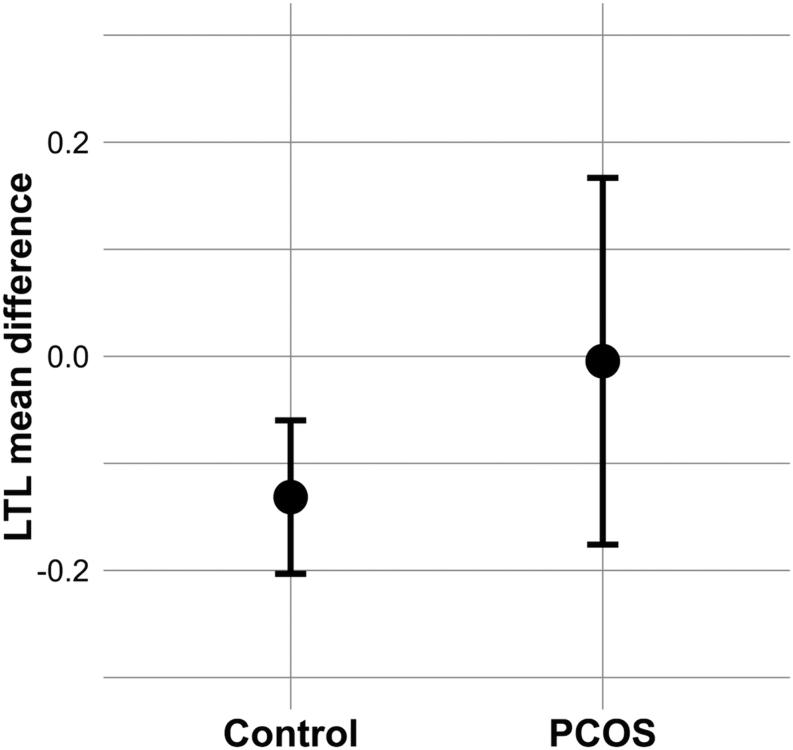
Women with PCOS had similar mean LTL at ages 31 and 46 (P > 0.4 for both). The mean LTL change between ages 31 and 46 did not differ between groups (P = 0.19). However, we observed a significant LTL attrition between ages 31 and 46 in the reference population (P < 0.001), but not in women with PCOS (P = 0.96).
CONCLUSIONS
This finding may suggest a difference in the LTL attrition rate in women with PCOS, an unexpected finding that might affect their risk of age-related disease. Further research is needed to clarify the underlying mechanisms.
目的
端粒是一种 DNA-蛋白质复合物,可保护染色体末端免受 DNA 损伤,是细胞衰老的替代生物标志物。目前的证据几乎完全来自横断面观察,支持白细胞端粒长度(LTL)与不良生活方式因素和心血管代谢危险因素之间存在负相关。多囊卵巢综合征(PCOS)是最常见的妇科内分泌疾病,与炎症和氧化应激有关,这两个因素都与端粒加速损耗有关。因此,我们假设与对照组相比,PCOS 女性的 LTL 更短,且减少速度更快。
设计
这是一项基于人群的队列研究,纳入了芬兰北部出生队列 1966 年的女性,在 31 岁和 46 岁时进行临床检查。该样本包括自我报告的 PCOS(31 岁时 n=190;46 岁时 n=207)和参照女性(31 岁时 n=1054;46 岁时 n=1324),并记录 LTL 数据。
方法
通过线性回归模型分析 LTL 与 31 岁和 46 岁时 PCOS 的关系,模型调整了相应年龄的 BMI、吸烟、饮酒和社会经济地位。
结果
PCOS 女性在 31 岁和 46 岁时的平均 LTL 相似(两者均 P>0.4)。两组之间 31 岁至 46 岁之间的平均 LTL 变化无差异(P=0.19)。然而,我们观察到参照人群中 31 岁至 46 岁之间的 LTL 损耗显著(P<0.001),但 PCOS 女性中没有(P=0.96)。
结论
这一发现可能表明 PCOS 女性的 LTL 损耗率存在差异,这一意外发现可能会影响她们与年龄相关疾病的风险。需要进一步研究来阐明潜在机制。

 Zotero 插件