
在英国生物库中,超过 40000 名参与者的握力、大脑结构与心理健康之间的关联。
Associations between grip strength, brain structure, and mental health in > 40,000 participants from the UK Biobank.
机构信息
Department of Radiology and Biomedical Imaging, Yale School of Medicine, New Haven, CT, 06510, USA.
Department of Biomedical Engineering, Yale University, New Haven, CT, 06520, USA.
出版信息
BMC Med. 2022 Sep 9;20(1):286. doi: 10.1186/s12916-022-02490-2.
BACKGROUND
Grip strength is a widely used and well-validated measure of overall health that is increasingly understood to index risk for psychiatric illness and neurodegeneration in older adults. However, existing work has not examined how grip strength relates to a comprehensive set of mental health outcomes, which can detect early signs of cognitive decline. Furthermore, whether brain structure mediates associations between grip strength and cognition remains unknown.
METHODS
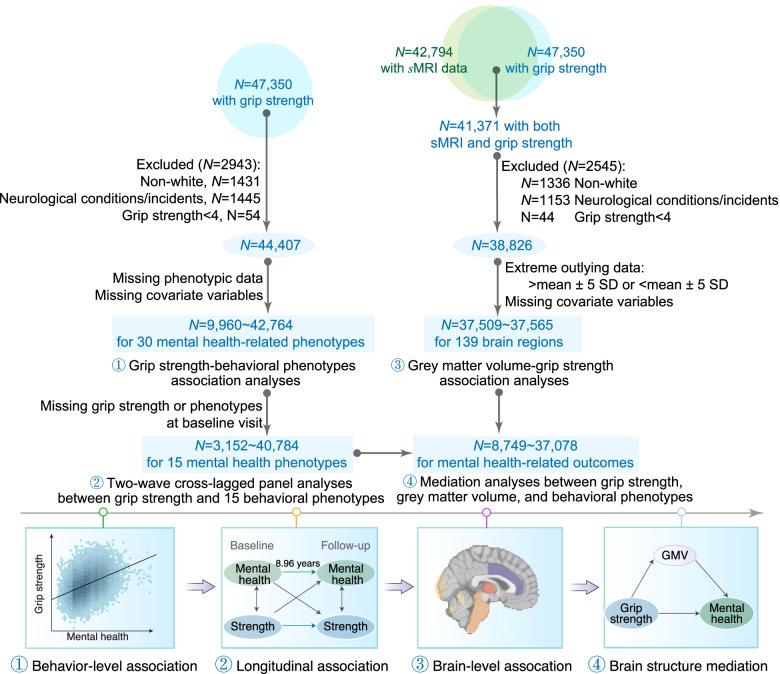
Based on cross-sectional and longitudinal data from over 40,000 participants in the UK Biobank, this study investigated the behavioral and neural correlates of handgrip strength using a linear mixed effect model and mediation analysis.
RESULTS
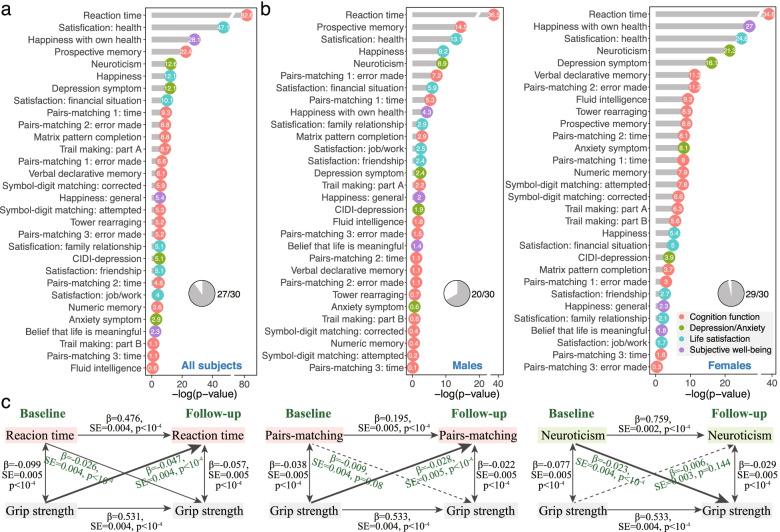
In cross-sectional analysis, we found that greater grip strength was associated with better cognitive functioning, higher life satisfaction, greater subjective well-being, and reduced depression and anxiety symptoms while controlling for numerous demographic, anthropometric, and socioeconomic confounders. Further, grip strength of females showed stronger associations with most behavioral outcomes than males. In longitudinal analysis, baseline grip strength was related to cognitive performance at ~9 years follow-up, while the reverse effect was much weaker. Further, baseline neuroticism, health, and financial satisfaction were longitudinally associated with subsequent grip strength. The results revealed widespread associations between stronger grip strength and increased grey matter volume, especially in subcortical regions and temporal cortices. Moreover, grey matter volume of these regions also correlated with better mental health and considerably mediated their relationship with grip strength.
CONCLUSIONS
Overall, using the largest population-scale neuroimaging dataset currently available, our findings provide the most well-powered characterization of interplay between grip strength, mental health, and brain structure, which may facilitate the discovery of possible interventions to mitigate cognitive decline during aging.
背景
握力是一种广泛使用且经过充分验证的整体健康指标,越来越多的研究表明,它可以预测老年人的精神疾病和神经退行性疾病风险。然而,现有研究尚未探讨握力与一系列心理健康结果的关系,而这些结果可以检测到认知能力下降的早期迹象。此外,握力与认知之间的关联是否与大脑结构有关尚不清楚。
方法
本研究基于英国生物库超过 40000 名参与者的横断面和纵向数据,使用线性混合效应模型和中介分析来研究手握力的行为和神经相关性。
结果
在横断面分析中,我们发现,在控制了大量人口统计学、人体测量学和社会经济混杂因素后,握力越大与认知功能越好、生活满意度越高、主观幸福感越强、抑郁和焦虑症状越少相关。此外,女性的握力与大多数行为结果的相关性强于男性。在纵向分析中,基线握力与大约 9 年后的认知表现相关,而相反的效果要弱得多。此外,基线神经质、健康和财务满意度与随后的握力呈纵向相关。结果表明,握力越强与灰质体积增加之间存在广泛的关联,尤其是在皮质下区域和颞叶。此外,这些区域的灰质体积也与更好的心理健康相关,并在很大程度上介导了它们与握力的关系。
结论
总之,使用目前可用的最大人群规模神经影像学数据集,我们的研究结果提供了握力、心理健康和大脑结构之间相互作用的最有力描述,这可能有助于发现可能的干预措施来减轻衰老过程中的认知能力下降。



 Zotero 插件