
特利鲁单抗在中重度特应性皮炎成年患者中的安全性:五项随机、双盲、安慰剂对照的 II 期和 III 期临床试验的汇总分析。
Safety of tralokinumab in adult patients with moderate-to-severe atopic dermatitis: pooled analysis of five randomized, double-blind, placebo-controlled phase II and phase III trials.
机构信息
Department of Dermatology, Oregon Health & Science University, Portland, OR, USA.
Brigham and Women's Hospital and Harvard Medical School, Boston, MA, USA.
出版信息
Br J Dermatol. 2022 Dec;187(6):888-899. doi: 10.1111/bjd.21867. Epub 2022 Oct 26.
BACKGROUND
Tralokinumab is a fully human monoclonal antibody that neutralizes the activity of interleukin-13, a key pathogenic driver of atopic dermatitis (AD). Clinical trials including adults with moderate-to-severe AD, of up to 52 weeks' duration, showed tralokinumab was efficacious and well tolerated.
OBJECTIVES
To characterize the safety profile of tralokinumab for the treatment of moderate-to-severe AD.
METHODS
Safety and laboratory measures were assessed in pooled analyses of phase II and III placebo-controlled clinical trials of tralokinumab in moderate-to-severe AD (NCT02347176, NCT03562377, NCT03131648, NCT03160885, NCT03363854).
RESULTS
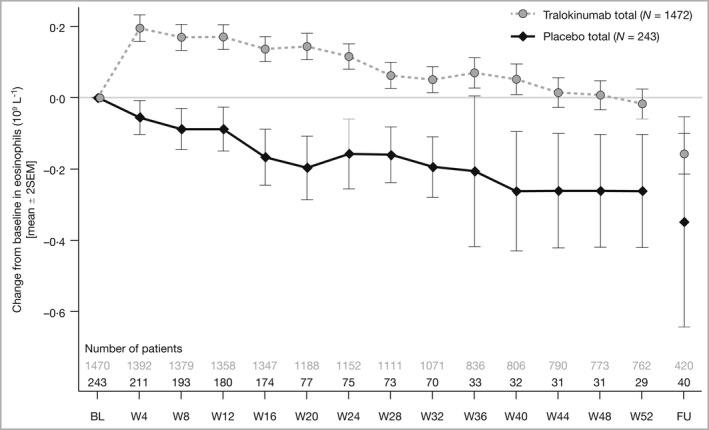
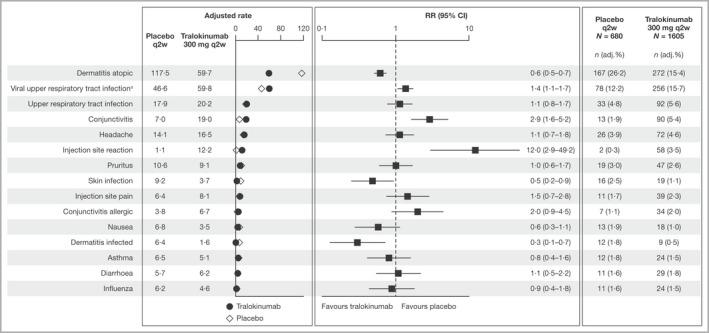
In total, 2285 patients were randomized in the initial treatment periods up to 16 weeks (1605 tralokinumab, 680 placebo). The frequencies of any adverse event (AE) were 65·7% for tralokinumab and 67·2% for placebo. The respective rates were 640 and 678 events per 100 patient-years of exposure (ep100PYE); rate ratio 1·0, 95% confidence interval (CI) 0·9-1·1. Serious AEs occurred in 2·1% of patients with tralokinumab and 2·8% with placebo (7·4 and 11·9 ep100PYE; rate ratio 0·7, 95% CI 0·4-1·2). The most common AEs occurring at a higher frequency and rate with tralokinumab vs. placebo were: viral upper respiratory tract infection (15·7% vs. 12·2%; 65·1 vs. 53·5 ep100PYE); upper respiratory tract infection (5·6% vs. 4·8%; 20·8 vs. 18·5 ep100PYE); conjunctivitis (5·4% vs. 1·9%; 21·0 vs. 6·9 ep100PYE); and injection-site reaction (3·5% vs. 0·3%; 22·9 vs. 4·0 ep100PYE). Some events in safety areas of interest occurred at a lower frequency and rate with tralokinumab vs. placebo: skin infections requiring systemic treatment (2·6% vs. 5·5%; 9·7 vs. 22·8 ep100PYE), eczema herpeticum (0·3% vs. 1·5%; 1·2 vs. 5·2 ep100PYE), opportunistic infections (3·4% vs. 4·9%; 13·0 vs. 21·3 ep100PYE) and serious infections (0·4% vs. 1·1%; 1·3 vs. 3·7 ep100PYE). AEs did not increase with continued maintenance and open-label treatment, including rates of common or serious AEs and AEs leading to study drug discontinuation. No clinically meaningful changes in mean laboratory measures were observed with treatment up to 1 year.
CONCLUSIONS
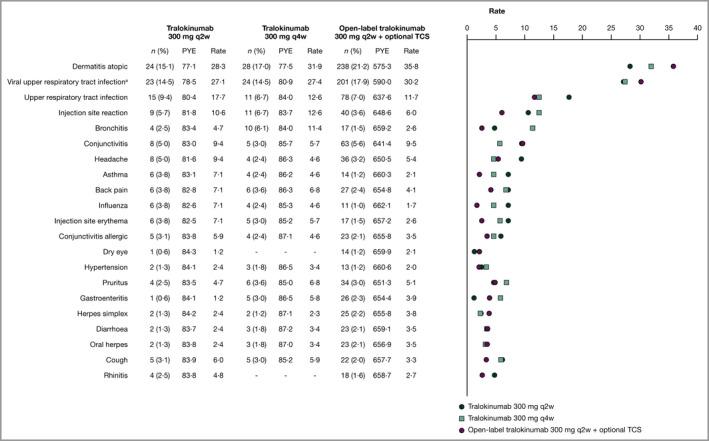
Across the AD population pool from five clinical trials, tralokinumab was well tolerated, with consistent safety findings during treatment of patients with moderate-to-severe AD. The safety profile during prolonged tralokinumab treatment was consistent with that during the initial treatment period; the frequency of events did not increase over time. What is already known about this topic? Tralokinumab is a fully human monoclonal antibody that specifically neutralizes interleukin-13, a key cytokine driving skin inflammation and epidermal barrier dysfunction in atopic dermatitis (AD). In clinical trials in moderate-to-severe AD, tralokinumab provided significant and early improvements in the extent and severity of AD and was well tolerated, with an overall safety profile comparable with placebo over 52 weeks. What does this study add? We report the frequency and rate of adverse events (AEs) from pooled observations of over 2000 patients from five phase II and phase III placebo-controlled clinical trials of tralokinumab in moderate-to-severe AD. During initial treatment up to 16 weeks, the frequencies of any AE and of serious AEs were similar for tralokinumab and placebo. AE rates did not increase with continued treatment up to 52 weeks. Common AEs occurring more frequently with tralokinumab vs. placebo were viral and upper respiratory tract infection, conjunctivitis and injection-site reaction. Some events occurred at a lower frequency and rate with tralokinumab vs. placebo, such as skin infections requiring systemic treatment, eczema herpeticum and opportunistic and serious infections. No clinically meaningful changes in mean laboratory measures were observed.
背景
特利鲁单抗是一种全人源单克隆抗体,能中和白细胞介素-13 的活性,白细胞介素-13 是特应性皮炎(AD)的关键致病驱动因素。包括中重度 AD 患者在内的长达 52 周的临床试验显示,特利鲁单抗具有疗效且耐受良好。
目的
描述特利鲁单抗治疗中重度 AD 的安全性概况。
方法
对特利鲁单抗治疗中重度 AD 的两项 II 期和三项 III 期安慰剂对照临床试验的汇总分析中评估了安全性和实验室检测指标(NCT02347176、NCT03562377、NCT03131648、NCT03160885、NCT03363854)。
结果
共有 2285 例患者在最初的 16 周治疗期内随机分组(1605 例特利鲁单抗,680 例安慰剂)。特利鲁单抗和安慰剂的任何不良事件(AE)发生率分别为 65.7%和 67.2%。相应的发生率分别为每 100 患者-年暴露(ep100PYE)640 次和 678 次;发生率比 1.0,95%置信区间(CI)0.9-1.1。特利鲁单抗组有 2.1%的患者发生严重 AE,安慰剂组有 2.8%(7.4 和 11.9 ep100PYE;发生率比 0.7,95%CI 0.4-1.2)。特利鲁单抗组比安慰剂组更常见且发生率和发生率更高的 AE 为:病毒性上呼吸道感染(15.7% vs. 12.2%;65.1 vs. 53.5 ep100PYE);上呼吸道感染(5.6% vs. 4.8%;20.8 vs. 18.5 ep100PYE);结膜炎(5.4% vs. 1.9%;21.0 vs. 6.9 ep100PYE);和注射部位反应(3.5% vs. 0.3%;22.9 vs. 4.0 ep100PYE)。一些在安全性方面引起关注的事件在特利鲁单抗组的发生率和发生率较低:需要全身治疗的皮肤感染(2.6% vs. 5.5%;9.7 vs. 22.8 ep100PYE);疱疹性湿疹(0.3% vs. 1.5%;1.2 vs. 5.2 ep100PYE);机会性感染(3.4% vs. 4.9%;13.0 vs. 21.3 ep100PYE)和严重感染(0.4% vs. 1.1%;1.3 vs. 3.7 ep100PYE)。AE 并未随持续维持和开放标签治疗而增加,包括常见或严重 AE 以及导致研究药物停药的 AE。治疗长达 1 年期间,未观察到平均实验室指标有临床意义的变化。
结论
在五项临床试验的 AD 患者人群中,特利鲁单抗具有良好的耐受性,在治疗中重度 AD 患者时具有一致的安全性。在延长的特利鲁单抗治疗期间的安全性与初始治疗期间一致;随着时间的推移,事件的频率没有增加。关于这个话题已经知道了什么?特利鲁单抗是一种全人源单克隆抗体,能特异性中和白细胞介素-13,白细胞介素-13 是特应性皮炎(AD)的关键细胞因子,可驱动皮肤炎症和表皮屏障功能障碍。在中重度 AD 的临床试验中,特利鲁单抗在 AD 的严重程度和范围方面提供了显著和早期的改善,并且具有良好的耐受性,在 52 周的时间内,其总体安全性与安慰剂相当。本研究增加了哪些新内容?我们报告了来自五项特利鲁单抗治疗中重度 AD 的 II 期和 III 期安慰剂对照临床试验的汇总观察中超过 2000 例患者的不良事件(AE)的频率和发生率。在最初的 16 周治疗期间,特利鲁单抗和安慰剂的任何 AE 和严重 AE 发生率相似。随着治疗时间延长至 52 周,AE 发生率并未增加。与特利鲁单抗相比,更常见的 AE 为病毒性和上呼吸道感染、结膜炎和注射部位反应。与特利鲁单抗相比,一些事件的发生率较低,如需要全身治疗的皮肤感染、疱疹性湿疹和机会性和严重感染。未观察到平均实验室指标有临床意义的变化。

 Zotero 插件