
新冠疫情后时代临床一线护士睡眠、疲劳与心理负荷的影响因素及相关性:一项多中心横断面研究
Factoring and correlation in sleep, fatigue and mental workload of clinical first-line nurses in the post-pandemic era of COVID-19: A multi-center cross-sectional study.
作者信息
Liu Yan, Xian Ji Shu, Wang Rui, Ma Kang, Li Fei, Wang Fei Long, Yang Xue, Mu Ning, Xu Kai, Quan Yu Lian, Wang Shi, Lai Ying, Yang Chuan Yan, Li Teng, Zhang Yanchun, Tan Binbin, Feng Hua, Chen Tu Nan, Wang Li Hua
机构信息
Southwest Hospital, Administrative Office, Army Medical University, Chongqing, China.
Department of Neurosurgery, Southwest Hospital, Army Medical University, Chongqing, China.
出版信息
Front Psychiatry. 2022 Aug 25;13:963419. doi: 10.3389/fpsyt.2022.963419. eCollection 2022.
BACKGROUND
A better understanding of the factors and their correlation with clinical first-line nurses' sleep, fatigue and mental workload is of great significance to personnel scheduling strategies and rapid responses to anti-pandemic tasks in the post-COVID-19 pandemic era.
OBJECTIVE
This multicenter and cross-sectional study aimed to investigate the nurses' sleep, fatigue and mental workload and contributing factors to each, and to determine the correlation among them.
METHODS
A total of 1,004 eligible nurses (46 males, 958 females) from three tertiary hospitals participated in this cluster sampling survey. The Questionnaire Star online tool was used to collect the sociodemographic and study target data: Sleep quality, fatigue, and mental workload. Multi-statistical methods were used for data analysis using SPSS 25.0 and Amos 21.0.
RESULTS
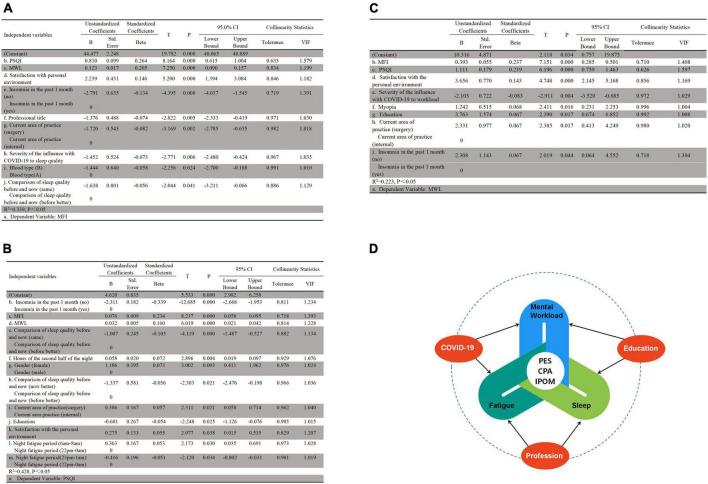
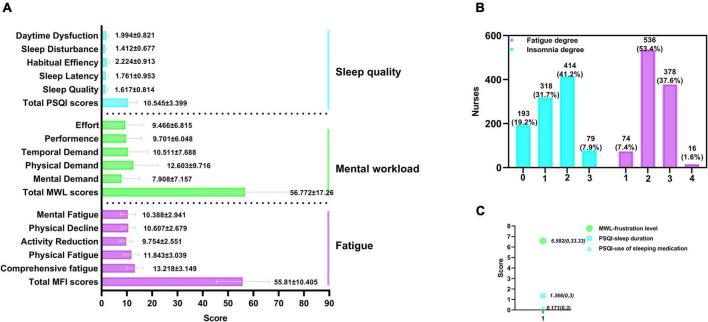
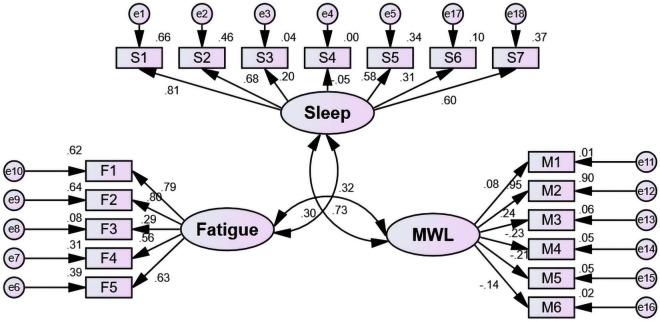
The average sleep quality score was 10.545 ± 3.399 (insomnia prevalence: 80.2%); the average fatigue score was 55.81 ± 10.405 (fatigue prevalence: 100%); and the weighted mental workload score was 56.772 ± 17.26. Poor sleep was associated with mental workload ( = 0.303, < 0.05) and fatigue ( = 0.727, < 0.01). Fatigue was associated with mental workload ( = 0.321, < 0.05). COVID-19 has caused both fatigue and mental workload. As 49% of nurses claimed their mental workload has been severely affected by COVID-19, while it has done slight harm to 68.9% of nurses' sleep quality.
CONCLUSION
In the post-COVID-19 pandemic era, the high prevalence of sleep disorders and fatigue emphasizes the importance of paying enough attention to the mental health of nurses in first-class tertiary hospitals. Efficient nursing strategies should focus on the interaction of sleep, fatigue and mental workload in clinical nurses. In that case, further research on solutions to the phenomenon stated above proves to be of great significance and necessity.
CLINICAL TRIAL REGISTRATION
[https://clinicaltrials.gov/], identifier [ChiCTR2100053133].
背景
更好地了解影响临床一线护士睡眠、疲劳和心理负荷的因素及其相关性,对于新冠疫情后时代的人员排班策略和对抗疫任务的快速响应具有重要意义。
目的
本多中心横断面研究旨在调查护士的睡眠、疲劳和心理负荷情况及其影响因素,并确定它们之间的相关性。
方法
来自三家三级医院的1004名符合条件的护士(46名男性,958名女性)参与了本次整群抽样调查。使用问卷星在线工具收集社会人口学和研究目标数据:睡眠质量、疲劳和心理负荷。采用多种统计方法,使用SPSS 25.0和Amos 21.0进行数据分析。
结果
睡眠质量平均得分为10.545±3.399(失眠患病率:80.2%);疲劳平均得分为55.81±10.405(疲劳患病率:100%);心理负荷加权得分为56.772±17.26。睡眠质量差与心理负荷(r = 0.303,P < 0.05)和疲劳(r = 0.727,P < 0.01)相关。疲劳与心理负荷相关(r = 0.321,P < 0.05)。新冠疫情导致了疲劳和心理负荷。49%的护士称其心理负荷受到新冠疫情的严重影响,而68.9%的护士的睡眠质量受到了轻微损害。
结论
在新冠疫情后时代,睡眠障碍和疲劳的高患病率凸显了充分关注一流三级医院护士心理健康的重要性。有效的护理策略应关注临床护士睡眠、疲劳和心理负荷之间的相互作用。因此,针对上述现象的解决方案的进一步研究具有重要意义和必要性。
临床试验注册

 Zotero 插件