
印度女性移民在新冠疫情后的恢复上面临比男性更大的障碍:来自一项面板研究的证据。
Indian female migrants face greater barriers to post-Covid recovery than males: Evidence from a panel study.
作者信息
Allard Jenna, Jagnani Maulik, Neggers Yusuf, Pande Rohini, Schaner Simone, Moore Charity Troyer
机构信息
Inclusion Economics at Yale University and MacMillan Center, Yale University; 34 Hillhouse Avenue, New Haven, CT 06511, USA.
Department of Economics, University of Colorado Denver, 1380 Lawrence Street, Denver, CO 80204, USA.
出版信息
EClinicalMedicine. 2022 Nov;53:101631. doi: 10.1016/j.eclinm.2022.101631. Epub 2022 Sep 6.
BACKGROUND
India's abrupt nationwide Covid-19 lockdown internally displaced millions of migrant workers, who returned to distant rural homes. Documenting their labour market reintegration is a critical aspect of understanding the economic costs of the pandemic for India's poor. In a country marked by low and declining female labour force participation, identifying gender gaps in labour market reintegration - as a marker of both women's vulnerability at times of crisis and setbacks in women's agency - is especially important. Yet most studies of pandemic-displaced internal migrants in India are small, rely on highly selected convenience samples, and lack a gender focus.
METHODS
Beginning in April 2020 we enrolled roughly 4,600 displaced migrants who had, during the lockdown, returned to two of India's poorest states into a cohort observational study which tracked enrolees through July 2021. Survey respondents were randomly selected from the states' official databases of return migrants, with sampling stratified by state and gender. 85% of enrolees (3950) were working prior to the pandemic. Our difference-in-means analysis uses three survey waves conducted in July to August 2020, January to March 2021, and June to July 2021. Our analysis focuses on a balanced panel of 1780 previously working enrolees (the 45% of respondents present in the first wave that also participated in the subsequent two survey rounds). Primary outcomes of interest include labour market re-entry, earnings, and measures of vulnerability by gender.
FINDINGS
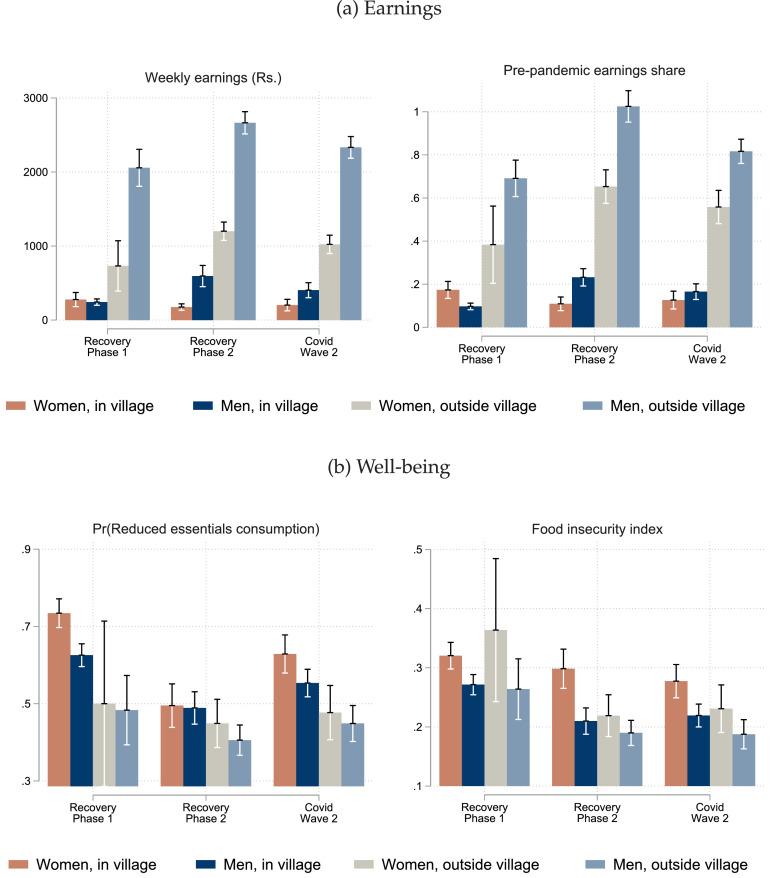
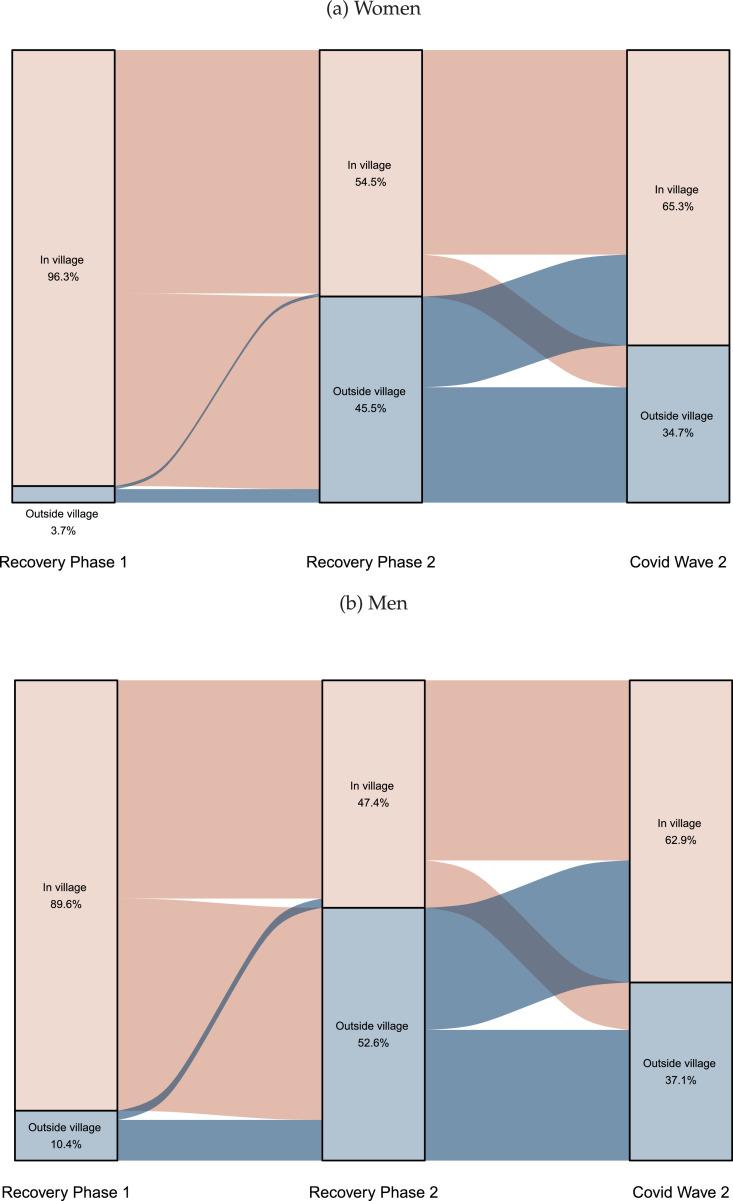
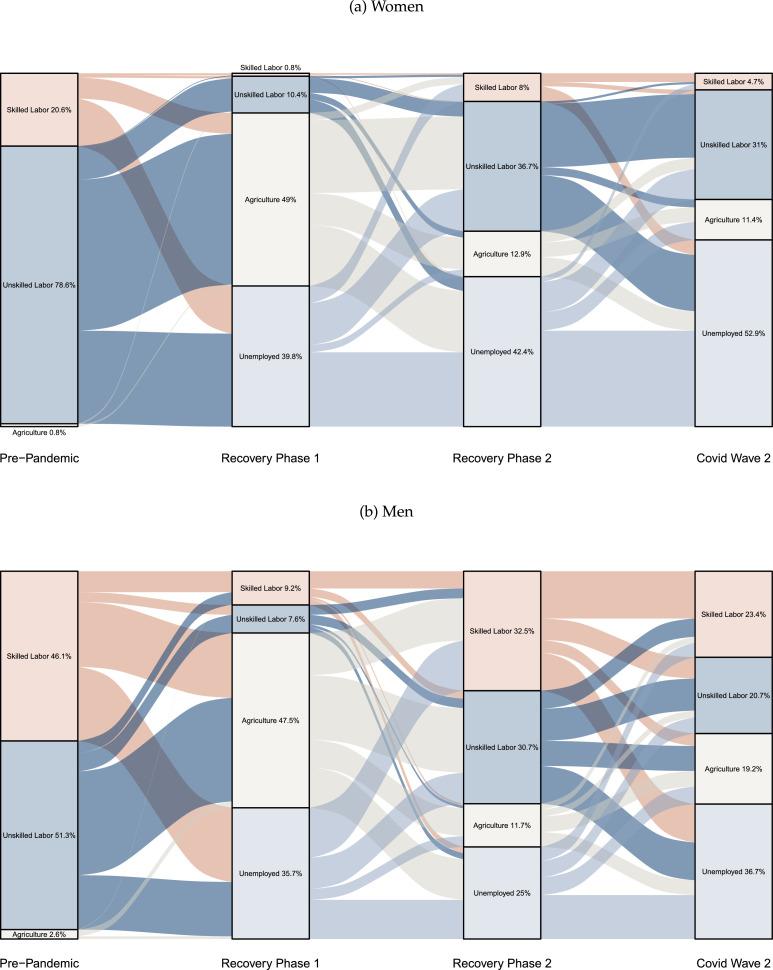
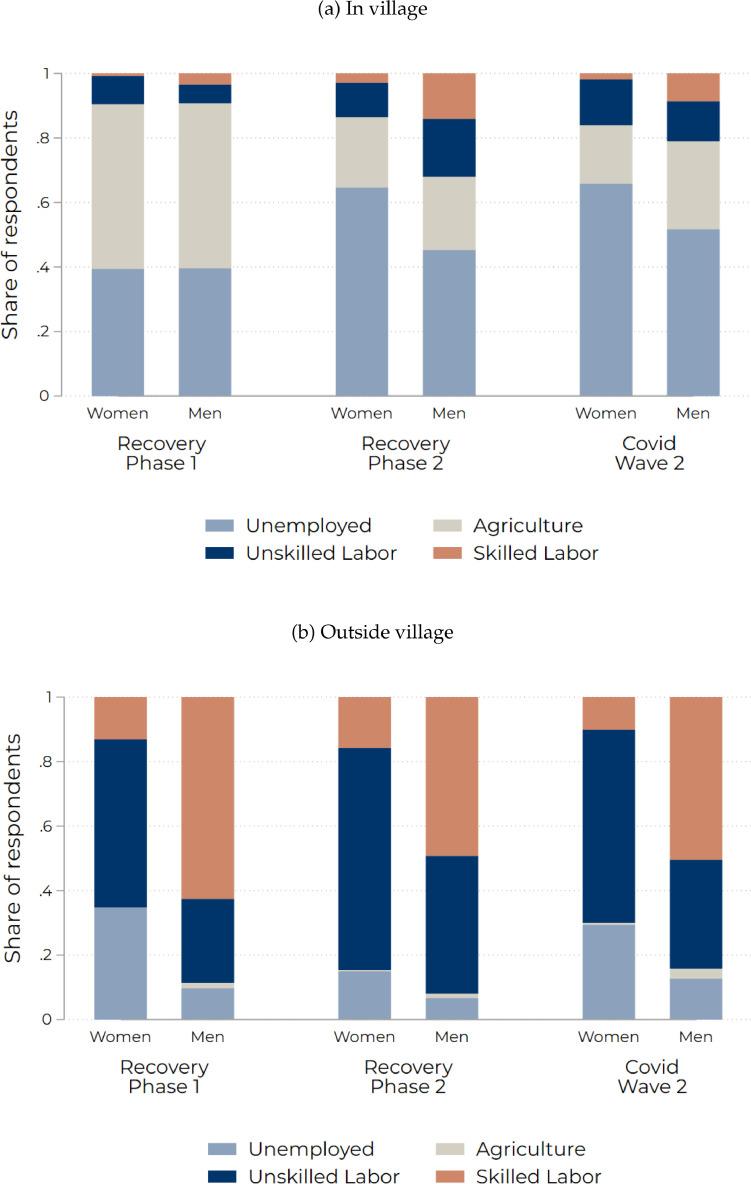
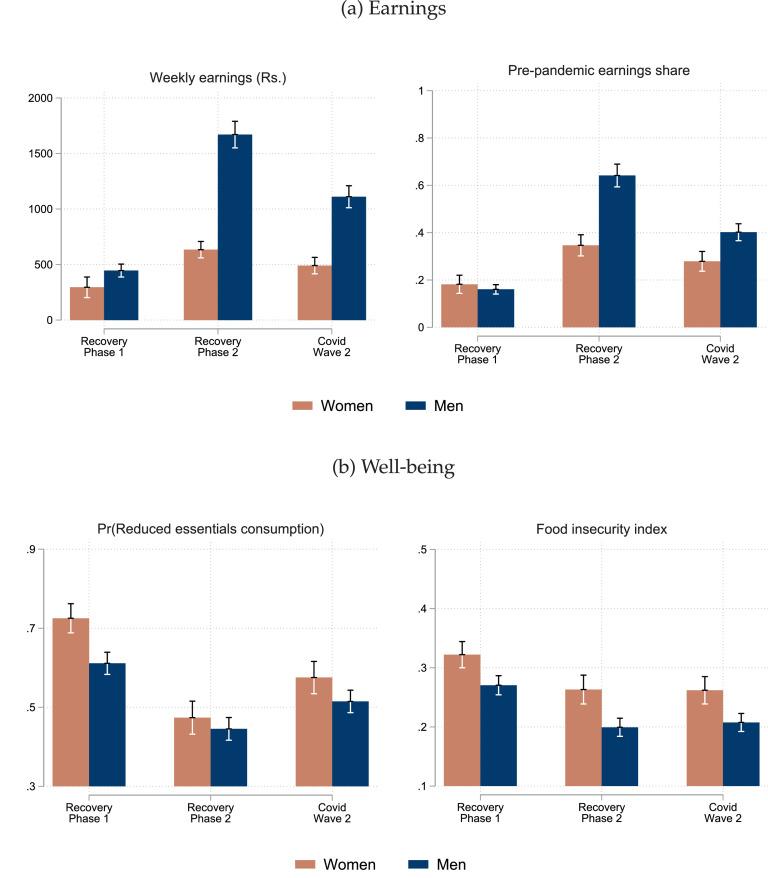
Before the March 2020 national lockdown, 98% (95% CI [97,99]) of workers were employed in the non-agricultural sector. In July 2020, one month after the end of the lockdown, incomes plummet, with both genders earning roughly 17% of their pre-pandemic incomes. 47% (95% CI [45,49]) were employed in agriculture and 37% (95% CI [35,39]) were unemployed. Remigration is critical to regaining income - by January 2021, male re-migrants report earnings on par with their pre-pandemic incomes, while men remaining in rural areas earn only 23% (95% CI [19,27]) of their pre-pandemic income. Remigration benefits women to a lesser extent - female re-migrants regain no more than 65% (95% CI [57,73]) of their pre-pandemic income at any point. Yet men and women struggle to remigrate throughout - by July 2021, no more than 63% (95% CI [60,66]) of men and 55% (95% CI [51,59]) of women had left their home villages since returning. Gender gaps in income recovery largely reflect higher rates of unemployment among women, both among those remaining in rural areas (9 percentage points (95% CI [6,13]) higher than men across waves) and among those who remigrate (13 percentage points (95% CI [9,17]) higher than men across waves). As a result, we observe gender gaps in well-being: relative to male counterparts, women across waves were 7 percentage points (95% CI [4,10]) more likely to report reduced consumption of essential goods and fared 6 percentage points (95% CI [4,7]) worse on a food insecurity index.
INTERPRETATION
Displaced migrants of both genders experienced persistent hardships for over a year after the initial pandemic lockdown. Women fare worse, driven by both lower rates of remigration and lower rates of labour market re-entry both inside and outside home villages. Some women drop out of the labour force entirely, but most unemployed report seeking or being available to work. In short, pandemic-induced labour market displacement has far-reaching, long-term consequences for migrant workers, especially women.
FUNDING
Survey costs were funded by research grants from IZA/FCDO Gender, Growth, and Labour Markets in Low Income Countries Programme, J-PAL Jobs and Opportunity Initiative, and the Evidence-based Measures of Empowerment for Research on Gender Equality (EMERGE) program at University of California San Diego.
背景
印度突然实施的全国性新冠疫情封锁致使数百万农民工在国内流离失所,他们返回了遥远的农村家乡。记录他们重新融入劳动力市场的情况,是理解疫情给印度贫困人口带来的经济成本的关键一环。在一个女性劳动力参与率较低且呈下降趋势的国家,识别劳动力市场重新融入方面的性别差距——作为危机时期女性脆弱性以及女性能动性受挫的一个标志——尤为重要。然而,印度大多数关于因疫情而流离失所的国内移民的研究规模较小,依赖高度选择性的便利样本,且缺乏性别视角。
方法
从2020年4月开始,我们将约4600名在封锁期间返回印度两个最贫困邦的流离失所移民纳入一项队列观察研究,该研究对参与者进行跟踪直至2021年7月。调查对象是从各邦返乡移民的官方数据库中随机选取的,抽样按邦和性别分层。85%的参与者(3950人)在疫情前有工作。我们的均值差异分析使用了2020年7月至8月、2021年1月至3月以及2021年6月至7月进行的三轮调查。我们的分析聚焦于1780名之前有工作的参与者组成的平衡样本(占第一轮调查中参与后续两轮调查的受访者的45%)。感兴趣的主要结果包括劳动力市场重新进入情况、收入以及按性别划分的脆弱性指标。
研究结果
在2020年3月全国封锁之前,98%(95%置信区间[97,99])的工人受雇于非农业部门。在2020年7月,即封锁结束后的一个月,收入暴跌,男女收入均约为疫情前收入的17%。47%(95%置信区间[45,49])的人从事农业工作,37%(95%置信区间[35,39])的人失业。再次迁移对于恢复收入至关重要——到2021年1月,男性再次迁移者报告的收入与疫情前收入相当,而留在农村地区的男性收入仅为疫情前收入的23%(95%置信区间[19,27])。再次迁移对女性的益处较小——女性再次迁移者在任何时候恢复的收入都不超过疫情前收入的65%(95%置信区间[57,73])。然而,男女在整个过程中都难以再次迁移——到2021年7月,自返乡以来,不超过63%(95%置信区间[60,66]) 的男性和55%(95%置信区间[51,59])的女性离开了他们的家乡村庄。收入恢复方面的性别差距在很大程度上反映了女性失业率较高,无论是留在农村地区的女性(各轮调查中比男性高9个百分点(95%置信区间[6,13]))还是再次迁移的女性(各轮调查中比男性高13个百分点(95%置信区间[9,17]))。因此,我们观察到了幸福感方面的性别差距:与男性相比,各轮调查中的女性报告基本商品消费减少的可能性高7个百分点(95%置信区间[4,10]),在粮食不安全指数上的表现差6个百分点(95%置信区间[4,7])。
解读
在最初的疫情封锁之后,男女流离失所的移民在一年多的时间里都经历了持续的艰难困苦。女性的情况更糟,这是由于她们再次迁移的比例较低以及在农村内外劳动力市场重新进入的比例较低。一些女性完全退出了劳动力市场,但大多数失业者表示正在寻找工作或有工作意愿。简而言之,疫情引发的劳动力市场流离失所对农民工,尤其是女性,产生了深远的长期影响。
资金来源
调查费用由以下研究资助提供:IZA/FCDO低收入国家性别、增长与劳动力市场项目、J-PAL就业与机会倡议以及加利福尼亚大学圣地亚哥分校的基于证据的性别平等研究赋权措施(EMERGE)项目。
 Zotero 插件