
生物电阻抗分析(BIA)方程用于估计老年人四肢骨骼肌质量的外部验证:偏差分析和校正因子推导以达成一致性的重要性。
External validation of BIA equations to estimate appendicular skeletal muscle mass in older adults: Importance of the bias analysis and derivation of correction factors to achieve agreement.
作者信息
Cáñez-Ríos María, Esparza-Romero Julián, González-Arellanes Rogelio, Ramírez-Torres Maribel, Figueroa-Pesqueira Guadalupe, Urquidez-Romero René, Rangel-Peniche Diana Beatriz, Alemán-Mateo Heliodoro
机构信息
Coordinación de Nutrición, Centro de Investigación en Alimentación y Desarrollo (CIAD), A.C., Hermosillo, Mexico.
Departamento de Ciencias de la Salud, Instituto de Ciencias Biomédicas, Universidad Autónoma de Ciudad Juárez, Ciudad Juárez, Mexico.
出版信息
Front Nutr. 2022 Aug 25;9:951346. doi: 10.3389/fnut.2022.951346. eCollection 2022.
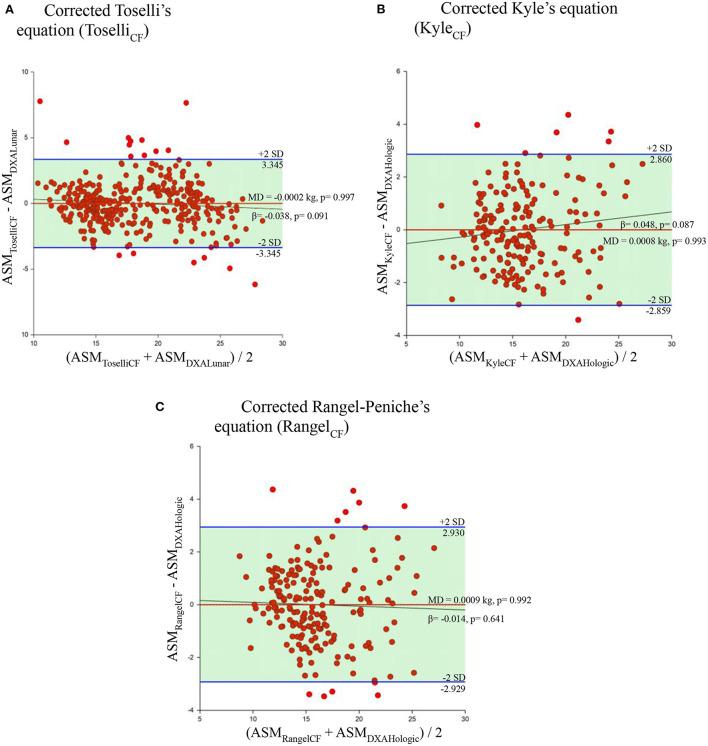
There are several equations based on bioelectrical impedance analysis (BIA) to estimate with high precision appendicular skeletal muscle mass (ASM). However, most of the external validation studies have reported that these equations are inaccurate or biased when applied to different populations. Furthermore, none of the published studies has derived correction factors (CFs) in samples of community-dwelling older adults, and none of the published studies have assessed the influence of the dual-energy X-ray absorptiometry (DXA) model on the validation process. This study assessed the agreement between six BIA equations and DXA to estimate ASM in non-Caucasian older adults considering the DXA model and proposed a CF for three of them. This analysis included 547 non-institutionalized subjects over 60 years old from the northwest of Mexico who were physically independent and without cognitive impairment: 192 subjects were measured using DXA Hologic, while 355 were measured by DXA Lunar. The agreement between each of the equations and DXA was tested considering the DXA model used as a reference method for the design of each equation, using the Bland and Altman procedure, a paired test, and simple linear regression as objective tests. This process was supported by the differences reported in the literature and confirmed in a subsample of 70 subjects measured with both models. Only six published BIA equations were included. The results showed that four equations overestimated ASM, and two underestimated it ( < 0.001, 95% CI for Kim's equation:-5.86--5.45, Toselli's:-0.51--0.15, Kyle's: 1.43-1.84, Rangel-Peniche's: 0.32-0.74, Sergi's: 0.83-1.23, and Yoshida's: 4.16-4.63 kg). However, Toselli's, Kyle's and Rangel-Peniche's equations were the only ones that complied with having a homogeneous bias. This finding allowed the derivation of CFs, which consisted of subtracting or adding the mean of the differences from the original equation. After estimating ASM applying the respective CF, the new ASM estimations showed no significant bias and its distribution remained homogeneously distributed. Therefore, agreement with DXA in the sample of non-Caucasian was achieved. Adding valid CFs to some BIA equations allowed to reduce the bias of some equations, making them valid to estimate the mean values of ASM at group level.
有几个基于生物电阻抗分析(BIA)的方程可高精度估算四肢骨骼肌质量(ASM)。然而,大多数外部验证研究报告称,这些方程应用于不同人群时不准确或存在偏差。此外,已发表的研究均未在社区居住的老年人样本中得出校正因子(CFs),也没有已发表的研究评估双能X线吸收法(DXA)模型对验证过程的影响。本研究评估了六个BIA方程与DXA在估算非白种老年人ASM方面的一致性,考虑了DXA模型,并为其中三个方程提出了CF。该分析纳入了547名来自墨西哥西北部的60岁以上非机构化受试者,他们身体独立且无认知障碍:192名受试者使用Hologic DXA进行测量,355名受试者使用Lunar DXA进行测量。将每个方程与DXA之间的一致性按照用于设计每个方程的DXA模型作为参考方法进行检验,采用Bland和Altman程序、配对t检验以及简单线性回归作为客观检验方法。这一过程得到了文献报道差异的支持,并在70名同时使用两种模型测量的受试者子样本中得到证实。仅纳入了六个已发表的BIA方程。结果显示,四个方程高估了ASM,两个方程低估了ASM(P<0.001,Kim方程的95%CI为:-5.86--5.45,Toselli方程的为:-0.51--0.15,Kyle方程的为:1.43 - 1.84,Rangel - Peniche方程的为:0.32 - 0.74,Sergi方程的为:0.83 - 1.23,Yoshida方程的为:4.16 - 4.63 kg)。然而,Toselli方程、Kyle方程和Rangel - Peniche方程是仅有的具有均匀偏差的方程。这一发现使得能够得出CFs,即从原始方程中减去或加上差异的均值。应用各自的CF估算ASM后,新的ASM估算值显示无显著偏差,其分布仍保持均匀分布。因此,在非白种人样本中实现了与DXA的一致性。在一些BIA方程中添加有效的CFs可减少某些方程的偏差,使其能够有效估算群体水平上ASM的均值。


 Zotero 插件