
在饮食中限制含硫氨基酸期间,大脑中的蛋白质合成速率保持不变,但骨骼肌中的蛋白质合成速率降低。
Rates of protein synthesis are maintained in brain but reduced in skeletal muscle during dietary sulfur amino acid restriction.
作者信息
Martinez Wenceslao, Zhang Qian, Linden Melissa A, Schacher Nate, Darvish Sanna, Mirek Emily T, Levy Jordan L, Jonsson William O, Anthony Tracy G, Hamilton Karyn L
机构信息
Department of Health and Exercise Science, Colorado State University, Fort Collins, CO, United States.
Department of Nutritional Sciences and the New Jersey Institute for Food, Nutrition and Health, Rutgers University, New Brunswick, NB, United States.
出版信息
Front Aging. 2022 Aug 24;3:975129. doi: 10.3389/fragi.2022.975129. eCollection 2022.
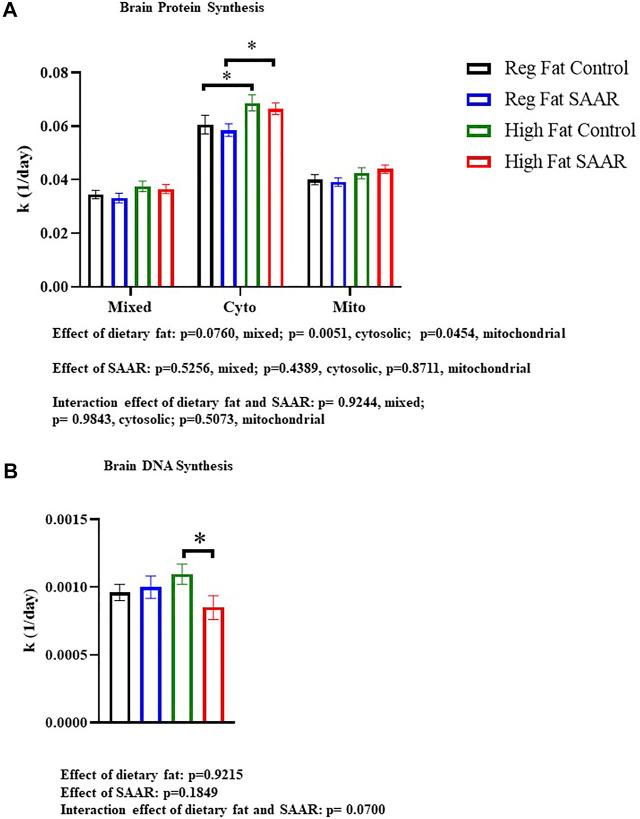
Dietary interventions such as sulfur amino acid restriction (SAAR) target multiple drivers of aging, and show promise for preventing or delaying the onset of chronic diseases. SAAR promotes metabolic health and longevity in laboratory animals. The effects of SAAR on proteostasis remain relatively unexplored. We previously reported that SAAR promotes mitochondrial proteostatic maintenance, despite suppression of global protein synthesis, in two peripheral tissues, the liver and skeletal muscle. However, the brain, a tissue vulnerable to age-related neurodegenerative diseases due to the loss of proteostasis, has not been thoroughly studied. Therefore, we sought to reveal proteostatic responses in the brains of mice fed SAAR for 35 days. Here, we demonstrate that male C57Bl/6J mice fed two levels of SAAR maintained rates of protein synthesis in all sub-cellular fractions of the pre-frontal cortex. In comparison, rates of skeletal muscle protein synthesis in SAAR fed mice were slower than control-fed mice. To gain mechanistic insight, we examined several key nutrient/energy sensitive signaling proteins: AMP-activated protein kinase (AMPK), eukaryotic initiation factor 2 (eIF2), and ribosomal protein S6 (rpS6). SAAR had minimal to modest effects on the total abundance and phosphorylation of these proteins in both tissues. Our results indicate that the pre-frontal cortex in brain is resistant to perturbations in protein synthesis in mice fed SAAR, unlike skeletal muscle, which had a reduction in global protein synthesis. The results from this study demonstrate that proteostatic control in brain is of higher priority than skeletal muscle during dietary SAAR.
饮食干预措施,如限制含硫氨基酸(SAAR),针对多种衰老驱动因素,有望预防或延缓慢性疾病的发生。SAAR可促进实验动物的代谢健康和延长寿命。SAAR对蛋白质稳态的影响仍相对未被探索。我们之前报道过,尽管整体蛋白质合成受到抑制,但SAAR在肝脏和骨骼肌这两个外周组织中促进线粒体蛋白质稳态维持。然而,大脑作为一个因蛋白质稳态丧失而易患与年龄相关神经退行性疾病的组织,尚未得到充分研究。因此,我们试图揭示喂食SAAR 35天的小鼠大脑中的蛋白质稳态反应。在此,我们证明,喂食两种水平SAAR的雄性C57Bl/6J小鼠在前额叶皮质的所有亚细胞组分中维持蛋白质合成速率。相比之下,喂食SAAR的小鼠骨骼肌蛋白质合成速率比对照喂养的小鼠慢。为了深入了解机制,我们检测了几种关键的营养/能量敏感信号蛋白:AMP激活的蛋白激酶(AMPK)、真核起始因子2(eIF2)和核糖体蛋白S6(rpS6)。SAAR对这两种组织中这些蛋白质的总丰度和磷酸化的影响微乎其微或适中。我们的结果表明,与骨骼肌不同,喂食SAAR的小鼠大脑中的前额叶皮质对蛋白质合成的扰动具有抗性,骨骼肌的整体蛋白质合成有所减少。这项研究的结果表明,在饮食SAAR期间,大脑中的蛋白质稳态控制比骨骼肌具有更高的优先级。



 Zotero 插件