
血小板通过抑制 T 细胞脱颗粒中干扰素-γ的产生与 T-SPOT.TB 假阴性结果相关。
Platelets correlate with false negative T-SPOT.TB results by inhibiting interferon-γ production in T cells degranulation.
机构信息
Department of Clinical Laboratory, The First Affiliated Hospital of Nanchang University, Nanchang, Jiangxi, China.
出版信息
Front Cell Infect Microbiol. 2022 Aug 24;12:937416. doi: 10.3389/fcimb.2022.937416. eCollection 2022.
BACKGROUND
T-SPOT.TB (T-SPOT) is widely used for the detection of Mycobacterium tuberculosis infection by detecting interferon-gamma (IFN-γ) release in T lymphocytes. This assay is performed on peripheral blood mononuclear cells (PBMCs) separated by Ficoll density gradient centrifugation, which often contain some residual platelets. Here, we investigated the impact of platelets on T-SPOT assay and related mechanisms.
METHODS
The correlation between platelet count, platelet-to-lymphocyte ratio (PLR), and the IFN-γ secreting T cells (ISCs) in positive control wells of T-SPOT assay were retrospectively analyzed. T-SPOT assay was performed with un-treated PBMCs, platelets-removed PBMCs, and platelets-enriched PBMCs to confirm the impact of platelets on T-SPOT assay. The activation of platelets and their impact on IFN-γ production in T cells were detected by flow cytometry (FCM). Platelets and T cells were cultured in a mixed culture system and co-culture system respectively, followed by detection of the frequencies of IFN-γ-producing T cells and the levels of intracellular IFN-γ in T cells by FCM. Moreover, the effect of platelet releasate on the T-SPOT assay was evaluated.
RESULTS
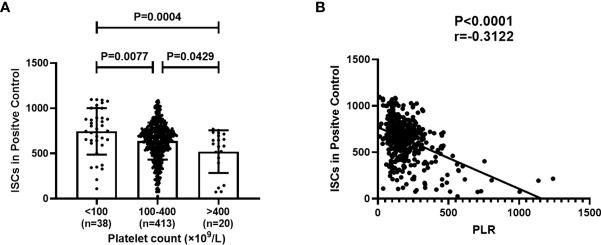
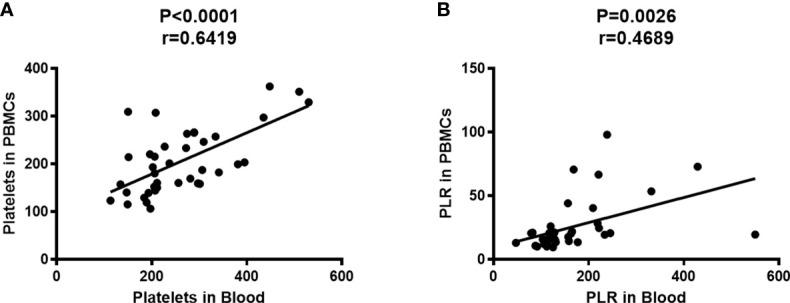
The ISCs in positive control wells of the T-SPOT assay showed a significant decrease with the increase in platelet count. The PLR of the peripheral blood were negatively correlated with the ISCs in positive control wells of the T-SPOT assay. Removal or enrichment of platelets significantly increased or decreased the ISCs and the positive rate of T-SPOT. Inhibition of platelet activation significantly increased the ISCs of T-SPOT. The frequencies of IFN-γ-producing T cells in PBMCs and the levels of intracellular IFN-γ were significantly reduced by the addition of platelets, both in the mixed culture system and the co-culture system. Platelet releasate upon thrombin activation significantly decreased the ISCs of T-SPOT.
CONCLUSIONS
Platelets correlate with negative T-SPOT results by inhibiting IFN-γ production in T cells degranulation.
背景
T-SPOT.TB(T-SPOT)通过检测 T 淋巴细胞中干扰素-γ(IFN-γ)的释放来广泛用于检测结核分枝杆菌感染。该检测是在通过菲可密度梯度离心分离的外周血单个核细胞(PBMC)上进行的,其中常含有一些残留的血小板。在这里,我们研究了血小板对 T-SPOT 检测的影响及其相关机制。
方法
回顾性分析 T-SPOT 检测阳性对照孔中血小板计数、血小板与淋巴细胞比值(PLR)与 IFN-γ分泌 T 细胞(ISCs)的相关性。采用未经处理的 PBMCs、去除血小板的 PBMCs 和富含血小板的 PBMCs 进行 T-SPOT 检测,以确认血小板对 T-SPOT 检测的影响。采用流式细胞术(FCM)检测血小板的激活及其对 T 细胞 IFN-γ产生的影响。将血小板和 T 细胞分别在混合培养系统和共培养系统中培养,然后通过 FCM 检测 IFN-γ分泌 T 细胞的频率和 T 细胞内 IFN-γ的水平。此外,还评估了血小板释放物对 T-SPOT 检测的影响。
结果
T-SPOT 检测阳性对照孔中的 ISCs 随血小板计数的增加而显著减少。外周血 PLR 与 T-SPOT 检测阳性对照孔中的 ISCs 呈负相关。去除或富集血小板可显著增加或减少 ISCs 和 T-SPOT 的阳性率。抑制血小板激活可显著增加 T-SPOT 的 ISCs。在混合培养系统和共培养系统中,加入血小板均可显著降低 PBMCs 中 IFN-γ分泌 T 细胞的频率和 T 细胞内 IFN-γ的水平。经凝血酶激活的血小板释放物可显著降低 T-SPOT 的 ISCs。
结论
血小板通过抑制 T 细胞脱颗粒中 IFN-γ的产生与 T-SPOT 检测的阴性结果相关。



 Zotero 插件