
对 47,XXY 克氏综合征患者进行睾丸精子提取术(TESE)的延迟并不会降低精子获取率,且当 TESE 结果为阳性时,抗缪勒管激素(AMH)水平更高。
Delaying testicular sperm extraction in 47,XXY Klinefelter patients does not impair the sperm retrieval rate, and AMH levels are higher when TESE is positive.
机构信息
Service de Médecine de la Reproduction, Hôpital Femme Mère Enfant, Hospices Civils de Lyon, Bron, France.
Université Claude Bernard Lyon 1, Lyon, France.
出版信息
Hum Reprod. 2022 Oct 31;37(11):2518-2531. doi: 10.1093/humrep/deac203.
STUDY QUESTION
Should testicular sperm extraction (TESE) in non-mosaic 47,XXY Klinefelter syndrome (KS) patients be performed soon after puberty or could it be delayed until adulthood?
SUMMARY ANSWER
The difference in sperm retrieval rate (SRR) in TESE was not significant between the 'Young' (15-22 years old) cohort and the 'Adult' (23-43 years old) cohort of non-mosaic KS patients recruited prospectively in parallel.
WHAT IS KNOWN ALREADY
Several studies have tried to define predictive factors for TESE outcome in non-mosaic KS patients, with very heterogeneous results. Some authors have found that age was a pejorative factor and recommended performing TESE soon after puberty. To date, no predictive factors have been unanimously recognized to guide clinicians in deciding to perform TESE in azoospermic KS patients.
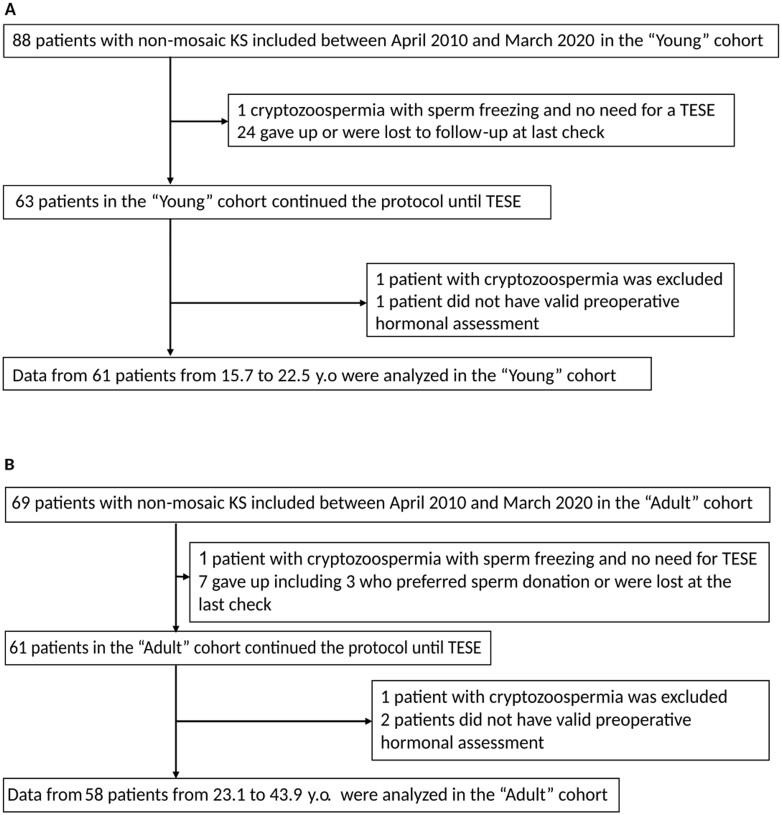
STUDY DESIGN, SIZE, DURATION: Two cohorts (Young: 15-22 years old; Adult: 23-43 years old) were included prospectively in parallel. A total of 157 non-mosaic 47,XXY KS patients were included between 2010 and 2020 in the reproductive medicine department of the University Hospital of Lyon, France. However 31 patients gave up before TESE, four had cryptozoospermia and three did not have a valid hormone assessment; these were excluded from this study.
PARTICIPANTS/MATERIALS, SETTING, METHODS: Data for 119 patients (61 Young and 58 Adult) were analyzed. All of these patients had clinical, hormonal and seminal evaluation before conventional TESE (c-TESE).
MAIN RESULTS AND THE ROLE OF CHANCE
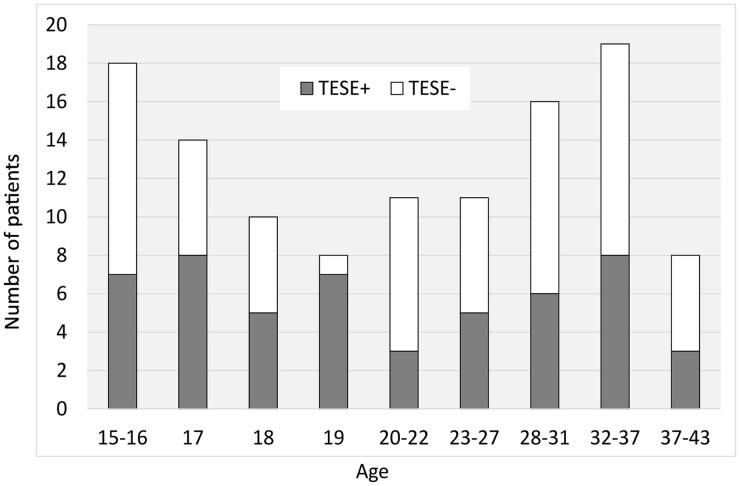
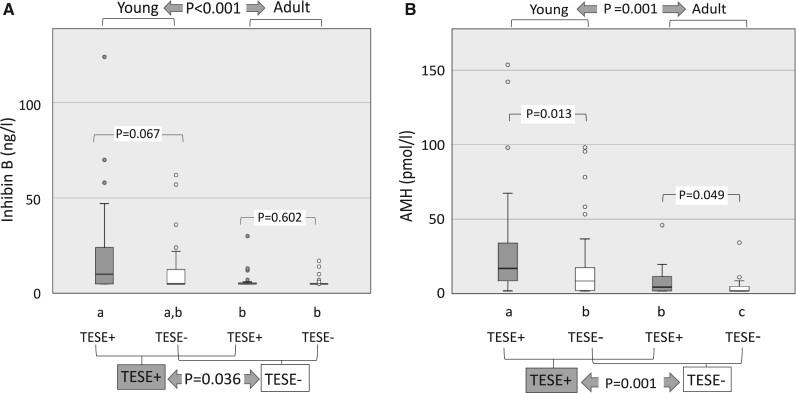
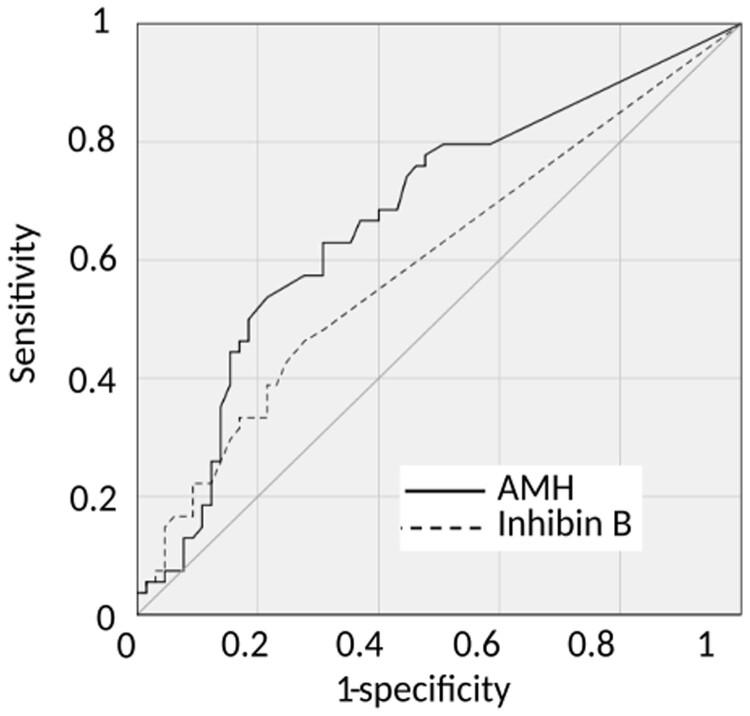
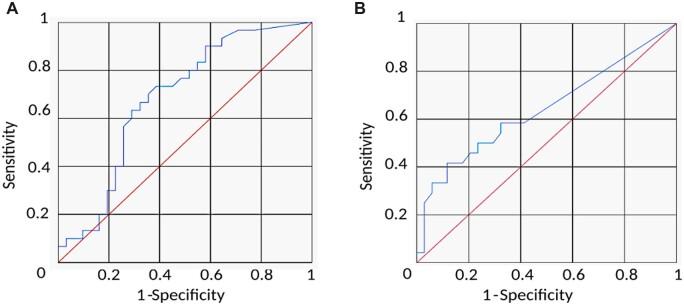
The global SRR was 45.4%. SRRs were not significantly different between the two age groups: Young SRR=49.2%, Adult SRR = 41.4%; P = 0.393. Anti-Müllerian hormone (AMH) and inhibin B were significantly higher in the Young group (AMH: P = 0.001, Inhibin B: P < 0.001), and also higher in patients with a positive TESE than in those with a negative TESE (AMH: P = 0.001, Inhibin B: P = 0.036). The other factors did not differ between age groups or according to TESE outcome. AMH had a better predictive value than inhibin B. SRRs were significantly higher in the upper quartile of AMH plasma levels than in the lower quartile (or in cases with AMH plasma level below the quantification limit): 67.7% versus 28.9% in the whole population (P = 0.001), 60% versus 20% in the Young group (P = 0.025) and 71.4% versus 33.3% in the Adult group (P = 0.018).
LIMITATIONS, REASONS FOR CAUTION: c-TESE was performed in the whole study; we cannot rule out the possibility of different results if microsurgical TESE had been performed. Because of the limited sensitivity of inhibin B and AMH assays, a large number of patients had values lower than the quantification limits, preventing the definition a threshold below which negative TESE can be predicted.
WIDER IMPLICATIONS OF THE FINDINGS
In contrast to some studies, age did not appear as a pejorative factor when comparing patients 15-22 and 23-44 years of age. Improved accuracy of inhibin B and AMH assays in the future might still allow discrimination of patients with persistent foci of spermatogenesis and guide clinician decision-making and patient information.
STUDY FUNDING/COMPETING INTEREST(S): The study was supported by a grant from the French Ministry of Health D50621 (Programme Hospitalier de Recherche Clinical Régional 2008). The authors have no conflicts of interest to disclose.
TRIAL REGISTRATION NUMBER
NCT01918280.
研究问题
非嵌合 47,XXY 克氏综合征(KS)患者是否应在青春期后不久进行睾丸精子提取(TESE),还是可以延迟到成年后进行?
总结答案
前瞻性平行招募的非嵌合 KS 患者“年轻”(15-22 岁)队列和“成年”(23-43 岁)队列之间,TESE 的精子回收率(SRR)差异无统计学意义。
已知情况
已有多项研究试图确定非嵌合 KS 患者 TESE 结果的预测因素,但结果非常不一致。一些作者发现年龄是一个不利因素,并建议在青春期后不久进行 TESE。迄今为止,还没有一致公认的预测因素来指导临床医生决定在非精子症 KS 患者中进行 TESE。
研究设计、大小和持续时间:前瞻性平行纳入两个队列(年轻:15-22 岁;成年:23-43 岁)。2010 年至 2020 年期间,法国里昂大学附属医院生殖医学科共纳入 157 例非嵌合 47,XXY KS 患者。然而,31 例患者在 TESE 前放弃,4 例患者有隐匿性少精子症,3 例患者没有有效的激素评估;这些患者被排除在本研究之外。
参与者/材料、设置、方法:对 119 例患者(61 例年轻和 58 例成年)的数据进行了分析。所有这些患者在进行常规 TESE(c-TESE)之前均进行了临床、激素和精液评估。
主要结果和机会的作用
总 SRR 为 45.4%。两组之间的 SRR 无显著差异:年轻组 SRR=49.2%,成年组 SRR=41.4%;P=0.393。年轻组 AMH(P=0.001)和抑制素 B 明显更高(P<0.001),且阳性 TESE 患者也高于阴性 TESE 患者(AMH:P=0.001,抑制素 B:P=0.036)。其他因素在年龄组之间或根据 TESE 结果没有差异。AMH 比抑制素 B 具有更好的预测价值。AMH 血浆水平较高的四分位数患者的 SRR 明显高于较低四分位数(或 AMH 血浆水平低于定量限的病例):全人群中 67.7%比 28.9%(P=0.001),年轻组中 60%比 20%(P=0.025),成年组中 71.4%比 33.3%(P=0.018)。
局限性、谨慎原因:在整个研究中进行了 c-TESE;如果进行了显微外科 TESE,我们不能排除结果不同的可能性。由于抑制素 B 和 AMH 检测的灵敏度有限,大量患者的检测值低于定量限,无法确定低于 TESE 阴性预测的阈值。
研究结果的更广泛意义
与一些研究相反,当比较 15-22 岁和 23-44 岁的患者时,年龄似乎不是一个不利因素。未来抑制素 B 和 AMH 检测的准确性提高,可能仍然可以区分具有持续生精灶的患者,并指导临床医生的决策和患者信息。
研究资助/利益冲突:该研究得到法国卫生部 D50621 拨款(2008 年区域医院研究临床方案)的支持。作者没有利益冲突需要披露。
临床试验注册
NCT01918280。

 Zotero 插件