
中国和印度的多病种共病流行状况和二元疾病模式:系统综述。
Community prevalence and dyad disease pattern of multimorbidity in China and India: a systematic review.
机构信息
School of Public Health, Harbin Medical University, Harbin, Heilongjiang, China.
The George Institute for Global Health, China, Beijing, China.
出版信息
BMJ Glob Health. 2022 Sep;7(9). doi: 10.1136/bmjgh-2022-008880.
BACKGROUND
Driven by the increasing life expectancy, China and India, the two most populous countries in the world are experiencing a rising burden of multimorbidity. This study aims to explore community prevalence and dyad patterns of multimorbidity in China and India.
METHODS
We conducted a systematic review of five English and Chinese electronic databases. Studies involving adults 18 years or older at a community level, which reported multimorbidity prevalence and/or patterns were included. A modified Newcastle-Ottawa Scale was used for quality assessment. Despite large heterogeneity among reported studies, a systematic synthesis of the results was conducted to report the findings.
RESULTS
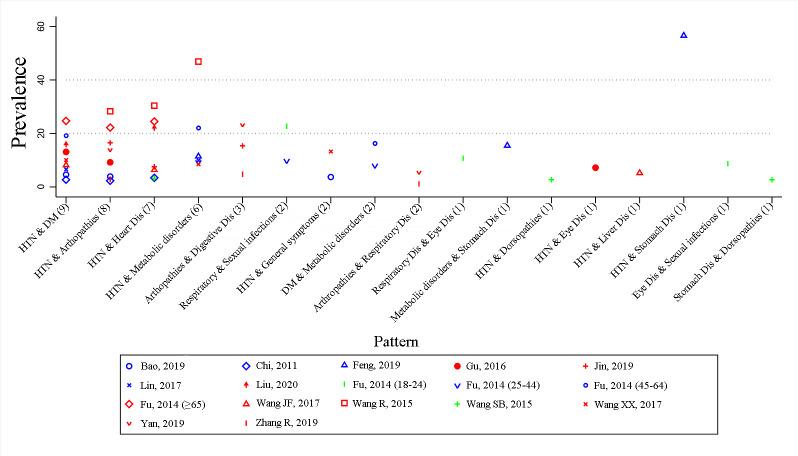
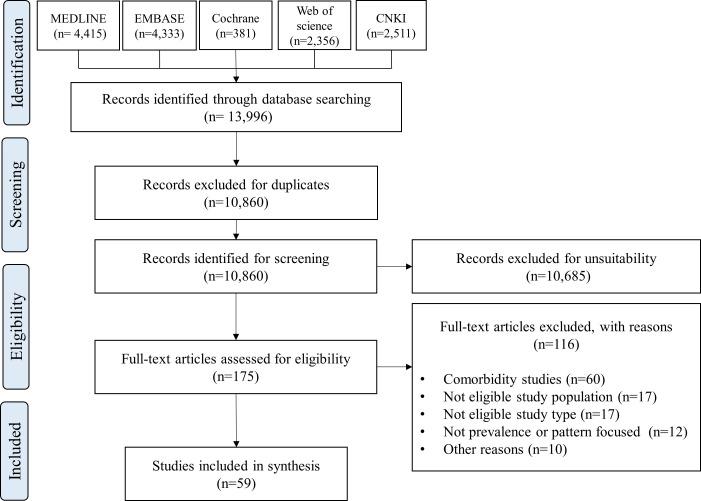
From 13 996 studies retrieved, 59 studies met the inclusion criteria (46 in China, 9 in India and 4 in both). The median prevalence of multimorbidity was 30.7% (IQR 17.1, 49.4), ranging from 1.5% to 90.5%. There was a large difference in multimorbidity prevalence between China and India, with median prevalence being 36.1% (IQR 19.6, 48.8) and 28.3% (IQR 8.9, 56.8), respectively. Among 27 studies that reported age-specific prevalence, 19 studies found multimorbidity prevalence increased with age, while 8 studies observed a paradoxical reduction in the oldest age group. Of the 34 studies that reported sex-specific prevalence, 86% (n=32) observed a higher prevalence in females. The most common multimorbidity patterns from 14 studies included hypertensive diseases combined with diabetes mellitus, arthropathies, heart diseases and metabolic disorders. All included studies were rated as fair or poor quality.
CONCLUSION
Multimorbidity is highly prevalent in China and India with hypertensive diseases and other comorbidities being the most observed patterns. The overall quality of the studies was low and there was a lack of representative samples in most studies. Large epidemiology studies, using a common definition of multimorbidity and national representative samples, with sex disaggregation are needed in both countries.
PROSPERO REGISTRATION NUMBER
CRD42020176774.
背景
随着预期寿命的增加,世界上人口最多的两个国家中国和印度正面临着多种疾病负担不断增加的问题。本研究旨在探讨中国和印度社区中多种疾病的流行情况和二元模式。
方法
我们对五个英文和中文电子数据库进行了系统回顾。纳入了以社区为基础、报告多种疾病流行率和/或模式的成年人(18 岁及以上)的研究。使用改良的纽卡斯尔-渥太华量表进行质量评估。尽管报告的研究之间存在很大的异质性,但我们仍对结果进行了系统综合,以报告研究结果。
结果
从检索到的 13996 项研究中,有 59 项研究符合纳入标准(46 项在中国,9 项在印度,4 项在中国和印度同时进行)。多种疾病的患病率中位数为 30.7%(IQR 17.1,49.4),范围为 1.5%至 90.5%。中国和印度的多种疾病患病率存在很大差异,患病率中位数分别为 36.1%(IQR 19.6,48.8)和 28.3%(IQR 8.9,56.8)。在报告特定年龄患病率的 27 项研究中,有 19 项研究发现多种疾病的患病率随年龄增长而增加,而 8 项研究观察到在最年长的年龄组中患病率呈反抛物线下降。在报告性别特异性患病率的 34 项研究中,86%(n=32)观察到女性患病率更高。从 14 项研究中报告的最常见的多种疾病模式包括高血压疾病合并糖尿病、关节病、心脏病和代谢紊乱。所有纳入的研究均被评为中等或低质量。
结论
中国和印度的多种疾病患病率很高,高血压疾病和其他合并症是最常见的模式。大多数研究的总体质量较低,且大多数研究缺乏代表性样本。两国都需要进行大型的流行病学研究,使用多种疾病的共同定义和全国代表性样本,并进行性别细分。
PROSPERO 注册号:CRD42020176774。


 Zotero 插件