
抑制SHP2可增强雷公藤红素对结直肠癌的生长抑制作用。
SHP2 inhibition improves celastrol-induced growth suppression of colorectal cancer.
作者信息
Zhang Linxi, Hu Xuefei, Meng Qingying, Li Ye, Shen Hao, Fu Yating, Zhang Fan, Chen Jiahui, Zhang Wei, Chang Wenjun, Pan Yamin
机构信息
Department of Navy Environmental and Occupational Health, Faculty of Naval Medicine, Navy Military Medical University, Shanghai, China.
Department of Digestive Endoscopy, Shuguang Hospital, Shanghai University of Traditional Chinese Medicine, Shanghai, China.
出版信息
Front Pharmacol. 2022 Sep 1;13:929087. doi: 10.3389/fphar.2022.929087. eCollection 2022.
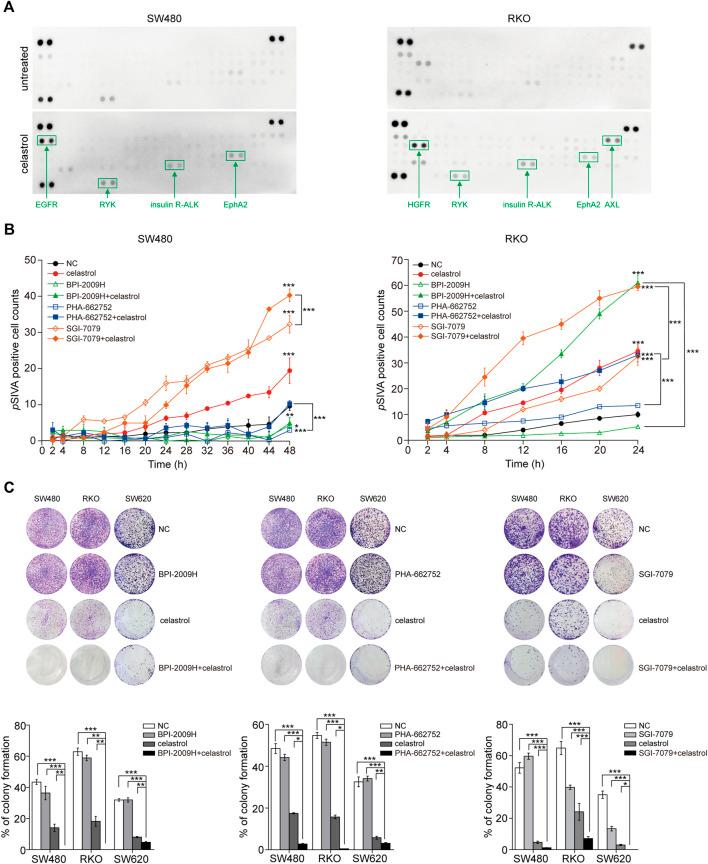
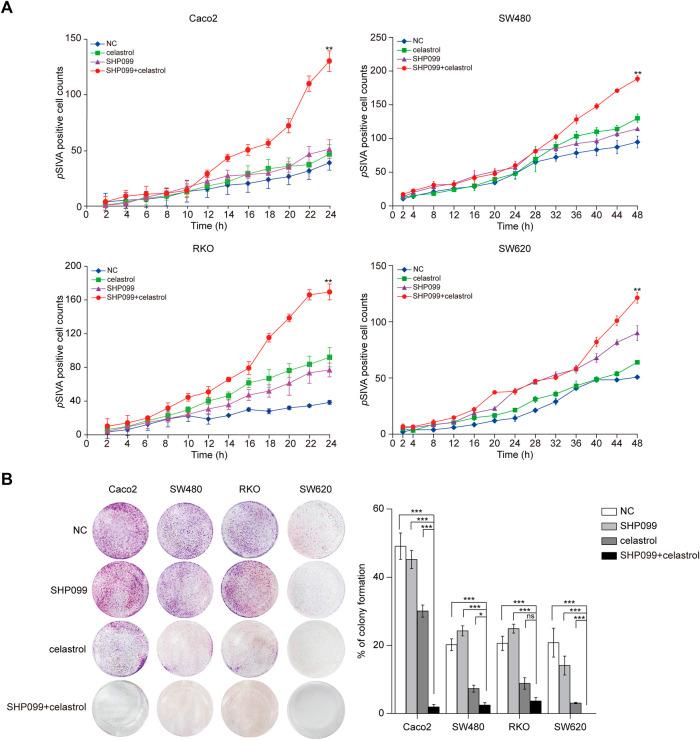
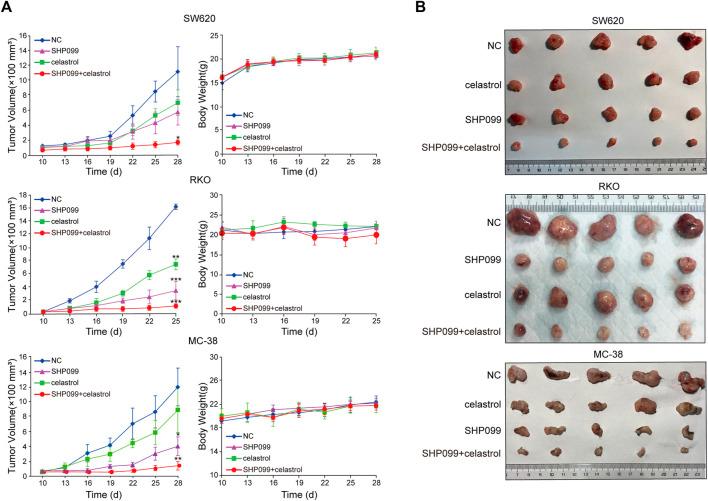
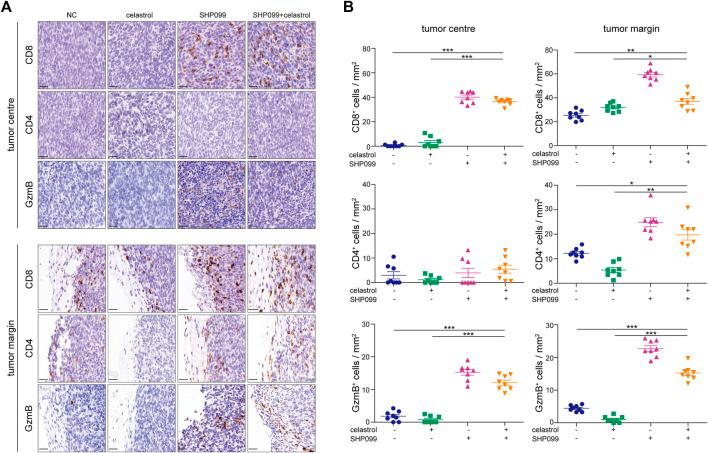
This study aimed to explore novel targets for celastrol sensitization in colorectal cancer (CRC) based on differentially regulated signals in response to high- or low-dose celastrol. Targeting signals were investigated using Western blotting or phosphorylated receptor tyrosine kinase (RTK) arrays. Corresponding inhibitors for the signals were individually combined with low-dose celastrol for the assessment of combined anti-CRC effects, based on proliferation, apoptosis, colony assays, and xenograft models. The potential mechanism for the combination of celastrol and SHP2 inhibition was further examined. Low-dose celastrol (<1 µM) did not effectively suppress AKT and ERK signals in CRC cells compared to high-dose celastrol (>1 µM). However, when combined with an AKT or ERK inhibitor, low-dose celastrol could cooperatively suppress CRC proliferation. Furthermore, failed AKT or ERK inhibition by low-dose celastrol may be due to reactivated RTK-SHP2 signaling with negative feedback. The combination of celastrol and the SHP2 inhibitor resulted in greatly reduced AKT and ERK signals, as well as greater inhibition of CRC growth than celastrol alone. Moreover, the mechanism underlying combination suppression was also involved in the activation of immune cell infiltration (mainly for CD8 cells) in CRC tissues. Failure to inhibit RTK-SHP2-AKT/ERK signaling contributed to the lack of CRC growth suppression by low-dose celastrol. However, the combination of celastrol and the SHP2 inhibitor resulted in synergistic inhibition of CRC growth and provided a promising therapeutic target.
本研究旨在基于高剂量或低剂量雷公藤红素响应中差异调节的信号,探索结直肠癌(CRC)中雷公藤红素致敏的新靶点。使用蛋白质免疫印迹法或磷酸化受体酪氨酸激酶(RTK)阵列研究靶向信号。基于增殖、凋亡、集落分析和异种移植模型,将相应信号的抑制剂分别与低剂量雷公藤红素联合使用,以评估联合抗CRC效应。进一步研究了雷公藤红素与SHP2抑制联合作用的潜在机制。与高剂量雷公藤红素(>1µM)相比,低剂量雷公藤红素(<1µM)不能有效抑制CRC细胞中的AKT和ERK信号。然而,当与AKT或ERK抑制剂联合使用时,低剂量雷公藤红素可协同抑制CRC增殖。此外,低剂量雷公藤红素未能抑制AKT或ERK可能是由于RTK-SHP2信号通过负反馈重新激活。雷公藤红素与SHP2抑制剂的联合使用导致AKT和ERK信号大幅降低,并且比单独使用雷公藤红素对CRC生长的抑制作用更强。此外,联合抑制的潜在机制还涉及CRC组织中免疫细胞浸润(主要是CD8细胞)的激活。未能抑制RTK-SHP2-AKT/ERK信号导致低剂量雷公藤红素对CRC生长缺乏抑制作用。然而,雷公藤红素与SHP2抑制剂的联合使用导致对CRC生长的协同抑制,并提供了一个有前景的治疗靶点。



 Zotero 插件