
个人和性边界:智障人士的体验。
Personal and sexual boundaries: the experiences of people with intellectual disabilities.
机构信息
Department of Neurohabilitation/Oslo University Hospital, Kirkeveien 166, 0450, Oslo, Norway.
Division of Clinical Neuroscience. Department of Research and Innovation, Oslo University Hospital, Oslo, Norway.
出版信息
BMC Public Health. 2022 Sep 19;22(1):1773. doi: 10.1186/s12889-022-14181-x.
BACKGROUND
Previous research shows that people with intellectual disabilities have less knowledge about sexual health and are more vulnerable to victimisation. In cases of sexual abuse, they are likely to encounter the criminal justice system as vulnerable witnesses. Several challenges arise when people with intellectual disabilities are in communication with the criminal justice system. We aimed to explore the perceptions, experiences and knowledge of people with intellectual disabilities regarding personal and sexual boundaries in order to identify factors relevant for preventing sexual abuse, to develop future studies.
METHOD
The study had a qualitative design. Data were collected from seven people with mild intellectual disabilities (25-40 years; 2 men, five women) through one-to-one interviews in specialised health care services for people with intellectual disabilities (SHCS). The participants lived alone, in group homes and with their families. Many received professional support services. Data were analysed using thematic analysis.
RESULTS
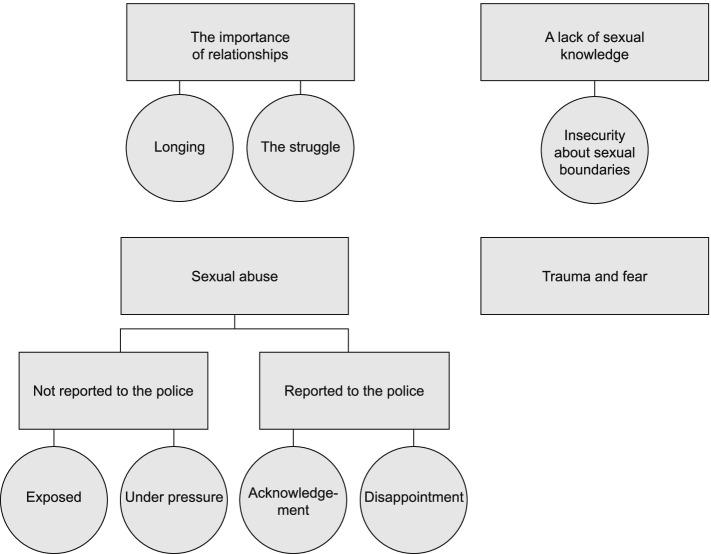
The interviews identified that the participants want to be in romantic relationships and that some, consider sex to be unimportant. Many of them have had trouble finding someone to have a romantic relationship with. The participants were unsure about sexual consent related to sexual activity, though many could explain the concept of consent in other contexts. Many participants reported that they had experienced sexual abuse, including online sexual abuse. Those participants who had reported the sexual abuse had positive experiences obtaining assistance from the criminal justice system. The participants who had experienced sexual abuse reported trauma and fear related to their experiences.
CONCLUSION
This study highlights the need for information about sexually abusive relationships, risks online and ways to get help. More attention should be given to the impact of trauma, police and mental health treatment following sexual abuse against people with intellectual disabilities.
背景
先前的研究表明,智障人士对性健康的了解较少,更容易成为受害者。在性虐待案件中,他们可能会作为弱势证人遭遇刑事司法系统。智障人士与刑事司法系统进行沟通时会遇到几个挑战。我们旨在探索智障人士对个人和性边界的认知、经验和知识,以便确定与预防性虐待相关的因素,为未来的研究奠定基础。
方法
本研究采用定性设计。通过在智障人士专门医疗保健服务机构(SHCS)中对七名轻度智障人士(25-40 岁;2 名男性,5 名女性)进行一对一访谈,收集数据。参与者独自居住,也有人居住在集体住所或与家人一起居住。他们中的许多人接受专业的支持服务。使用主题分析对数据进行分析。
结果
访谈确定参与者希望建立浪漫关系,且有些人认为性不重要。他们中的许多人在寻找浪漫关系的伴侣方面遇到了困难。参与者不确定与性活动相关的性同意,但许多人可以在其他情况下解释同意的概念。许多参与者报告曾遭受过性虐待,包括网络性虐待。那些报告过性虐待的参与者在从刑事司法系统获得帮助方面有着积极的体验。曾遭受过性虐待的参与者报告了与他们的经历相关的创伤和恐惧。
结论
本研究强调了需要提供有关性虐待关系、在线风险和求助途径的信息。应更加关注创伤、警察和性虐待后心理健康治疗对智障人士的影响。
 Zotero 插件