
新冠病毒感染后疲劳与认知障碍:一项前瞻性多中心研究。
Fatigue and cognitive impairment after COVID-19: A prospective multicentre study.
作者信息
Hartung Tim J, Neumann Christian, Bahmer Thomas, Chaplinskaya-Sobol Irina, Endres Matthias, Geritz Johanna, Haeusler Karl Georg, Heuschmann Peter U, Hildesheim Hanna, Hinz Andreas, Hopff Sina, Horn Anna, Krawczak Michael, Krist Lilian, Kudelka Jennifer, Lieb Wolfgang, Maetzler Corina, Mehnert-Theuerkauf Anja, Montellano Felipe A, Morbach Caroline, Schmidt Sein, Schreiber Stefan, Steigerwald Flo, Störk Stefan, Maetzler Walter, Finke Carsten
机构信息
Klinik und Hochschulambulanz für Neurologie, Charité-Universitätsmedizin Berlin, Berlin, Germany.
Department of Medical Psychology and Medical Sociology, University Medical Center Leipzig, Leipzig, Germany.
出版信息
EClinicalMedicine. 2022 Sep 17;53:101651. doi: 10.1016/j.eclinm.2022.101651. eCollection 2022 Nov.
BACKGROUND
Reliable estimates of frequency, severity and associated factors of both fatigue and cognitive impairment after COVID-19 are needed. Also, it is not clear whether the two are distinct sequelae of COVID-19 or part of the same syndrome."
METHODS
In this prospective multicentre study, frequency of post-COVID fatigue and cognitive impairment were assessed in = 969 patients (535 [55%] female) ≥6 months after SARS-CoV-2 infection with the FACIT-Fatigue scale (cut-off ≤30) and Montreal Cognitive Assessment (≤25 mild, ≤17 moderate impairment) between November 15, 2020 and September 29, 2021 at University Medical Center Schleswig-Holstein, Campus Kiel and University Hospital Würzburg in Germany. 969 matched non-COVID controls were drawn from a pre-pandemic, randomised, Germany-wide population survey which also included the FACIT-Fatigue scale. Associated sociodemographic, comorbid, clinical, psychosocial factors and laboratory markers were identified with univariate and multivariable linear regression models.
FINDINGS
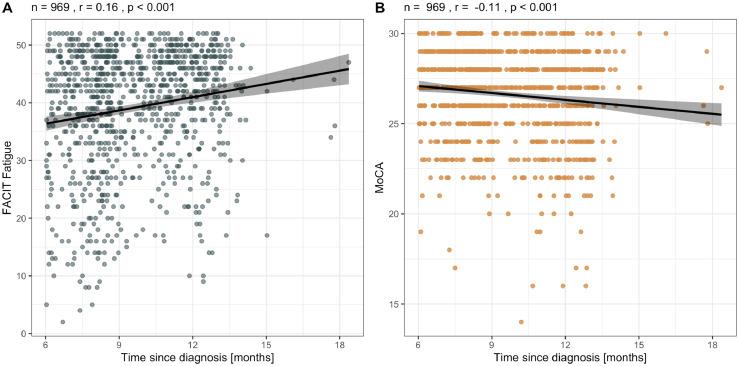
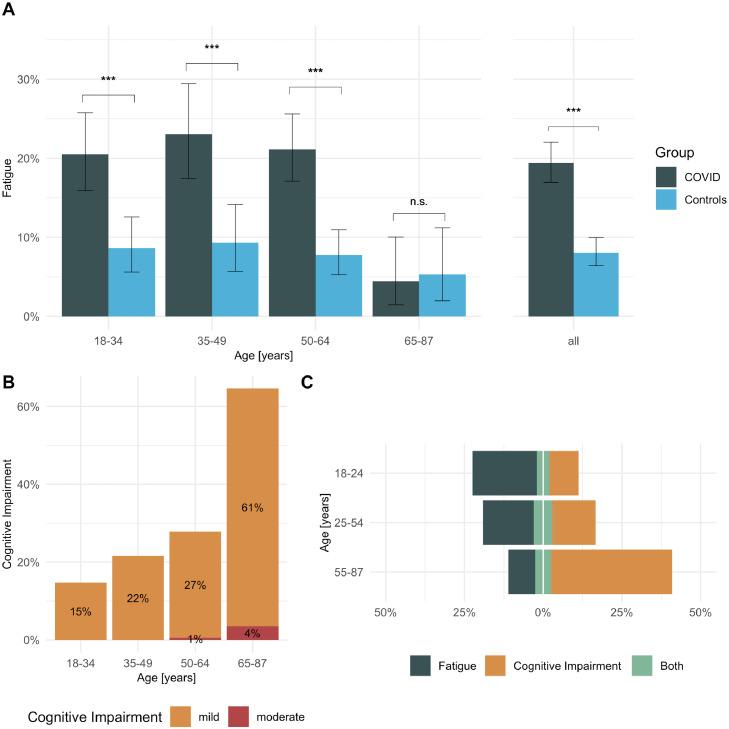
On average 9 months after infection, 19% of patients had clinically relevant fatigue, compared to 8% of matched non-COVID controls ( < 0.001). Factors associated with fatigue were female gender, younger age, history of depression and the number of acute COVID symptoms. Among acute COVID symptoms, altered consciousness, dizziness and myalgia were most strongly associated with long-term fatigue. Moreover, 26% of patients had mild and 1% had moderate cognitive impairment. Factors associated with cognitive impairment were older age, male gender, shorter education and a history of neuropsychiatric disease. There was no significant correlation between fatigue and cognitive impairment and only 5% of patients suffered from both conditions.
INTERPRETATION
Fatigue and cognitive impairment are two common, but distinct sequelae of COVID-19 with potentially separate pathophysiological pathways.
FUNDING
German Federal Ministry of Education and Research (BMBF).
背景
需要对新冠病毒感染后疲劳和认知障碍的频率、严重程度及相关因素进行可靠估计。此外,目前尚不清楚这两者是新冠病毒感染的不同后遗症,还是同一综合征的一部分。
方法
在这项前瞻性多中心研究中,于2020年11月15日至2021年9月29日期间,在德国基尔大学医学中心施勒斯维希-霍尔斯坦校区和维尔茨堡大学医院,使用FACIT疲劳量表(临界值≤30)和蒙特利尔认知评估量表(≤25为轻度,≤17为中度损伤),对969例(535例[55%]为女性)感染新冠病毒至少6个月后的患者进行新冠病毒感染后疲劳和认知障碍的频率评估。从疫情前一项德国范围内的随机人群调查中选取969例匹配的非新冠对照,该调查也包括FACIT疲劳量表。采用单变量和多变量线性回归模型确定相关的社会人口统计学、合并症、临床、心理社会因素及实验室指标。
研究结果
感染后平均9个月时,19%的患者存在临床相关疲劳,而匹配的非新冠对照中这一比例为8%(P<0.001)。与疲劳相关的因素包括女性、较年轻年龄、抑郁病史及急性新冠症状的数量。在急性新冠症状中,意识改变、头晕和肌痛与长期疲劳的关联最为密切。此外,26%的患者存在轻度认知障碍,1%的患者存在中度认知障碍。与认知障碍相关的因素包括年龄较大、男性、教育程度较低及神经精神疾病史。疲劳与认知障碍之间无显著相关性,仅有5%的患者同时患有这两种疾病。
解读
疲劳和认知障碍是新冠病毒感染后两种常见但不同的后遗症,可能具有各自独立的病理生理途径。
资金来源
德国联邦教育与研究部(BMBF)
 Zotero 插件