
医护人员中,mRNA 疫苗接种与未接种者,初次感染奥密克戎(B.1.1.529)BA.1 或 前奥密克戎 SARS-CoV-2 对 BA.2 再感染的保护作用:一项病例对照研究。
Protection against omicron (B.1.1.529) BA.2 reinfection conferred by primary omicron BA.1 or pre-omicron SARS-CoV-2 infection among health-care workers with and without mRNA vaccination: a test-negative case-control study.
机构信息
Biological Risks Unit, Institut National de Santé Publique du Québec, Quebec, QC, Canada; Social and Preventive Medicine Department, Faculty of Medicine, Laval University, Quebec, QC, Canada.
Communicable Diseases and Immunization Services, BC Centre for Disease Control, Vancouver, BC, Canada.
出版信息
Lancet Infect Dis. 2023 Jan;23(1):45-55. doi: 10.1016/S1473-3099(22)00578-3. Epub 2022 Sep 21.
BACKGROUND
There is a paucity of data on vaccine-induced or infection-induced (hybrid or natural) immunity against omicron (B.1.1.529) subvariant BA.2, particularly in comparing the effects of previous SARS-CoV-2 infection with the same or different genetic lineage. We aimed to estimate the protection against omicron BA.2 associated with previous primary infection with omicron BA.1 or pre-omicron SARS-CoV-2, among health-care workers with and without mRNA vaccination.
METHODS
We conducted a test-negative case-control study among health-care workers aged 18 years or older who were tested for SARS-CoV-2 in Quebec, Canada, between March 27 and June 4, 2022, when BA.2 was the predominant variant and was presumptively diagnosed with a positive test result. We identified cases (positive test during study period) and controls (negative test during study period) using the provincial laboratory database that records all nucleic acid amplification testing for SARS-CoV-2 in Quebec, and used the provincial immunisation registry to determine vaccination status. Logistic regression models compared the likelihood of BA.2 infection or reinfection (second positive test ≥30 days after primary infection) among health-care workers who had previous primary infection and none to three mRNA vaccine doses versus unvaccinated health-care workers with no primary infection.
FINDINGS
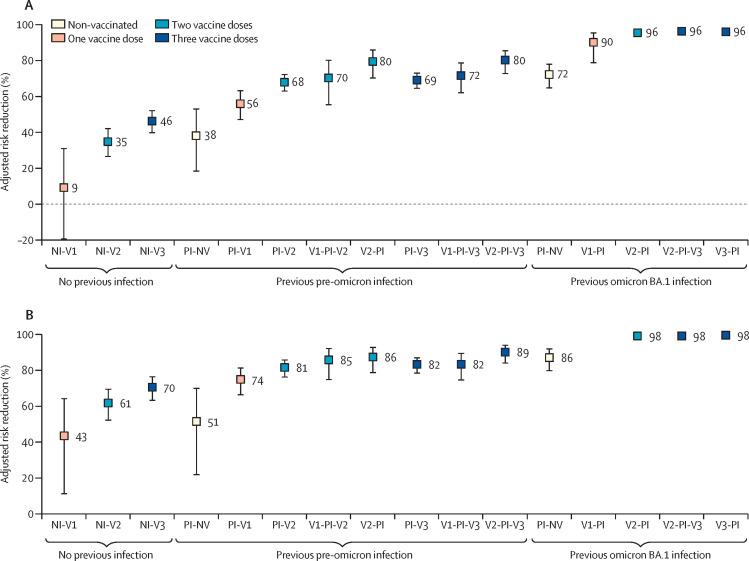
258 007 SARS-CoV-2 tests were done during the study period. Among those with a valid result and that met the inclusion criteria, there were 37 732 presumed BA.2 cases (2521 [6·7%] reinfections following pre-omicron primary infection and 659 [1·7%] reinfections following BA.1 primary infection) and 73 507 controls (7360 [10·0%] had pre-omicron primary infection and 12 315 [16·8%] had BA.1 primary infection). Pre-omicron primary infection was associated with a 38% (95% CI 19-53) reduction in BA.2 infection risk, with higher BA.2 protection among those who had also received one (56%, 95% CI 47-63), two (69%, 64-73), or three (70%, 66-74) mRNA vaccine doses. Omicron BA.1 primary infection was associated with greater protection against BA.2 infection (risk reduction of 72%, 95% CI 65-78), and protection was increased further among those who had received two doses of mRNA vaccine (96%, 95-96), but was not improved with a third dose (96%, 95-97).
INTERPRETATION
Health-care workers who had received two doses of mRNA vaccine and had previous BA.1 infection were subsequently well protected for a prolonged period against BA.2 reinfection, with a third vaccine dose conferring no improvement to that hybrid protection. If this protection also pertains to future variants, there might be limited benefit from additional vaccine doses for people with hybrid immunity, depending on timing and variant.
FUNDING
Ministère de la Santé et des Services Sociaux du Québec.
背景
目前关于奥密克戎(B.1.1.529)亚变体 BA.2 引起的疫苗诱导或感染诱导(混合或自然)免疫的数据很少,特别是在比较先前的 SARS-CoV-2 感染与相同或不同遗传谱系的感染效果时。我们旨在估计先前感染奥密克戎 BA.1 或前奥密克戎 SARS-CoV-2 的医护人员中,mRNA 疫苗接种对奥密克戎 BA.2 相关的保护作用。
方法
我们在加拿大魁北克省进行了一项针对年龄在 18 岁或以上的医护人员的病例对照研究,这些医护人员在 2022 年 3 月 27 日至 6 月 4 日期间接受了 SARS-CoV-2 检测,当时 BA.2 是主要变体,并且假定阳性检测结果是阳性的。我们使用省级实验室数据库来确定病例(研究期间的阳性检测结果)和对照(研究期间的阴性检测结果),该数据库记录了魁北克省所有的 SARS-CoV-2 核酸扩增检测,并用省级免疫登记处来确定疫苗接种状况。使用逻辑回归模型比较了先前感染过奥密克戎且接种了 0 至 3 剂 mRNA 疫苗的医护人员与未感染过 SARS-CoV-2 的未接种医护人员中 BA.2 感染或再感染(初次感染后 30 天以上的第二次阳性检测)的可能性。
结果
在研究期间共进行了 258007 次 SARS-CoV-2 检测。在有有效结果且符合纳入标准的人群中,有 37732 例 BA.2 假定病例(2521 例(6.7%)是在奥密克戎初次感染后的再感染,659 例(1.7%)是在 BA.1 初次感染后的再感染)和 73507 例对照(7360 例(10.0%)有奥密克戎初次感染,12315 例(16.8%)有 BA.1 初次感染)。奥密克戎初次感染可降低 38%(95%CI 19-53)的 BA.2 感染风险,其中接受过一剂(56%,95%CI 47-63)、两剂(69%,95%CI 64-73)或三剂(70%,95%CI 66-74)mRNA 疫苗接种的人群的 BA.2 保护率更高。奥密克戎 BA.1 初次感染与 BA.2 感染的保护作用更强(降低 72%,95%CI 65-78),且在接受过两剂 mRNA 疫苗接种的人群中保护作用进一步提高(96%,95-96%),但第三剂接种并未提高保护作用(96%,95-97%)。
解释
接受过两剂 mRNA 疫苗接种且有 BA.1 感染史的医护人员随后对 BA.2 再感染有较长时间的良好保护作用,第三剂疫苗接种没有进一步提高这种混合保护作用。如果这种保护作用也适用于未来的变体,那么根据时间和变体的不同,对于具有混合免疫的人来说,额外接种疫苗的益处可能有限。
资助
魁北克省卫生和社会服务部。


 Zotero 插件