
肿瘤微环境中的线粒体氧化应激与癌症免疫逃逸:敌是友?
Mitochondrial oxidative stress in the tumor microenvironment and cancer immunoescape: foe or friend?
机构信息
National Institute of Cancer Research, National Health Research Institutes, 35 Keyan Road, Zhunan, Miaoli, 35053, Taiwan.
Joint PhD Program in Molecular Medicine, NHRI & NCU, Zhunan, Miaoli, 35053, Taiwan.
出版信息
J Biomed Sci. 2022 Sep 26;29(1):74. doi: 10.1186/s12929-022-00859-2.
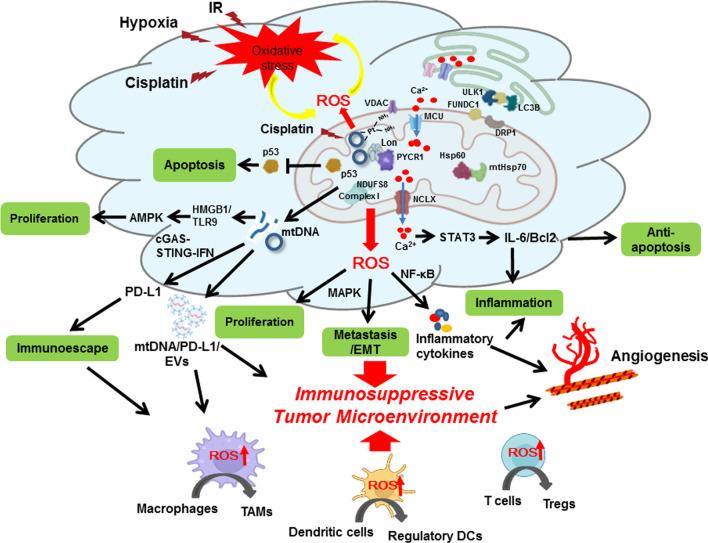
The major concept of "oxidative stress" is an excess elevated level of reactive oxygen species (ROS) which are generated from vigorous metabolism and consumption of oxygen. The precise harmonization of oxidative stresses between mitochondria and other organelles in the cell is absolutely vital to cell survival. Under oxidative stress, ROS produced from mitochondria and are the major mediator for tumorigenesis in different aspects, such as proliferation, migration/invasion, angiogenesis, inflammation, and immunoescape to allow cancer cells to adapt to the rigorous environment. Accordingly, the dynamic balance of oxidative stresses not only orchestrate complex cell signaling events in cancer cells but also affect other components in the tumor microenvironment (TME). Immune cells, such as M2 macrophages, dendritic cells, and T cells are the major components of the immunosuppressive TME from the ROS-induced inflammation. Based on this notion, numerous strategies to mitigate oxidative stresses in tumors have been tested for cancer prevention or therapies; however, these manipulations are devised from different sources and mechanisms without established effectiveness. Herein, we integrate current progress regarding the impact of mitochondrial ROS in the TME, not only in cancer cells but also in immune cells, and discuss the combination of emerging ROS-modulating strategies with immunotherapies to achieve antitumor effects.
“氧化应激”的主要概念是活性氧(ROS)的过度升高水平,这些 ROS 是由剧烈代谢和氧气消耗产生的。线粒体和细胞内其他细胞器之间氧化应激的精确协调对细胞存活至关重要。在氧化应激下,线粒体产生的 ROS 是肿瘤发生的主要介质,在增殖、迁移/侵袭、血管生成、炎症和免疫逃避等方面促进肿瘤发生,使癌细胞能够适应恶劣的环境。因此,氧化应激的动态平衡不仅协调了癌细胞中复杂的细胞信号事件,也影响了肿瘤微环境(TME)中的其他成分。免疫细胞,如 M2 巨噬细胞、树突状细胞和 T 细胞,是 ROS 诱导的炎症引起的免疫抑制性 TME 的主要组成部分。基于这一概念,已经有许多减轻肿瘤氧化应激的策略被用于癌症预防或治疗,但这些操作是基于不同的来源和机制设计的,没有确立的有效性。在此,我们整合了目前关于线粒体 ROS 在 TME 中影响的最新进展,不仅在癌细胞中,而且在免疫细胞中,讨论了新兴的 ROS 调节策略与免疫疗法的结合,以实现抗肿瘤效果。
 Zotero 插件