
为苏格兰邓弗里斯和加洛韦地区筛查逾期的女性提供多种宫颈癌筛查选项的影响。
The impact of offering multiple cervical screening options to women whose screening was overdue in Dumfries and Galloway, Scotland.
作者信息
Wedisinghe L, Sasieni P, Currie H, Baxter G
机构信息
Department of Obstetrics and Gyanecology, Central Queensland Hospital and Health Service, Rockhampton, QLD 4700, Australia.
NHS Dumfries and Galloway, Dumfries and Galloway Royal Infirmary, Dumfries DG2 8RX, United Kingdom.
出版信息
Prev Med Rep. 2022 Aug 11;29:101947. doi: 10.1016/j.pmedr.2022.101947. eCollection 2022 Oct.
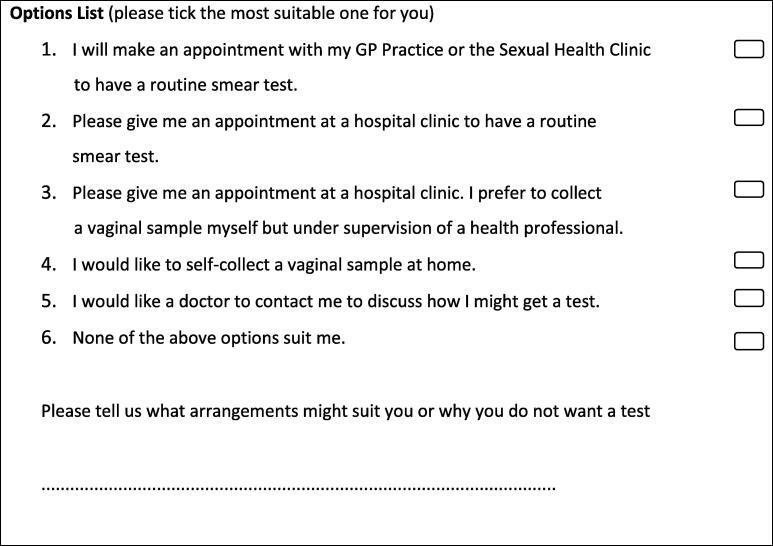
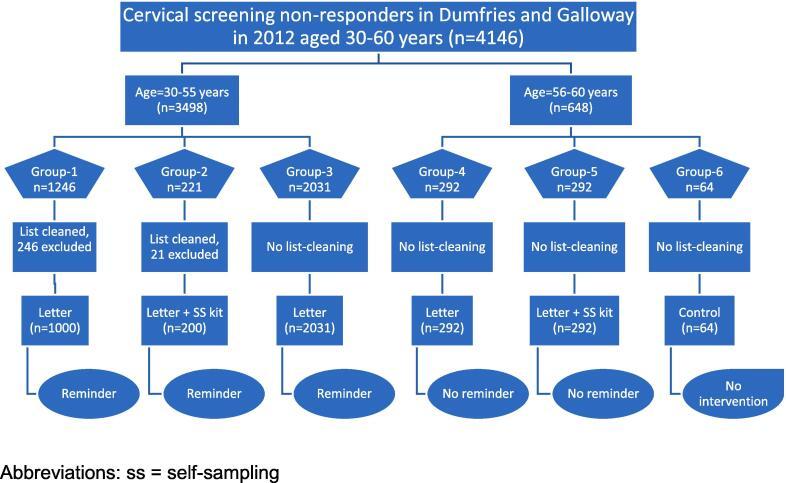
Most women who develop cancer have not been screened regularly. One in four women in Scotland, is overdue for cervical screening. Aim was to assess the impact of offering multiple cervical screening options to women whose screening is overdue. A prospective cohort study including all women whose screening was overdue, aged 30-60 years in Dumfries and Galloway in 2012. Potentially eligible women (n = 4146) were identified split into six groups. Women aged 30-55 years were allocated to three different groups. Group 1 (letter, n = 1246), Group 2 (letter and kit, n = 221), Group 3 (letter, n = 2031). Women aged 56-60 years were allocated to: Group 4 (letter, n = 292), Group 5 (letter and kit, n = 292) and Group 6 (control, n = 64). Women who self-collected a vaginal sample were requested to complete a questionnaire. The percentages of women responding were 24 % (21-26), 32 % (25-38), 16 % (14-18), 15 % (11-20) and 12 % (9-17) in groups 1 to 5 respectively, compared with 3 % (0-11) among controls. A significantly higher number of women (n = 383, 10 % of 3815) opted for self-sampling in comparison with undergoing a cervical screening test (CST) at the GP practice (n = 197, 5 %, x = 59.0, p < 0.0001). The Evalyn® Brush was well accepted (218/313 = 70 %) by those who requested self-sampling. Almost all (265/272 = 97 %) women who self-collected a vaginal sample said that if they had the option of self-sampling, they would regularly participate in future cervical screening. Offering more flexible screening options, self-sampling in particular, appears to increase cervical screening participation.
大多数患癌症的女性未进行过定期筛查。在苏格兰,四分之一的女性宫颈筛查逾期未做。目的是评估为筛查逾期的女性提供多种宫颈筛查选项的影响。一项前瞻性队列研究,纳入了2012年在邓弗里斯和加洛韦地区所有30至60岁筛查逾期的女性。确定了潜在符合条件的女性(n = 4146)并分为六组。30至55岁的女性被分配到三个不同组。第1组(信件通知,n = 1246),第2组(信件通知和试剂盒,n = 221),第3组(信件通知,n = 2031)。56至60岁的女性被分配到:第4组(信件通知,n = 292),第5组(信件通知和试剂盒,n = 292)和第6组(对照组,n = 64)。自行采集阴道样本的女性被要求填写一份问卷。第1至5组女性的回复率分别为24%(21 - 26)、32%(25 - 38)、16%(14 - 18)、15%(11 - 20)和12%(9 - 17),而对照组为3%(0 - 11)。与在全科医生诊所接受宫颈筛查测试(CST)(n = 197,5%)相比,选择自行采样的女性数量显著更多(n = 383,占3815人的10%,χ = 59.0,p < 0.0001)。自行采样者对Evalyn® 刷的接受度良好(218/313 = 70%)。几乎所有自行采集阴道样本的女性(265/272 = 97%)表示,如果有自行采样的选项,她们会定期参与未来的宫颈筛查。提供更灵活的筛查选项,尤其是自行采样,似乎会提高宫颈筛查的参与率。
 Zotero 插件