
健康声明数据中的痴呆症:不同病例定义对发病率和患病率估计的影响。
Dementia in health claims data: The influence of different case definitions on incidence and prevalence estimates.
机构信息
Leibniz Institute for Prevention Research and Epidemiology - BIPS, Bremen, Germany.
出版信息
Int J Methods Psychiatr Res. 2023 Jun;32(2):e1947. doi: 10.1002/mpr.1947. Epub 2022 Sep 27.
OBJECTIVES
The epidemiology of dementia subtypes including Alzheimer's disease (AD) and vascular dementia (VD) and their reliance on different case definitions ("algorithms") in health claims data are still understudied.
METHODS
Based on health claims data, prevalence estimates (per 100 persons), incidence rates (IRs, per 100 person-years), and proportions of AD, VD, and other dementias (oD) were calculated. Five algorithms of increasing strictness considered inpatient/outpatient diagnoses (#1, #2), antidementia drugs (#3) or supportive diagnostics (#4, #5).
RESULTS
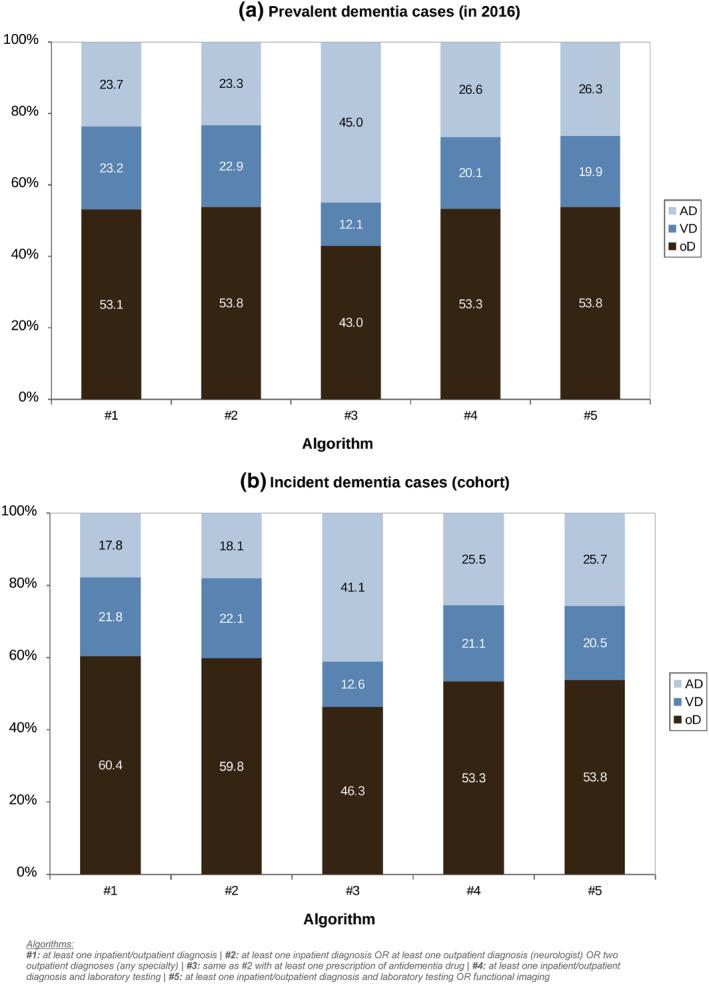
Algorithm 1 detected 213,409 cases (#2: 197,400; #3: 48,688; #4: 3033; #5: 3105), a prevalence for any dementia of 3.44 and an IR of 1.39 (AD: 0.80/0.21, VD: 0.79/0.31). The prevalence decreased by algorithms for any dementia (#2: 3.19; #3: 0.75; #4: 0.04; #5: 0.05) as did IRs (#2: 1.13; #3: 0.18; #4: 0.05, #5: 0.05). Algorithms 1-2, and 4-5 revealed similar proportions of AD (23.3%-26.6%), VD (19.9%-23.2%), and oD (53.1%-53.8%), algorithm 3 estimated 45% (AD), 12.1% (VD), and 43.0% (oD).
CONCLUSIONS
Health claims data show lower estimates of AD than previously reported, due to markedly lower prevalent/incident proportions of patients with corresponding codes. Using medication in defining dementia potentially improves estimating the proportion of AD while supportive diagnostics were of limited use.
目的
痴呆亚型(包括阿尔茨海默病[AD]和血管性痴呆[VD])的流行病学及其在健康索赔数据中对不同病例定义(“算法”)的依赖仍研究不足。
方法
基于健康索赔数据,计算了每 100 人患病率估计值(每 100 人)、发病率(IR,每 100 人年)以及 AD、VD 和其他痴呆症(oD)的比例。使用了五种逐渐严格的算法,考虑了住院/门诊诊断(#1、#2)、抗痴呆药物(#3)或支持性诊断(#4、#5)。
结果
算法 1 检测到 213409 例病例(#2:197400;#3:48688;#4:3033;#5:3105),任何痴呆症的患病率为 3.44,发病率为 1.39(AD:0.80/0.21,VD:0.79/0.31)。任何痴呆症的患病率随着算法的增加而降低(#2:3.19;#3:0.75;#4:0.04;#5:0.05),IR 也降低(#2:1.13;#3:0.18;#4:0.05,#5:0.05)。算法 1-2 和 4-5 显示出 AD(23.3%-26.6%)、VD(19.9%-23.2%)和 oD(53.1%-53.8%)的相似比例,算法 3 估计 AD 为 45%(AD)、12.1%(VD)和 43.0%(oD)。
结论
健康索赔数据显示 AD 的估计值低于先前报告,这是由于具有相应代码的患者的患病率和发病率比例明显降低。使用药物定义痴呆症可以提高 AD 比例的估计,而支持性诊断的作用有限。

 Zotero 插件