
用于远程监测 HbA1c 和血糖变异性的非侵入性可穿戴设备:概念验证。
Non-invasive wearables for remote monitoring of HbA1c and glucose variability: proof of concept.
机构信息
Biomedical Engineering, Duke University, Durham, North Carolina, USA.
Endocrinology, Duke University Health System, Durham, North Carolina, USA.
出版信息
BMJ Open Diabetes Res Care. 2021 Jun;9(1). doi: 10.1136/bmjdrc-2020-002027.
INTRODUCTION
Diabetes prevalence continues to grow and there remains a significant diagnostic gap in one-third of the US population that has pre-diabetes. Innovative, practical strategies to improve monitoring of glycemic health are desperately needed. In this proof-of-concept study, we explore the relationship between non-invasive wearables and glycemic metrics and demonstrate the feasibility of using non-invasive wearables to estimate glycemic metrics, including hemoglobin A1c (HbA1c) and glucose variability metrics.
RESEARCH DESIGN AND METHODS
We recorded over 25 000 measurements from a continuous glucose monitor (CGM) with simultaneous wrist-worn wearable (skin temperature, electrodermal activity, heart rate, and accelerometry sensors) data over 8-10 days in 16 participants with normal glycemic state and pre-diabetes (HbA1c 5.2-6.4). We used data from the wearable to develop machine learning models to predict HbA1c recorded on day 0 and glucose variability calculated from the CGM. We tested the accuracy of the HbA1c model on a retrospective, external validation cohort of 10 additional participants and compared results against CGM-based HbA1c estimation models.
RESULTS
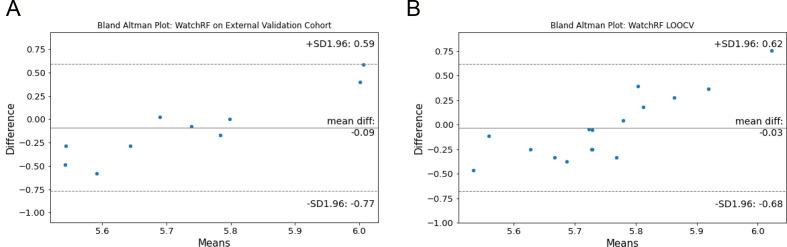
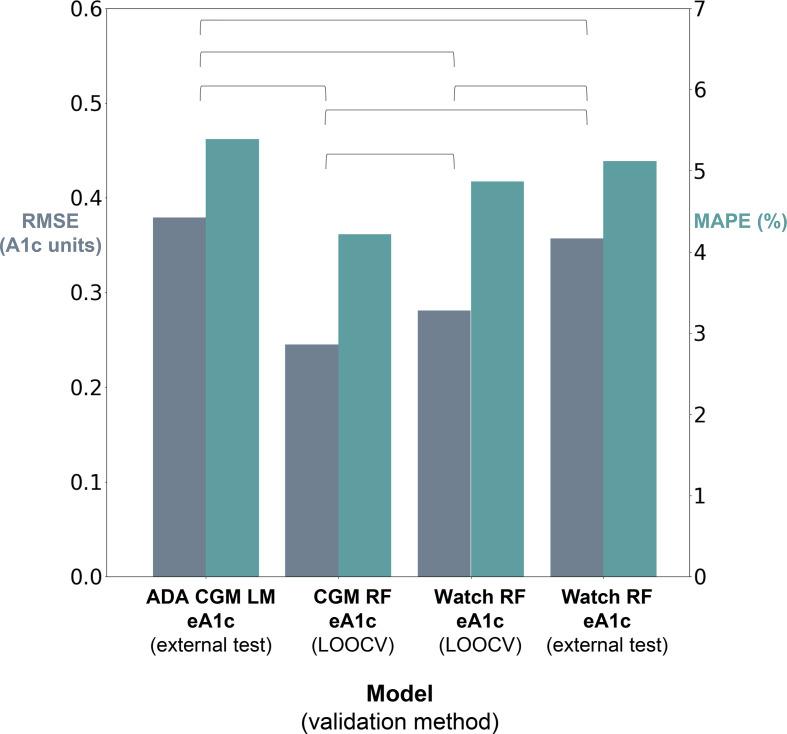
A total of 250 days of data from 26 participants were collected. Out of the 27 models of glucose variability metrics that we developed using non-invasive wearables, 11 of the models achieved high accuracy (<10% mean average per cent error, MAPE). Our HbA1c estimation model using non-invasive wearables data achieved MAPE of 5.1% on an external validation cohort. The ranking of wearable sensor's importance in estimating HbA1c was skin temperature (33%), electrodermal activity (28%), accelerometry (25%), and heart rate (14%).
CONCLUSIONS
This study demonstrates the feasibility of using non-invasive wearables to estimate glucose variability metrics and HbA1c for glycemic monitoring and investigates the relationship between non-invasive wearables and the glycemic metrics of glucose variability and HbA1c. The methods used in this study can be used to inform future studies confirming the results of this proof-of-concept study.
简介
糖尿病的患病率持续上升,在美国三分之一患有前驱糖尿病的人群中,仍存在显著的诊断差距。急需创新、实用的策略来改善血糖健康监测。在这项概念验证研究中,我们探讨了非侵入性可穿戴设备与血糖指标之间的关系,并展示了使用非侵入性可穿戴设备来估计血糖指标,包括糖化血红蛋白 (HbA1c) 和血糖变异性指标的可行性。
研究设计和方法
我们在 16 名血糖正常和前驱糖尿病(HbA1c 5.2-6.4)参与者中记录了超过 25000 次连续血糖监测仪(CGM)测量值,同时记录了手腕佩戴的可穿戴设备(皮肤温度、皮肤电活动、心率和加速度计传感器)数据,时长为 8-10 天。我们使用可穿戴设备的数据开发机器学习模型来预测第 0 天记录的 HbA1c 和 CGM 计算的血糖变异性。我们在 10 名额外参与者的回顾性外部验证队列中测试了 HbA1c 模型的准确性,并将结果与基于 CGM 的 HbA1c 估计模型进行了比较。
结果
共收集了 26 名参与者的 250 天数据。在使用非侵入性可穿戴设备开发的 27 种血糖变异性指标模型中,有 11 种模型达到了高精度(<10%平均绝对百分比误差,MAPE)。我们使用非侵入性可穿戴设备数据的 HbA1c 估计模型在外部验证队列中达到了 5.1%的 MAPE。在估计 HbA1c 方面,可穿戴设备传感器的重要性排名依次为皮肤温度(33%)、皮肤电活动(28%)、加速度计(25%)和心率(14%)。
结论
这项研究证明了使用非侵入性可穿戴设备来估计血糖变异性指标和 HbA1c 以进行血糖监测的可行性,并研究了非侵入性可穿戴设备与血糖变异性和 HbA1c 的血糖指标之间的关系。本研究中使用的方法可用于为未来的研究提供信息,以确认本概念验证研究的结果。


 Zotero 插件