
肿瘤学期刊编辑委员会中的性别代表性。
Gender representation on editorial boards of leading oncology journals.
机构信息
Editorial Department of Chinese Journal of Cancer Research, Peking University Cancer Hospital & Institute, Beijing, China; Key Laboratory of Carcinogenesis and Translational Research (Ministry of Education/Beijing), Beijing, China.
Editorial Department of Chinese Journal of Cancer Research, Peking University Cancer Hospital & Institute, Beijing, China; Key Laboratory of Carcinogenesis and Translational Research (Ministry of Education/Beijing), Beijing, China.
出版信息
ESMO Open. 2022 Oct;7(5):100590. doi: 10.1016/j.esmoop.2022.100590. Epub 2022 Sep 26.
BACKGROUND
There has historically been women underrepresentation on editorial boards of peer-reviewed medical journals. High-ranked oncology journals showcase cancer-related scientific work at the forefront of the discipline. There is urgent need to investigate gender representation on editorial boards at leading oncology journals.
MATERIALS AND METHODS
Sixty high-ranked oncology journals based on impact factor calculated by the Journal Citation Reports (JCR) 2021 from Web of Science/Clarivate Analytics were identified. Gender-related information of editorial boards was obtained from each journal's website. The gender of each member of the editorial team was confirmed by an internet search for picture and/or gender-specific pronoun from journal or personal profile. Fisher's exact tests and analysis of variance were used to analyze categorical and continuous variables, respectively. Significance was set at P < 0.05.
RESULTS
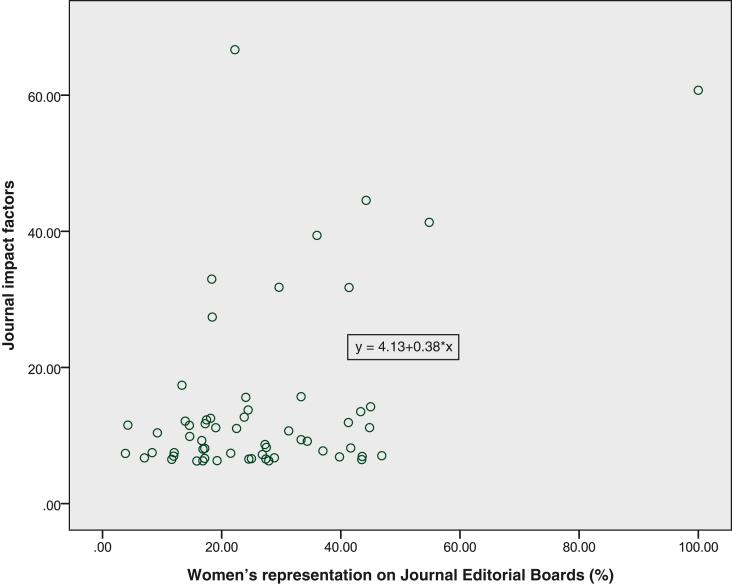
Among 4898 members on editorial boards of top oncology journals with the highest impact factor, 1177 were women. Women made up 24% (1177 of 4898) of members on editorial boards in top oncology journals, and there was significantly less women board members than men (P < 0.0001). The mean female composition of editorial boards of oncology journals was 27% (range from 4% to 100%). Among 71 editors-in-chief of the top oncology journals, 14 (20%) were women. There was a positive correlation between the presence of women in journal editorial leadership and the percentage of women on editorial boards (r = 0.340, P = 0.008). The underrepresentation of women on oncology journal editorial boards was significantly different among quartiles of journal impact factor. There was no significant correlation between women's representation on journal editorial boards (%) and journal impact factors (r = 0.226, P = 0.086).
CONCLUSIONS
The results demonstrated that there are gender disparities among editorial leadership at high-impact oncology journals. There are cultural and structural barriers and prejudices to gender parity and diversity on editorial boards of oncology journals.
背景
在同行评审医学期刊的编辑委员会中,女性的代表性历来不足。排名较高的肿瘤学期刊展示了该学科前沿的癌症相关科学工作。迫切需要调查领先肿瘤学期刊编辑委员会的性别代表性。
材料和方法
根据科睿唯安(Clarivate Analytics)Web of Science/JCR 2021 计算的影响因子,确定了 60 种排名较高的肿瘤学期刊。从每个期刊的网站上获得了编辑委员会的性别相关信息。通过互联网搜索期刊或个人资料中的图片和/或性别特定代词,确认了编辑团队中每个成员的性别。使用 Fisher 精确检验和方差分析分别分析分类变量和连续变量。显著性水平设置为 P < 0.05。
结果
在具有最高影响因子的顶级肿瘤学期刊的 4898 名编辑委员会成员中,有 1177 名是女性。女性在顶级肿瘤学期刊的编辑委员会成员中占 24%(4898 名中的 1177 名),女性委员明显少于男性(P < 0.0001)。肿瘤学期刊编辑委员会女性构成的平均值为 27%(范围为 4%至 100%)。在 71 名顶级肿瘤学期刊的主编中,有 14 名(20%)是女性。期刊编辑领导层中女性的存在与编辑委员会中女性的比例之间存在正相关关系(r = 0.340,P = 0.008)。在期刊影响因子的四分位数中,肿瘤学期刊编辑委员会中女性的代表性差异显著。期刊编辑委员会中女性的代表性(%)与期刊影响因子之间没有显著相关性(r = 0.226,P = 0.086)。
结论
结果表明,在高影响力肿瘤学期刊的编辑领导层中存在性别差异。在肿瘤学期刊编辑委员会中实现性别平等和多样性存在文化和结构障碍以及偏见。
 Zotero 插件