
理解家庭健康助手的技术格局:范围文献综述和现有移动健康应用程序的景观分析。
Understanding the Technological Landscape of Home Health Aides: Scoping Literature Review and a Landscape Analysis of Existing mHealth Apps.
机构信息
Department of Information Science, Jacobs Technion-Cornell Institute, Cornell Tech, New York, NY, United States.
Division of General Internal Medicine, Department of Medicine, Weill Cornell Medicine, New York, NY, United States.
出版信息
J Med Internet Res. 2022 Nov 11;24(11):e39997. doi: 10.2196/39997.
BACKGROUND
Home health aides (HHAs) provide necessary hands-on care to older adults and those with chronic conditions in their homes. Despite their integral role, HHAs experience numerous challenges in their work, including their ability to communicate with other health care professionals about patient care while caring for patients and access to educational resources. Although technological interventions have the potential to address these challenges, little is known about the technological landscape and existing technology-based interventions designed for and used by this workforce.
OBJECTIVE
We conducted a scoping review of the scientific literature to identify existing studies that have described, designed, deployed, or tested technology-based tools and apps intended for use by HHAs to care for patients at home. To complement our literature review, we conducted a landscape analysis of existing mobile apps intended for HHAs providing in-home care.
METHODS
We searched the following databases from their inception to October 2020: Ovid MEDLINE, Ovid Embase, Cochrane Library, and CINAHL (EBSCO). A total of 3 researchers screened the yield using prespecified inclusion and exclusion criteria. In addition, 4 researchers independently reviewed these articles, and a fifth researcher arbitrated when needed. Among studies that met the inclusion criteria, data were extracted and summarized narratively. An analysis of mobile health apps designed for HHAs was performed using a predefined set of terms to search Google Play and Apple App stores. Overall, 2 researchers independently screened the resulting apps, and those that met the inclusion criteria were categorized according to their intended purpose and functionality.
RESULTS
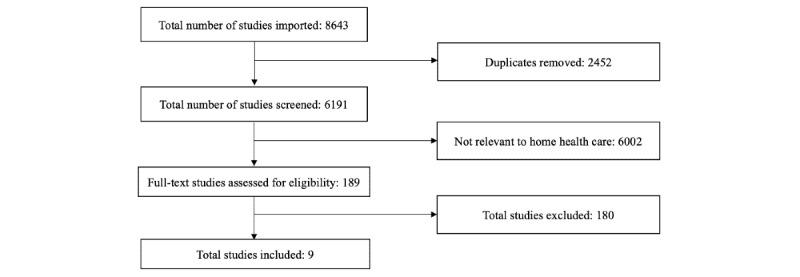
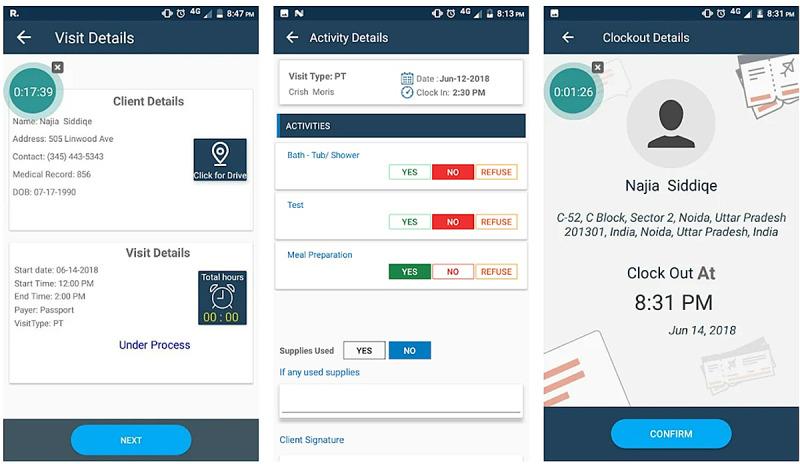
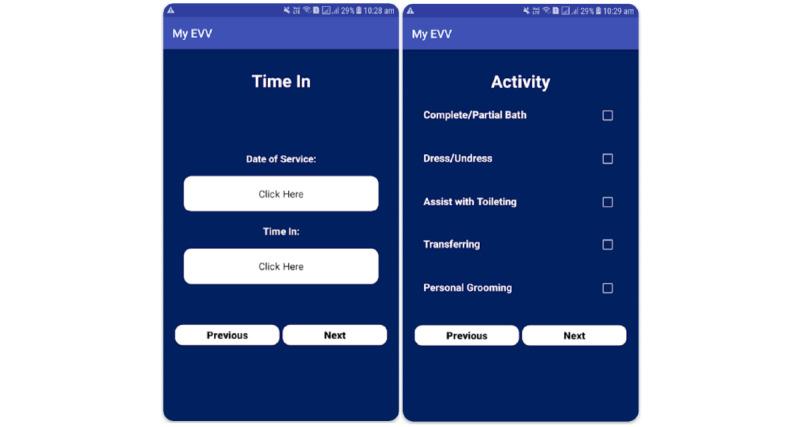
Of the 8643 studies retrieved, 182 (2.11%) underwent full-text review, and 4.9% (9/182) met our inclusion criteria. Approximately half (4/9, 44%) of the studies were descriptive in nature, proposing technology-based systems (eg, web portals and dashboards) or prototypes without a technical or user-based evaluation of the technology. In most (7/9, 78%) papers, HHAs were just one of several users and not the sole or primary intended users of the technology. Our review of mobile apps yielded 166 Android and iOS apps, of which 48 (29%) met the inclusion criteria. These apps provided HHAs with one or more of the following functions: electronic visit verification (29/48, 60%), clocking in and out (23/48, 48%), documentation (22/48, 46%), task checklist (19/48, 40%), communication between HHA and agency (14/48, 29%), patient information (6/48, 13%), resources (5/48, 10%), and communication between HHA and patients (4/48, 8%). Of the 48 apps, 25 (52%) performed monitoring functions, 4 (8%) performed supporting functions, and 19 (40%) performed both.
CONCLUSIONS
A limited number of studies and mobile apps have been designed to support HHAs in their work. Further research and rigorous evaluation of technology-based tools are needed to assess their impact on the work HHAs provide in patient's homes.
背景
家庭健康助手(HHAs)为老年人和慢性病患者在家中提供必要的护理。尽管他们发挥着重要作用,但在照顾患者的同时,与其他医疗保健专业人员沟通患者护理以及获取教育资源方面,HHAs 仍面临诸多挑战。尽管技术干预有解决这些挑战的潜力,但对于专为这一劳动力设计和使用的基于技术的工具和应用程序,我们对其技术领域和现有技术干预措施知之甚少。
目的
我们对科学文献进行了范围界定审查,以确定已经描述、设计、部署或测试过的基于技术的工具和应用程序,这些工具和应用程序旨在供 HHAs 在家庭中照顾患者。为了补充我们的文献综述,我们对专为提供家庭护理的 HHAs 设计的现有移动应用程序进行了景观分析。
方法
我们从以下数据库中检索了从成立到 2020 年 10 月的所有内容:Ovid MEDLINE、Ovid Embase、Cochrane 图书馆和 CINAHL(EBSCO)。共有 3 名研究人员使用预定义的纳入和排除标准筛选了产量。此外,4 名研究人员独立审查了这些文章,第 5 名研究人员在需要时进行仲裁。在符合纳入标准的研究中,提取并按叙述方式总结数据。使用预定义的一组术语对专为 HHAs 设计的移动健康应用程序进行了分析,以搜索 Google Play 和 Apple App 商店。总的来说,2 名研究人员独立筛选了结果应用程序,符合纳入标准的应用程序根据其预期用途和功能进行了分类。
结果
在检索到的 8643 项研究中,有 182 项(2.11%)进行了全文审查,其中 4.9%(9/182)符合我们的纳入标准。大约一半(4/9,44%)的研究具有描述性,提出了基于技术的系统(例如,网络门户和仪表板)或原型,而没有对技术进行技术或用户评估。在大多数(7/9,78%)论文中,HHAs 只是几个用户之一,而不是技术的唯一或主要预期用户。我们对移动应用程序的审查产生了 166 个 Android 和 iOS 应用程序,其中 48 个(29%)符合纳入标准。这些应用程序为 HHAs 提供了以下一项或多项功能:电子访问验证(29/48,60%)、签到和签出(23/48,48%)、文档(22/48,46%)、任务清单(19/48,40%)、HHAs 和机构之间的通信(14/48,29%)、患者信息(6/48,13%)、资源(5/48,10%)和 HHAs 和患者之间的通信(4/48,8%)。在 48 个应用程序中,有 25 个(52%)执行监控功能,4 个(8%)执行支持功能,19 个(40%)执行两者功能。
结论
专为 HHAs 工作设计的研究和移动应用程序数量有限。需要进一步研究和严格评估基于技术的工具,以评估它们对 HHAs 在患者家中提供的工作的影响。


 Zotero 插件