
全国性荷兰儿科 DCM 队列的遗传评估:遗传检测在风险分层中的应用。
Genetic Evaluation of A Nation-Wide Dutch Pediatric DCM Cohort: The Use of Genetic Testing in Risk Stratification.
机构信息
Dept of Pediatric Cardiology, Erasmus MC, Univ Medical Center Rotterdam, Rotterdam (M.H.M., M.D.).
Dept of Pediatric Cardiology, Univ of Groningen, Univ Medical Center Groningen, Groningen (G.J.M.S.).
出版信息
Circ Genom Precis Med. 2022 Oct;15(5):e002981. doi: 10.1161/CIRCGEN.120.002981. Epub 2022 Sep 30.
BACKGROUND
This study aimed to describe the current practice and results of genetic evaluation in Dutch children with dilated cardiomyopathy and to evaluate genotype-phenotype correlations that may guide prognosis.
METHODS
We performed a multicenter observational study in children diagnosed with dilated cardiomyopathy, from 2010 to 2017.
RESULTS
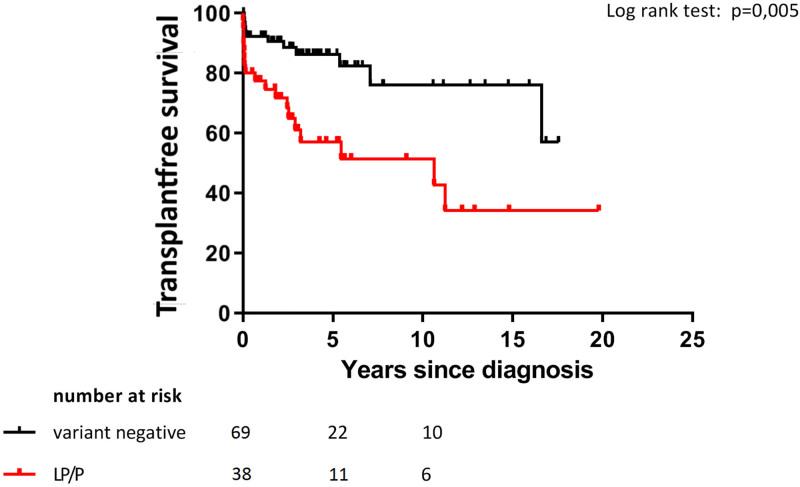
One hundred forty-four children were included. Initial diagnostic categories were idiopathic dilated cardiomyopathy in 67 children (47%), myocarditis in 23 (16%), neuromuscular in 7 (5%), familial in 18 (13%), inborn error of metabolism in 4 (3%), malformation syndrome in 2 (1%), and "other" in 23 (16%). Median follow-up time was 2.1 years [IQR 1.0-4.3]. Hundred-seven patients (74%) underwent genetic testing. We found a likely pathogenic or pathogenic variant in 38 children (36%), most often in (n = 8). In 1 patient initially diagnosed with myocarditis, a pathogenic variant was found. During the study, 39 patients (27%) reached study endpoint (SE: all-cause death or heart transplantation). Patients with a likely pathogenic or pathogenic variant were more likely to reach SE compared with those without (hazard ratio 2.8; 95% CI 1.3-5.8, = 0.007), while transplant-free survival was significantly lower ( = 0.006). Clinical characteristics at diagnosis did not differ between the 2 groups.
CONCLUSIONS
Genetic testing is a valuable tool for predicting prognosis in children with dilated cardiomyopathy, with carriers of a likely pathogenic or pathogenic variant having a worse prognosis overall. Genetic testing should be incorporated in clinical work-up of all children with dilated cardiomyopathy regardless of presumed disease pathogenesis.
背景
本研究旨在描述荷兰扩张型心肌病患儿遗传评估的现状及结果,并评估可能指导预后的基因型-表型相关性。
方法
我们对 2010 年至 2017 年间诊断为扩张型心肌病的患儿进行了一项多中心观察性研究。
结果
共纳入 144 例患儿。初始诊断类别为特发性扩张型心肌病 67 例(47%)、心肌炎 23 例(16%)、神经肌肉疾病 7 例(5%)、家族性扩张型心肌病 18 例(13%)、先天性代谢缺陷 4 例(3%)、畸形综合征 2 例(1%)和“其他”23 例(16%)。中位随访时间为 2.1 年[IQR 1.0-4.3]。107 例患者(74%)接受了基因检测。我们在 38 例患儿中发现了可能致病性或致病性变异,最常见的是 (n=8)。1 例最初诊断为心肌炎的患者发现了致病性 变异。在研究期间,39 例患者(27%)达到了研究终点(SE:全因死亡或心脏移植)。与无变异的患者相比,有变异的患者更有可能达到 SE(风险比 2.8;95%CI 1.3-5.8, = 0.007),而无移植生存率显著降低( = 0.006)。两组患儿的诊断时临床特征无差异。
结论
基因检测是预测扩张型心肌病患儿预后的有价值工具,携带可能致病性或致病性变异的患儿总体预后较差。无论推测的疾病发病机制如何,基因检测都应纳入所有扩张型心肌病患儿的临床评估中。

 Zotero 插件