
临床痴呆评定量表的盒式总和高度预测轻度认知障碍阶段的转化或逆转。
Sum of boxes of the clinical dementia rating scale highly predicts conversion or reversion in predementia stages.
作者信息
Tzeng Ray-Chang, Yang Yu-Wan, Hsu Kai-Cheng, Chang Hsin-Te, Chiu Pai-Yi
机构信息
Department of Neurology, Tainan Municipal Hospital, Tainan, Taiwan.
Department of Neurology, China Medical University Hospital, Taichung, Taiwan.
出版信息
Front Aging Neurosci. 2022 Sep 23;14:1021792. doi: 10.3389/fnagi.2022.1021792. eCollection 2022.
BACKGROUND
The clinical dementia rating (CDR) scale is commonly used to diagnose dementia due to Alzheimer's disease (AD). The sum of boxes of the CDR (CDR-SB) has recently been emphasized and applied to interventional trials for tracing the progression of cognitive impairment (CI) in the early stages of AD. We aimed to study the influence of baseline CDR-SB on disease progression to dementia or reversion to normal cognition (NC).
MATERIALS AND METHODS
The baseline CDR < 1 cohort registered from September 2015 to August 2020 with longitudinal follow-up in the History-based Artificial Intelligence Clinical Dementia Diagnostic System (HAICDDS) database was retrospectively analyzed for the rates of conversion to CDR ≥ 1. A Cox regression model was applied to study the influence of CDR-SB levels on progression, adjusting for age, education, sex, neuropsychological tests, neuropsychiatric symptoms, parkinsonism, and multiple vascular risk factors.
RESULTS
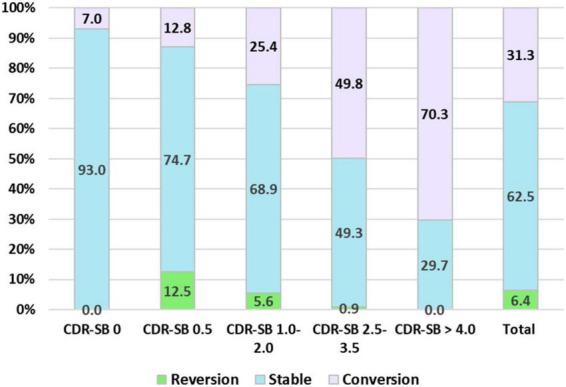
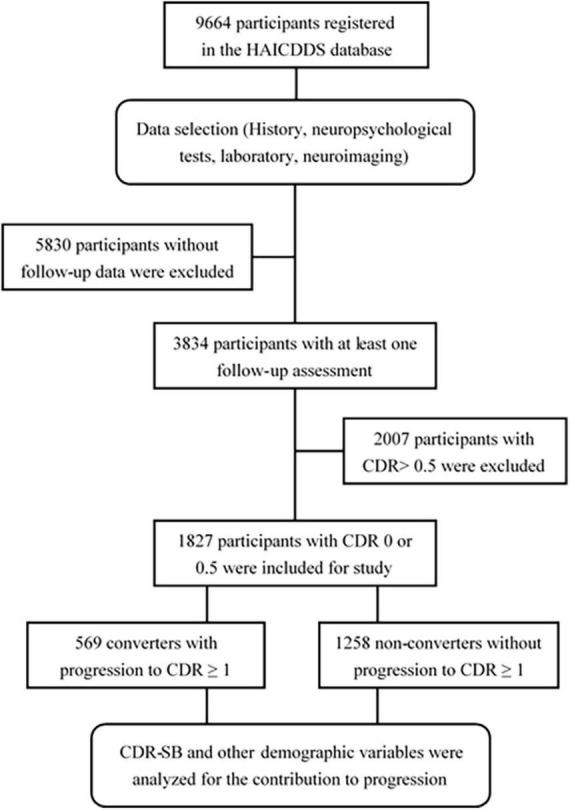
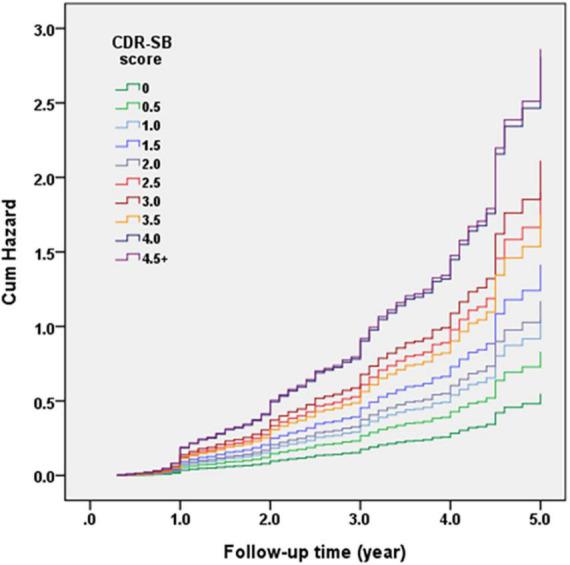
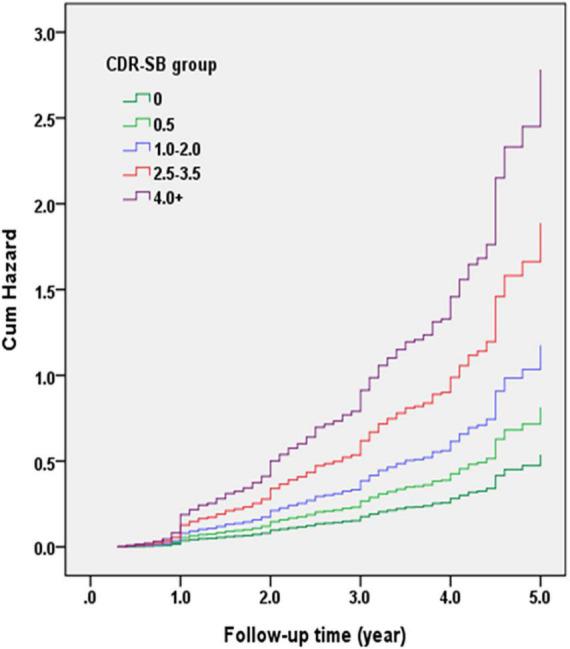
A total of 1,827 participants were analyzed, including 1,258 (68.9%) non-converters, and 569 (31.1%) converters with mean follow-up of 2.1 (range 0.4-5.5) and 1.8 (range 0.3-5.0) years, respectively. Conversion rates increased with increasing CDR-SB scores. Compared to a CDR-SB score of 0, the hazard ratios (HR) for conversion to dementia were 1.51, 1.91, 2.58, 2.13, 3.46, 3.85, 3.19, 5.12, and 5.22 for CDR-SB scores of 0.5, 1.0, 1.5, 2.0, 2.5, 3.0, 3.5, 4.0, and ≥4.5, respectively (all < 0.05 except for CDR-SB score = 0.5). In addition, older age, lower education, lower cognitive performance, and a history of diabetes also increased conversion rates. Furthermore, reversions to NC were 12.5, 5.6, 0.9, and 0% for CDR-SB scores of 0.5, 1.0-2.0, 2.5-3.5 and ≥4.0, respectively ( < 0.001).
CONCLUSION
CDR-SB in predementia or very mild dementia (VMD) stages highly predicts progression to dementia or reversion to NC. Therefore, CDR-SB could be a good candidate for tracing the effectiveness of pharmacological and non-pharmacological interventions in populations without dementia.
背景
临床痴呆评定量表(CDR)常用于诊断阿尔茨海默病(AD)所致痴呆。最近,CDR量表总分(CDR-SB)受到重视,并应用于干预试验,以追踪AD早期认知障碍(CI)的进展情况。我们旨在研究基线CDR-SB对疾病进展为痴呆或恢复正常认知(NC)的影响。
材料与方法
回顾性分析2015年9月至2020年8月在基于病史的人工智能临床痴呆诊断系统(HAICDDS)数据库中登记的基线CDR<1队列,并进行纵向随访,以分析转变为CDR≥1的比例。应用Cox回归模型研究CDR-SB水平对疾病进展的影响,并对年龄、教育程度、性别、神经心理学测试、神经精神症状、帕金森综合征和多种血管危险因素进行校正。
结果
共分析了1827名参与者,其中1258名(68.9%)未转变者,569名(31.1%)转变者,平均随访时间分别为2.1年(范围0.4 - 5.5年)和1.8年(范围0.3 - 5.0年)。转变比例随CDR-SB评分的增加而升高。与CDR-SB评分为0相比,CDR-SB评分为0.5、1.0、1.5、2.0、2.5、3.0、3.5、4.0和≥4.5时转变为痴呆的风险比(HR)分别为1.51、1.91、2.58、2.13、3.46、3.85、3.19、5.12和5.22(除CDR-SB评分为0.5外,均P<0.05)。此外,年龄较大、教育程度较低、认知表现较差以及有糖尿病史也会增加转变比例。此外,CDR-SB评分为0.5、1.0 - 2.0、2.5 - 3.5和≥4.0时恢复为NC的比例分别为12.5%、5.6%、0.9%和0%(P<0.001)。
结论
痴呆前期或极轻度痴呆(VMD)阶段的CDR-SB高度预测疾病进展为痴呆或恢复为NC。因此,CDR-SB可能是追踪无痴呆人群中药物和非药物干预效果的良好指标。
 Zotero 插件