
病例报告:一名类风湿关节炎合并SARS-CoV-2抗原持续存在的患者使用SARS-CoV-2抗病毒药物和IL-6阻断剂治疗长期新冠症状
Case report: Treatment of long COVID with a SARS-CoV-2 antiviral and IL-6 blockade in a patient with rheumatoid arthritis and SARS-CoV-2 antigen persistence.
作者信息
Visvabharathy Lavanya, Orban Zachary S, Koralnik Igor J
机构信息
Ken and Ruth Davee Department of Neurology, Feinberg School of Medicine, Northwestern University, Chicago, IL, United States.
出版信息
Front Med (Lausanne). 2022 Sep 23;9:1003103. doi: 10.3389/fmed.2022.1003103. eCollection 2022.
INTRODUCTION
Long COVID, or post-acute sequelae of SARS-CoV-2 infection (PASC) in ∼30% of all infected individuals. Here, we present a case of PASC in a patient with rheumatoid arthritis characterized by viral persistence in the nasopharynx for 6 months after acute infection. We demonstrate transient disappearance of antigen persistence and decreased antiviral and autoimmune T cell responses after nirmatrelvir/ritonavir and tocilizumab treatment.
CASE PRESENTATION
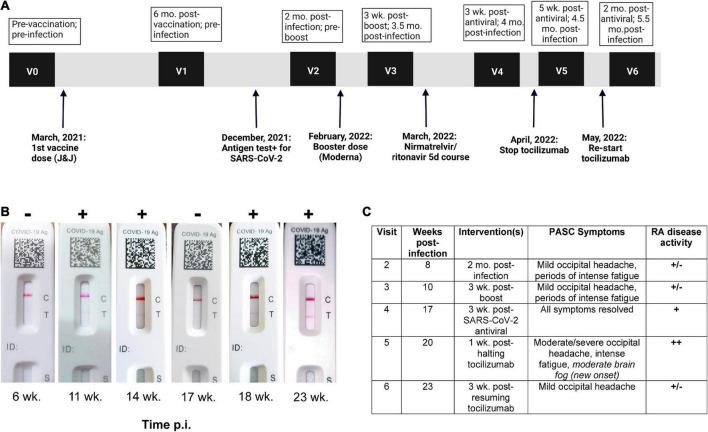
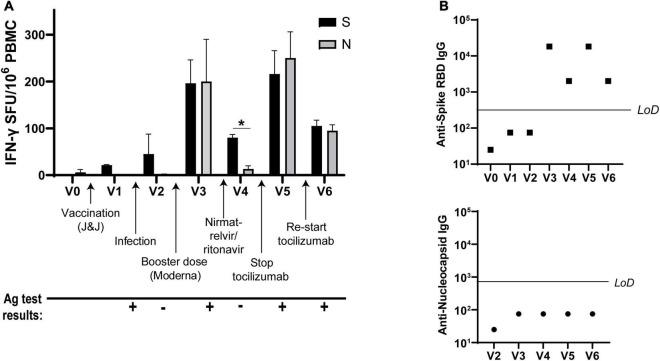
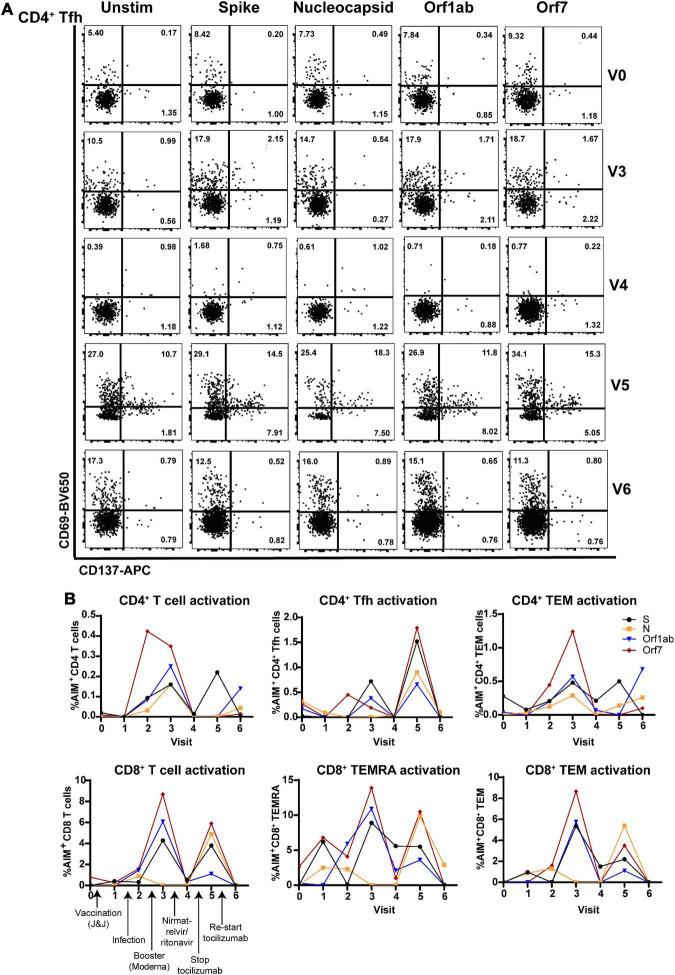
A 37-year-old female with a 7-year history of rheumatoid arthritis enrolled in a COVID-19 research study was found to continuously test SARS-CoV-2 antigen positive in the nasopharynx for 6 months after acute infection. She simultaneously presented with new-onset PASC symptoms including chronic occipital headache and periods of intense fatigue 8 weeks after acute infection. The patient was prescribed nirmatrelvir/ritonavir to treat SARS-CoV-2 persistence at 3.5 months post-acute infection and observed a reduction in PASC symptoms 3 weeks after completing antiviral treatment. After resurgence of PASC symptoms, she stopped treatment with tocilizumab for rheumatoid arthritis to attempt complete SARS-CoV-2 viral clearance. The severity of the patient's PASC symptoms subsequently increased, and she developed new-onset brain fog in addition to previous symptoms, which resolved after resumption of tocilizumab treatment. Assessment of adaptive immune responses demonstrated that nirmatrelvir/ritonavir and tocilizumab treatment decreased antiviral and autoreactive T cell activation. After resuming tocilizumab treatment, the patient's PASC symptoms were significantly reduced, but nasopharyngeal antigen positivity remained.
CONCLUSION
These data suggest that nirmatrelvir/ritonavir should be considered in the treatment of PASC in patients who have SARS-CoV-2 antigen persistence, though care must be taken to monitor the patient for symptom resurgence or viral reactivation. In addition, the IL-6 inhibitor tocilizumab may ameliorate PASC symptoms in patients with persistent headache, fatigue, and brain fog.
引言
长新冠,即新冠病毒2感染后急性后遗症(PASC),在约30%的所有感染个体中出现。在此,我们报告一例类风湿性关节炎患者的PASC病例,其特征为急性感染后鼻咽部病毒持续存在6个月。我们证明了在使用奈玛特韦/利托那韦和托珠单抗治疗后,抗原持续性短暂消失,抗病毒和自身免疫性T细胞反应降低。
病例介绍
一名有7年类风湿性关节炎病史的37岁女性参加了一项新冠病毒研究,发现其在急性感染后6个月鼻咽部新冠病毒抗原持续呈阳性。急性感染8周后,她同时出现了新发的PASC症状,包括慢性枕部头痛和间歇性严重疲劳。该患者在急性感染后3.5个月被开了奈玛特韦/利托那韦来治疗新冠病毒持续性感染,在完成抗病毒治疗3周后观察到PASC症状有所减轻。在PASC症状复发后,她停止了类风湿性关节炎的托珠单抗治疗,试图完全清除新冠病毒。患者的PASC症状随后加重,除了之前的症状外,还出现了新发的脑雾,在恢复托珠单抗治疗后症状缓解。适应性免疫反应评估表明,奈玛特韦/利托那韦和托珠单抗治疗降低了抗病毒和自身反应性T细胞的激活。恢复托珠单抗治疗后,患者的PASC症状明显减轻,但鼻咽部抗原仍为阳性。
结论
这些数据表明,对于有新冠病毒抗原持续性的患者,在治疗PASC时应考虑使用奈玛特韦/利托那韦,不过必须注意监测患者症状复发或病毒再激活情况。此外,白细胞介素-6抑制剂托珠单抗可能会改善持续出现头痛、疲劳和脑雾症状的患者的PASC症状。

 Zotero 插件