
医疗保险、地理位置、种族与族裔与美国产后护理推荐接受率差异的关联。
Association of Health Insurance, Geography, and Race and Ethnicity With Disparities in Receipt of Recommended Postpartum Care in the US.
机构信息
University of Minnesota Rural Health Research Center, University of Minnesota School of Public Health, Minneapolis.
Division of Health Policy and Management, University of Minnesota School of Public Health, Minneapolis.
出版信息
JAMA Health Forum. 2022 Oct 7;3(10):e223292. doi: 10.1001/jamahealthforum.2022.3292.
IMPORTANCE
Little is known about the quality of postpartum care or disparities in the content of postpartum care associated with health insurance, rural or urban residency, and race and ethnicity.
OBJECTIVES
To examine receipt of recommended postpartum care content and to describe variations across health insurance type, rural or urban residence, and race and ethnicity.
DESIGN, SETTINGS, AND PARTICIPANTS: This cross-sectional survey of patients with births from 2016 to 2019 used data from the Pregnancy Risk Assessment Monitoring System (43 states and 2 jurisdictions). A population-based sample of patients conducted by state and local health departments in partnership with the Centers for Disease Control and Prevention were surveyed about maternal experiences 2 to 6 months after childbirth (mean weighted response rate, 59.9%). Patients who attended a postpartum visit were assessed for content at that visit. Analyses were performed November 2021 to July 2022.
EXPOSURES
Medicaid or private health insurance, rural or urban residence, and race and ethnicity (non-Hispanic White or racially minoritized groups).
MAIN OUTCOMES AND MEASURES
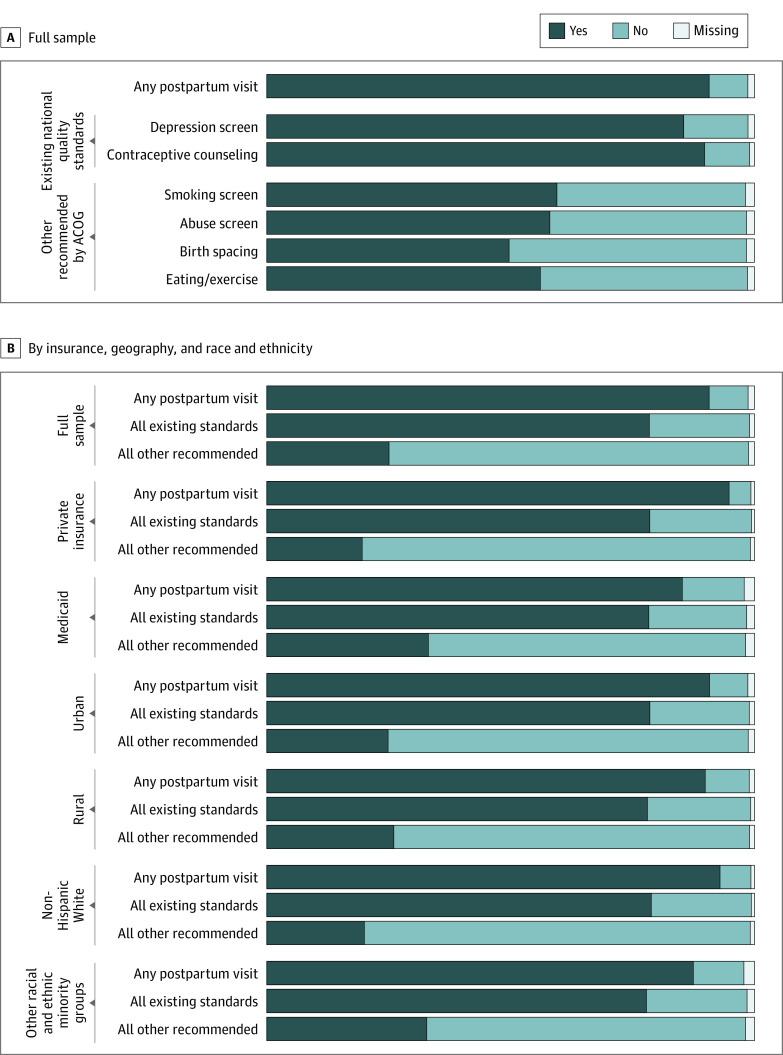
Receipt of 2 postpartum care components recommended by national quality standards (depression screening and contraceptive counseling), and/or other recommended components (smoking screening, abuse screening, birth spacing counseling, eating and exercise discussions) with estimated risk-adjusted predicted probabilities and percentage-point (pp) differences.
RESULTS
Among the 138 073 patient-respondents, most (59.5%) were in the age group from 25 to 34 years old; 59 726 (weighted percentage, 40%) were insured by Medicaid; 27 721 (15%) were rural residents; 9718 (6%) were Asian, 24 735 (15%) were Black, 22 210 (15%) were Hispanic, 66 323 (60%) were White, and fewer than 1% were Indigenous (Native American/Alaska Native) individuals. Receipt of both depression screening and contraceptive counseling both significantly lower for Medicaid-insured patients (1.2 pp lower than private; 95% CI, -2.1 to -0.3), rural residents (1.3 pp lower than urban; 95% CI, -2.2 to -0.4), and people of racially minoritized groups (0.8 pp lower than White individuals; 95% CI, -1.6 to -0.1). The highest receipt of these components was among privately insured White urban residents (80%; 95% CI, 79% to 81%); the lowest was among privately insured racially minoritized rural residents (75%; 95% CI, 72% to 78%). Receipt of all other components was significantly higher for Medicaid-insured patients (6.1 pp; 95% CI, 5.2 to 7.0), rural residents (1.1 pp; 95% CI, 0.1 to 2.0), and people of racially minoritized groups (8.5 pp; 95% CI, 7.7 to 9.4). The highest receipt of these components was among Medicaid-insured racially minoritized urban residents (34%; 95% CI, 33% to 35%), the lowest was among privately insured White urban residents (19%; 95% CI, 18% to 19%).
CONCLUSIONS AND RELEVANCE
The findings of this cross-sectional survey of postpartum individuals in the US suggest that inequities in postpartum care content were extensive and compounded for patients with multiple disadvantaged identities. Examining only 1 dimension of identity may understate the extent of disparities. Future studies should consider the content of postpartum care visits.
重要性
对于与医疗保险、农村或城市居住、种族和族裔有关的产后护理质量或产后护理内容的差异,人们知之甚少。
目的
检查接受推荐的产后护理内容,并描述医疗保险类型、农村或城市居住以及种族和族裔之间的差异。
设计、地点和参与者:本横断面调查研究了 2016 年至 2019 年的分娩患者,数据来自妊娠风险评估监测系统(43 个州和 2 个司法管辖区)。疾病控制与预防中心与州和地方卫生部门合作,对产后 2 至 6 个月的产妇经历进行了基于人群的抽样调查(加权响应率平均为 59.9%)。接受产后访视的患者在该访视时评估其内容。分析于 2021 年 11 月至 2022 年 7 月进行。
暴露因素
医疗补助或私人医疗保险、农村或城市居住以及种族和族裔(非西班牙裔白人或少数族裔群体)。
主要结果和措施
接受了国家质量标准推荐的 2 项产后护理内容(抑郁筛查和避孕咨询)和/或其他推荐内容(吸烟筛查、虐待筛查、生育间隔咨询、饮食和运动讨论),并估计了风险调整后的预测概率和百分点(pp)差异。
结果
在 138073 名患者应答者中,大多数(59.5%)年龄在 25 至 34 岁之间;59726 人(加权百分比,40%)由医疗补助保险覆盖;27721 人(15%)居住在农村地区;9718 人(6%)是亚洲人,24735 人(15%)是黑人,22210 人(15%)是西班牙裔,66323 人(60%)是白人,不到 1%的人是原住民(美洲原住民/阿拉斯加原住民)。接受抑郁筛查和避孕咨询的人数,医疗保险覆盖的患者显著较低(比私人保险低 1.2 个百分点;95%CI,-2.1 至-0.3),农村居民(比城市居民低 1.3 个百分点;95%CI,-2.2 至-0.4),以及少数族裔群体(比白人低 0.8 个百分点;95%CI,-1.6 至-0.1)。这些内容接受程度最高的是私人保险的白人城市居民(80%;95%CI,79%至 81%);最低的是私人保险的少数族裔农村居民(75%;95%CI,72%至 78%)。接受所有其他内容的人数,医疗保险覆盖的患者显著较高(6.1 个百分点;95%CI,5.2 至 7.0),农村居民(1.1 个百分点;95%CI,0.1 至 2.0),以及少数族裔群体(8.5 个百分点;95%CI,7.7 至 9.4)。这些内容接受程度最高的是医疗保险的少数族裔城市居民(34%;95%CI,33%至 35%),最低的是私人保险的白人城市居民(19%;95%CI,18%至 19%)。
结论和相关性
本横断面调查研究了美国产后个人的情况,表明产后护理内容的不平等现象广泛存在,并因患者具有多种不利身份而加剧。仅检查一个身份维度可能会低估差异的程度。未来的研究应考虑产后护理访问的内容。


 Zotero 插件