
耗尽衰竭细胞:在肿瘤微环境中靶向调节性 T 细胞。
Exhaust the exhausters: Targeting regulatory T cells in the tumor microenvironment.
机构信息
Department of Neurology, The College of Medicine, The Ohio State University, Columbus, OH, United States.
Pelotonia Institute for Immuno-Oncology, The James Comprehensive Cancer Center, The Ohio State University, Columbus, OH, United States.
出版信息
Front Immunol. 2022 Sep 30;13:940052. doi: 10.3389/fimmu.2022.940052. eCollection 2022.
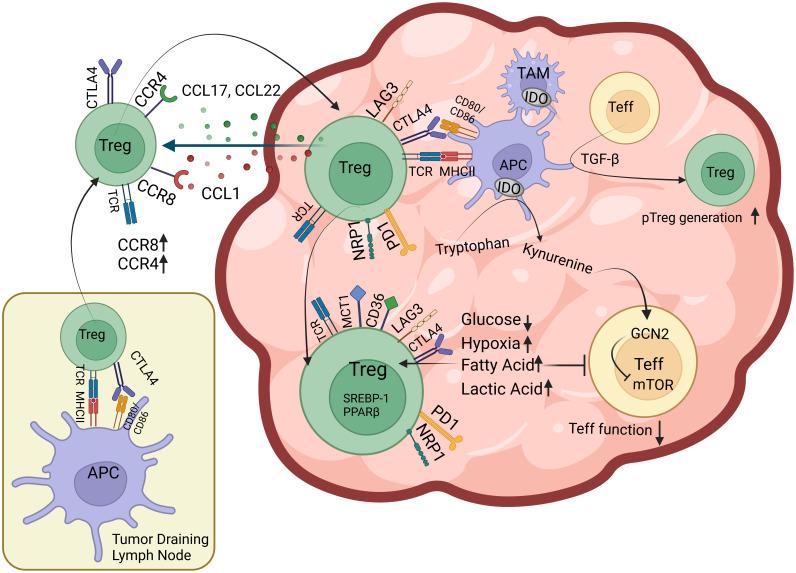
The concept of cancer immunotherapy has gained immense momentum over the recent years. The advancements in checkpoint blockade have led to a notable progress in treating a plethora of cancer types. However, these approaches also appear to have stalled due to factors such as individuals' genetic make-up, resistant tumor sub-types and immune related adverse events (irAE). While the major focus of immunotherapies has largely been alleviating the cell-intrinsic defects of CD8 T cells in the tumor microenvironment (TME), amending the relationship between tumor specific CD4 T cells and CD8 T cells has started driving attention as well. A major roadblock to improve the cross-talk between CD4 T cells and CD8 T cells is the immune suppressive action of tumor infiltrating T regulatory (Treg) cells. Despite their indispensable in protecting tissues against autoimmune threats, Tregs have also been under scrutiny for helping tumors thrive. This review addresses how Tregs establish themselves at the TME and suppress anti-tumor immunity. Particularly, we delve into factors that promote Treg migration into tumor tissue and discuss the unique cellular and humoral composition of TME that aids survival, differentiation and function of intratumoral Tregs. Furthermore, we summarize the potential suppression mechanisms used by intratumoral Tregs and discuss ways to target those to ultimately guide new immunotherapies.
近年来,癌症免疫疗法的概念得到了迅猛发展。检查点阻断的进展导致了多种癌症类型治疗的显著进展。然而,由于个体的遗传构成、耐药肿瘤亚型和免疫相关不良事件(irAE)等因素,这些方法似乎也停滞不前。虽然免疫疗法的主要重点主要是缓解肿瘤微环境(TME)中 CD8 T 细胞的内在缺陷,但修正肿瘤特异性 CD4 T 细胞和 CD8 T 细胞之间的关系也开始引起关注。改善 CD4 T 细胞和 CD8 T 细胞之间的串扰的主要障碍是肿瘤浸润性调节性 T 细胞(Treg)的免疫抑制作用。尽管 Tregs 在保护组织免受自身免疫威胁方面不可或缺,但它们也因帮助肿瘤生长而受到关注。这篇综述讨论了 Tregs 如何在 TME 中建立并抑制抗肿瘤免疫。特别是,我们深入研究了促进 Treg 向肿瘤组织迁移的因素,并讨论了有助于肿瘤内 Treg 存活、分化和功能的 TME 的独特细胞和体液组成。此外,我们总结了肿瘤内 Treg 所使用的潜在抑制机制,并讨论了靶向这些机制的方法,最终为新的免疫疗法提供指导。


 Zotero 插件