
药剂师主导的抗菌药物管理计划对中国县级三级综合医院抗生素使用的影响:使用差分法的回顾性研究。
The impact of pharmacist-led antimicrobial stewardship program on antibiotic use in a county-level tertiary general hospital in China: A retrospective study using difference-in-differences design.
机构信息
Department of Infection Management, The First Affiliated Hospital of Soochow University, Suzhou, China.
School of Health Policy and Management, Nanjing Medical University, Nanjing, China.
出版信息
Front Public Health. 2022 Oct 3;10:1012690. doi: 10.3389/fpubh.2022.1012690. eCollection 2022.
BACKGROUND
Inappropriate use of antibiotics has become a major driver for the spread of antimicrobial resistance globally, particularly common in China. Antimicrobial stewardship programs are effective in optimizing antimicrobial use and decreasing the emergence of multi-drug-resistant organisms, and the pharmacist has performed a leading role in this program.
OBJECTIVE
To evaluate the impact of antimicrobial stewardship programs driven by pharmacists on antibiotic consumption and costs and the appropriateness of antibiotic use.
METHODS
A single-center retrospective quasi-experimental design was conducted in two independent hepatobiliary surgery wards and two independent respiratory wards in a county-level tertiary general hospital in Jiangsu, China. Each intervention group was served with antimicrobial stewardship programs with prescriptions audit and feedback, antibiotics restriction, education, and training. The propensity score matching method was employed to balance confounding variables between the intervention group and control group, and a difference-in-differences analysis was used to evaluate the impact of antimicrobial stewardship programs. The primary outcome was measured by scores of rationality evaluation of antibiotics.
RESULTS
The DID results demonstrated that the implementation of the antimicrobial stewardship programs was associated with a reduction in the average length of hospital stay (coefficient = -3.234, = 0.006), DDDs per patient (coefficient = -2.352, = 0.047), and hospitalization costs (coefficient = -7745.818, = 0.005) in the hepatobiliary surgery ward, while it was associated with a decrease in DDDs per patient (coefficient = -3.948, = 0.029), defined daily doses per patient day (coefficient = -0.215, = 0.048), and antibiotic costs (coefficient = -935.087, = 0.014) in the respiratory ward. The program was also associated with a decrease in rationality evaluation scores ( < 0.001) in two wards.
CONCLUSION
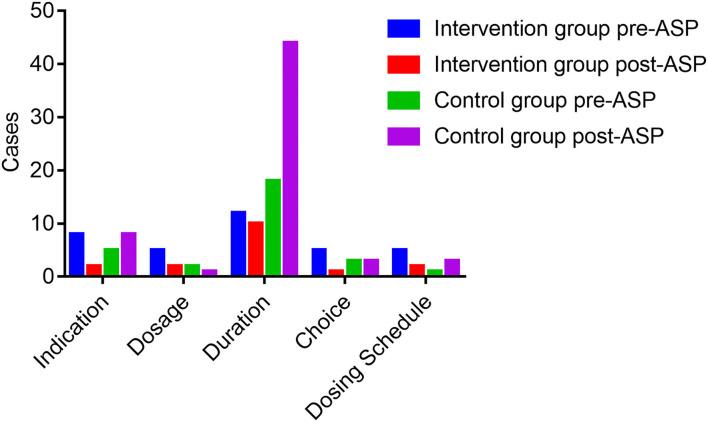
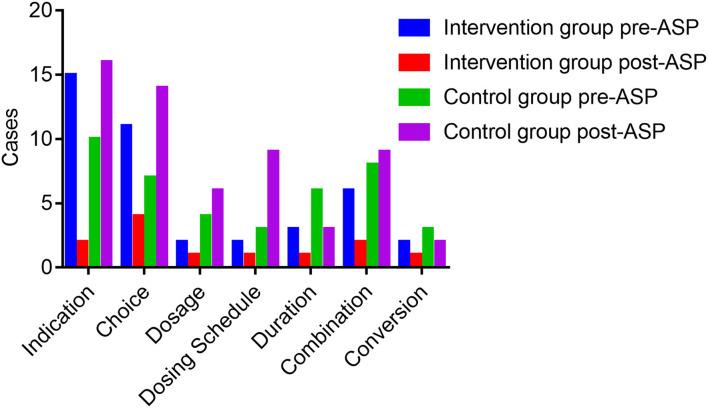
The result reveals that the implementation of the antimicrobial stewardship programs is effective in reducing the length of hospital stay, decreasing antibiotics consumption and costs, and improving the appropriateness of antimicrobial use such as decreasing irrational use of cephalosporins, reducing combinations, and improving timely conversion. However, great attention ought to be paid to the improper use of broad-spectrum antibiotics. The government is responsible for providing sustainable formal education for pharmacists, and more funding and staff support to promote antimicrobial stewardship programs.
背景
抗生素的不恰当使用已成为全球抗菌药物耐药性传播的主要驱动因素,在中国尤为普遍。抗菌药物管理计划可有效优化抗菌药物的使用并减少多药耐药菌的出现,且药剂师在该计划中发挥了主导作用。
目的
评估由药剂师主导的抗菌药物管理计划对抗生素使用量、费用和抗生素使用合理性的影响。
方法
在中国江苏省一家县级三级综合医院的两个独立肝胆外科病房和两个独立呼吸科病房中,采用单中心回顾性准实验设计。每个干预组均采用抗菌药物管理计划,包括处方审核和反馈、抗生素限制、教育和培训。采用倾向评分匹配法平衡干预组和对照组之间的混杂变量,并采用差值-差异分析评估抗菌药物管理计划的影响。主要结局指标为抗生素合理性评价得分。
结果
DID 结果表明,抗菌药物管理计划的实施与肝胆外科病房平均住院时间(系数=-3.234, =0.006)、患者每日限定剂量(系数=-2.352, =0.047)和住院费用(系数=-7745.818, =0.005)的降低相关,而与呼吸科病房患者每日限定剂量(系数=-3.948, =0.029)、患者每用药日限定剂量(系数=-0.215, =0.048)和抗生素费用(系数=-935.087, =0.014)的降低相关。该计划还与两个病房的抗生素合理性评价得分降低相关( < 0.001)。
结论
结果表明,抗菌药物管理计划的实施可有效缩短住院时间,减少抗生素使用量和费用,提高抗生素使用的合理性,如减少头孢菌素的不合理使用、减少联合用药和提高及时转换。然而,应高度关注广谱抗生素的不当使用。政府负责为药剂师提供可持续的正规教育,并提供更多的资金和人员支持,以促进抗菌药物管理计划的实施。

 Zotero 插件