
代谢重编程与癌症表观遗传学的串扰:机制与治疗机会的更新。
Crosstalk between metabolic reprogramming and epigenetics in cancer: updates on mechanisms and therapeutic opportunities.
机构信息
Department of Ophthalmology, Ninth People's Hospital, Shanghai Jiao Tong University School of Medicine, Shanghai, 200011, P. R. China.
Shanghai Key Laboratory of Orbital Diseases and Ocular Oncology, Shanghai, 200011, P. R. China.
出版信息
Cancer Commun (Lond). 2022 Nov;42(11):1049-1082. doi: 10.1002/cac2.12374. Epub 2022 Oct 20.
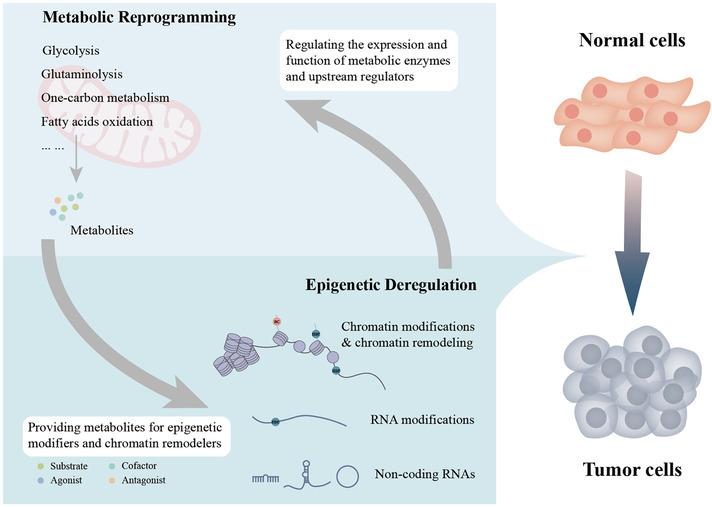
Reversible, spatial, and temporal regulation of metabolic reprogramming and epigenetic homeostasis are prominent hallmarks of carcinogenesis. Cancer cells reprogram their metabolism to meet the high bioenergetic and biosynthetic demands for vigorous proliferation. Epigenetic dysregulation is a common feature of human cancers, which contributes to tumorigenesis and maintenance of the malignant phenotypes by regulating gene expression. The epigenome is sensitive to metabolic changes. Metabolism produces various metabolites that are substrates, cofactors, or inhibitors of epigenetic enzymes. Alterations in metabolic pathways and fluctuations in intermediate metabolites convey information regarding the intracellular metabolic status into the nucleus by modulating the activity of epigenetic enzymes and thus remodeling the epigenetic landscape, inducing transcriptional responses to heterogeneous metabolic requirements. Cancer metabolism is regulated by epigenetic machinery at both transcriptional and post-transcriptional levels. Epigenetic modifiers, chromatin remodelers and non-coding RNAs are integral contributors to the regulatory networks involved in cancer metabolism, facilitating malignant transformation. However, the significance of the close connection between metabolism and epigenetics in the context of cancer has not been fully deciphered. Thus, it will be constructive to summarize and update the emerging new evidence supporting this bidirectional crosstalk and deeply assess how the crosstalk between metabolic reprogramming and epigenetic abnormalities could be exploited to optimize treatment paradigms and establish new therapeutic options. In this review, we summarize the central mechanisms by which epigenetics and metabolism reciprocally modulate each other in cancer and elaborate upon and update the major contributions of the interplays between epigenetic aberrations and metabolic rewiring to cancer initiation and development. Finally, we highlight the potential therapeutic opportunities for hematological malignancies and solid tumors by targeting this epigenetic-metabolic circuit. In summary, we endeavored to depict the current understanding of the coordination between these fundamental abnormalities more comprehensively and provide new perspectives for utilizing metabolic and epigenetic targets for cancer treatment.
代谢重编程和表观遗传稳态的可逆、时空调节是癌症发生的显著标志。癌细胞重新编程其代谢以满足旺盛增殖的高生物能量和生物合成需求。表观遗传失调是人类癌症的一个共同特征,它通过调节基因表达促进肿瘤发生和维持恶性表型。表观基因组对代谢变化很敏感。代谢产生各种代谢物,这些代谢物是表观遗传酶的底物、辅助因子或抑制剂。代谢途径的改变和中间代谢物的波动通过调节表观遗传酶的活性将关于细胞内代谢状态的信息传递到核内,从而重塑表观遗传景观,诱导对异质代谢需求的转录反应。癌症代谢受表观遗传机制在转录和转录后水平的调节。表观遗传修饰剂、染色质重塑因子和非编码 RNA 是参与癌症代谢调控网络的重要组成部分,促进恶性转化。然而,代谢和表观遗传学在癌症背景下的密切联系的意义尚未被充分揭示。因此,总结和更新支持这种双向串扰的新出现的证据,并深入评估代谢重编程和表观遗传异常之间的串扰如何被利用来优化治疗方案并建立新的治疗选择,将是建设性的。在这篇综述中,我们总结了表观遗传学和代谢在癌症中相互调节的核心机制,并详细阐述和更新了表观遗传异常和代谢重编程对癌症发生和发展的主要贡献。最后,我们强调了通过靶向这种表观遗传代谢电路为血液恶性肿瘤和实体瘤提供潜在治疗机会的重要性。总之,我们努力更全面地描绘这些基本异常之间的协调关系,并为利用代谢和表观遗传靶点治疗癌症提供新的视角。


 Zotero 插件